Turning 18 changes some disability supports. The handover to adult support is not automatic.
When a disabled young person in New Zealand turns 18, some supports and legal responsibilities change, but there is no automatic handover to the adult system. The Child Disability Allowance generally stops from the start of the pay period after the 18th birthday. If the young person is continuing in education and is not financially independent, it can continue until they no longer meet those criteria or 31 December of the year they turn 18, whichever comes first. Students with ORS funding or a specialist education agreement to attend a state specialist school can remain eligible through the end of the year they turn 21. This school support does not automatically convert into adult DSS funding; families must coordinate the transition across agencies, eligibility rules, and application processes.
The starting point for adult support is your local Needs Assessment and Service Coordination agency — a NASC — or, where available, an Enabling Good Lives (EGL) site. The NASC or EGL site checks eligibility and assesses support needs for services such as home support, community participation, Individualised Funding, and residential care. If the assessment understates their needs, funded hours are set too low. If you miss the application window, your young person joins a waiting list with no guaranteed resolution date.
The information is publicly available — scattered across MSD Disability Support Services, Whaikaha, Work and Income, the Ministry of Education, and your regional NASC provider. Five agencies, five sets of rules, no unified workflow. And since Disability Support Services transferred from Whaikaha to MSD in September 2024, resources published before that date describe an agency structure that no longer exists.
The Cross-Agency Transition Roadmap: One Document That Maps the Full System
This is not a summary of what the government websites say. It is a structured preparation system that connects the NASC assessment to the income support application to the funding plan to the complaints pathway — and shows you how to move through each one with the right evidence, at the right time, with the young person's voice leading every step.
The 51-page guide covers 13 chapters. Here is what each one does for you:
The post-2024 agency architecture
Who does what after the September 2024 transfer. MSD now runs DSS operations. Whaikaha handles policy and monitoring. Your regional NASC conducts assessments and allocates funding. Work and Income manages income support. The guide maps the relationships so you stop being redirected between agencies that each say the other one handles it.
Eligibility — the functional impact standard
A diagnosis alone does not qualify your young person for Disability Support Services. The assessment evaluates functional impact: what they can and cannot do independently in daily life, not what their medical records say. The guide explains the specific age boundaries (16, 18, 21, 65), the qualifying criteria, and how the system distinguishes between physical, intellectual, sensory, and neurological conditions.
NASC assessment preparation with a Functional Impact Worksheet
Families routinely describe their young person's abilities on a good day during the assessment meeting — and receive a funding allocation based on a good day. The guide includes a structured worksheet that captures the full daily reality: personal care, mobility, safety supervision, communication support, and community access. The young person and their family complete it together before the meeting, so the assessor sees accurate evidence instead of an improvised summary under pressure.
Every funding stream, with purchasing rules
Home and Community Support Services. Individualised Funding — including the Enhanced IF option for employing your own support workers. Carer Support. Environmental Support. Residential Care. Community Participation for school leavers with very high needs. Each stream has its own eligibility rules and budget boundaries. The guide explains the flexible-funding purchasing changes effective 1 April 2026, including the exceptions, what can be funded, and when prior approval is needed.
The income support transition
The Child Disability Allowance generally stops from the start of the pay period following the 18th birthday, subject to the limited education and financial-dependence exception described above. The Supported Living Payment and Jobseeker Support with a Health Condition or Disability have different eligibility thresholds, different medical evidence requirements, and different work obligations. The guide walks through the application process, includes a worked example of how the abatement formula reduces the payment as income rises, and explains the interaction between benefit income and disability funding.
Legal capacity at 18 — without defaulting to guardianship
When your young person turns 18, your parental guardianship ends automatically. That does not mean you need a court order to stay involved. The guide covers the Protection of Personal and Property Rights Act, Enduring Powers of Attorney, and the supported decision-making principles that keep the young person's autonomy as the starting point — with formal legal arrangements only where genuinely needed.
Waiting lists: what the timeframes actually mean
The official standard says a NASC should contact the person within two weeks of referral to schedule an assessment, or within two working days if urgent. That is the timeframe for initial contact — not for the assessment itself, the allocation, or the start of services. The guide explains the realistic progression, the steps for following up, how to request prioritisation, and what escalation looks like when the system is not moving.
The review, complaints, and escalation pathway
When you disagree with a NASC decision, the first step is not the Ombudsman. The guide maps the NASC review process, the free and independent Health and Disability Advocacy Service, the Health and Disability Commissioner, and the Ombudsman — in order, with the contact details and the specific grounds each body considers.
The free checklist
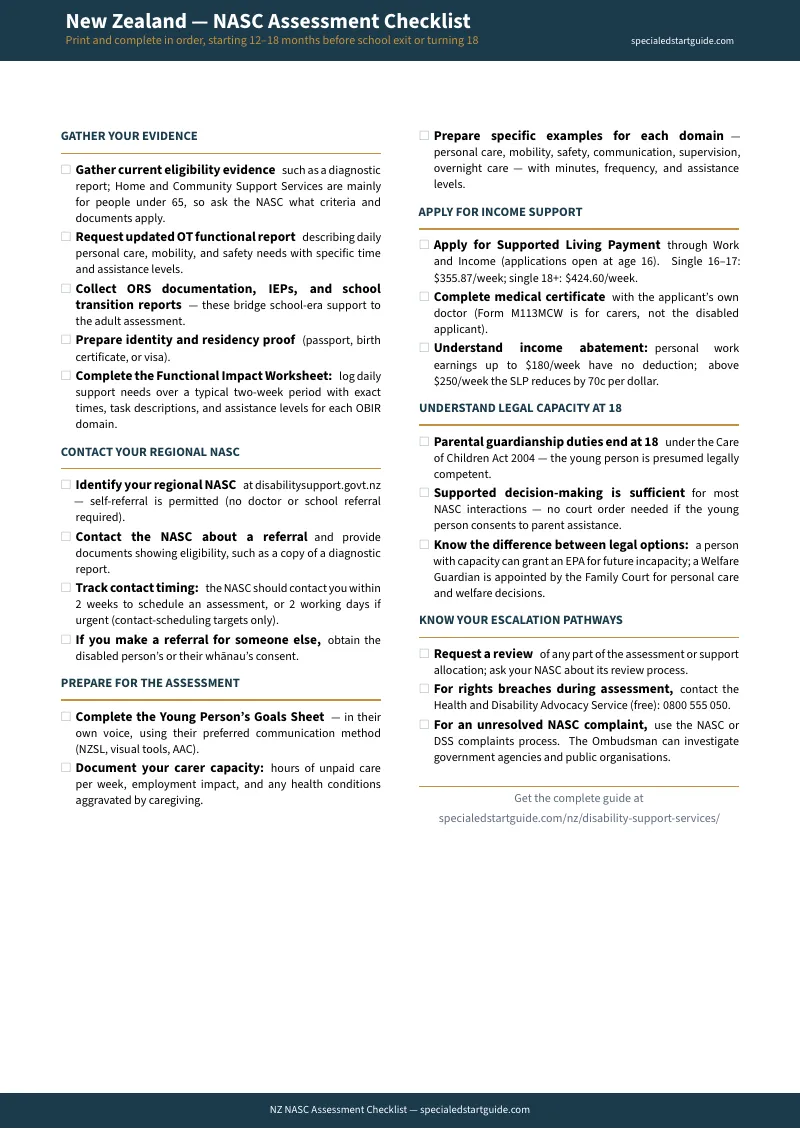
A one-page printable covering the eligibility requirements, the evidence to gather, and the agencies to contact. Designed for families who need an immediate starting point before reading the full guide.
Who This Is For
- Parents and carers of a disabled teenager approaching 18 who need to understand the adult support system before the transition arrives — not after the waiting list starts
- Young disabled people who want to understand their own rights, lead their own planning, and know what to expect from the assessment process
- Whānau and families who have been navigating children's disability services for years and are now facing a system that works differently at every level
- Anyone supporting a disabled young person who has searched for a guide and found only Australian NDIS templates, American IEP transition kits, or government pages that describe the bureaucracy without explaining how to navigate it
What the Guide Is Not
This is not a government publication and not endorsed by any agency. It is not legal, medical, or financial advice. It cannot alter waiting list positions, guarantee eligibility, or change how much support a NASC allocates. What it does is organise the publicly available rules into a structured preparation workflow — so your family arrives at every meeting knowing what exists, what to ask for, and what to do when the answer is no.
Your Investment
The guide costs — a one-off download with a full refund and no time limit if it does not help. Private disability consultants in New Zealand charge hundreds per hour. A formal legal opinion on capacity planning costs significantly more. This guide gives your family the cross-agency roadmap, the assessment preparation framework, the income support walkthrough, and the complaints pathway for less than the cost of one professional consultation hour.
Download the free NASC Assessment Checklist first if you want a starting point. If the checklist confirms you need the full system, the guide is here.
Frequently Asked Questions
What if the rules change after I buy?
We update the guide when the rules change. Email us any time, even years later, and we'll send you the current edition free.