The School Advocacy System That Turns "She Just Needs More Practice" Into a Real Evaluation, Real Intervention, and Real Accommodations
You have watched your child count on their fingers through another year of math. You have seen the tears over ten homework problems that should take fifteen minutes. You have heard the teacher say "she just needs to practice her facts more" while your child's confidence disappears one failed quiz at a time.
You know something is different about how your child processes numbers. The school knows too — but acknowledging it means evaluating, and evaluating means providing services. So they wait, they reassure, and they suggest more of the same worksheets that have never worked.
The Dyscalculia Support & Math Intervention Kit is the School Advocacy System — the evaluation checklists, legal frameworks, intervention data, IEP goal templates, and word-for-word pushback scripts that professional special education advocates use, organized for a parent who needs to act before the next meeting. It replaces the scattered forum advice and midnight Google sessions with a single, structured toolkit that tells you exactly what to request, what to document, and what to say when the school says no.
Warning Signs by Age
Detailed indicators from early primary through secondary school — subitizing failure, place value confusion, persistent finger-counting, spatial reasoning gaps, digit reversal, and math anxiety escalation. Use this section to document what you observe at home in the specific language that evaluators and school teams recognize.
Evaluation Checklist
The specific assessment measures a comprehensive math disability evaluation should include — math achievement scored separately for calculation and problem-solving, number sense processing, subitizing speed, symbolic vs. non-symbolic quantity comparison, and visual-spatial working memory. When the school hands you a report that tested only broad math achievement, this checklist shows you exactly what they missed and what to request next.
SLD-Math Eligibility Pathway
Step-by-step guidance through the Specific Learning Disability in Mathematics classification across four jurisdictions: US (IDEA/Section 504), UK (SEND Code of Practice/EHCP), Canada (provincial IPRC processes), and Australia (Disability Standards for Education/NCCD). A terminology translation matrix maps the equivalent concepts across all four systems so you use the exact legal terms your school recognizes — whether that is an IEP, an EHCP, an IPRC placement, or an NCCD adjustment.
Evidence-Based Intervention Comparison Chart
Side-by-side analysis of multisensory math interventions — CRA (Concrete-Representational-Abstract) instruction, number-sense routines, Cuisenaire rod approaches, strategic instruction models, and technology-based tools. Each entry covers the evidence behind it, which deficits it targets, how it is delivered, and practical considerations for your school. Name a specific methodology in your written request instead of accepting vague "extra math help."
IEP Goal Banks for Number Sense
Copy-and-paste measurable goals organized by domain — subitizing and quantity comparison, place value and base-ten understanding, math fact retrieval strategies, multi-step calculation procedures, and mathematical problem-solving. Every goal uses observable verbs, accuracy criteria, and methodology specificity. Replace the "will improve math skills" goals that let schools measure nothing and deliver nothing.
Calculator & Testing Accommodation Requests
Pre-formatted request language for multi-line display four-function calculators — devices like the TI-106 II that show the full typed equation alongside the result, preventing working-memory drops and digit-transposition errors. The request distinguishes these from graphing calculators and explains why the accommodation does not invalidate the assessment. Includes extended time, separate testing, and reduced problem set requests with the legal basis for each.
Pushback Scripts for Every Denial
Fill-in-the-blank responses for the exact objections school teams use: "we don't test for dyscalculia," "she just needs more practice," "his reading scores bring up his average," "we already tried RTI," "a calculator would be an unfair advantage," and "the private evaluation doesn't apply here." Each script cites the applicable legal framework and tells you what to put in writing so the conversation leaves a paper trail.
Cross-Jurisdiction Legal Frameworks
Your rights and procedures mapped across four systems — US (IDEA, Section 504, state-level math screening mandates), UK (Children and Families Act, SEND Code of Practice, Equality Act reasonable adjustments), Canada (provincial education acts, IPRC/IEP mechanisms), and Australia (DDA, Disability Standards for Education, NCCD tiers). The legal scaffolding behind every pushback script and accommodation request, organized so you cite the right statute in the right country.
Who This Is For
You have a child who is bright in everything except numbers. The school sees the reading scores and says there is no disability. You have spent money on tutoring that did not stick, fought for an evaluation the school would not perform, or sat through meetings where professionals used acronyms you did not understand and handed you a plan that changes nothing. You are done waiting for someone else to figure this out.
Why Free Articles and Forum Advice Are Not Enough
Free resources explain what dyscalculia is. They describe the signs, list possible accommodations, and summarize the science. What they do not provide is the five-sentence email to send when the school refuses to evaluate, the side-by-side intervention chart to slide across the meeting table, the specific IEP goals that force evidence-based instruction, or the response script when the principal says "we don't recognize dyscalculia." Free tools educate. This toolkit equips you to act — with the same structured documentation and legal language that professional advocates use.
Hiring an independent special education advocate costs $150 to $300 per hour. A standard advocacy package for one IEP cycle runs $950 to $2,500. A private neuropsychological evaluation costs $2,500 to $6,000. This toolkit gives you the frameworks those professionals use — the evaluation criteria, the intervention comparison data, the goal specifications, the dispute letters, and the meeting scripts — for less than the cost of one math tutoring session.
What You Get
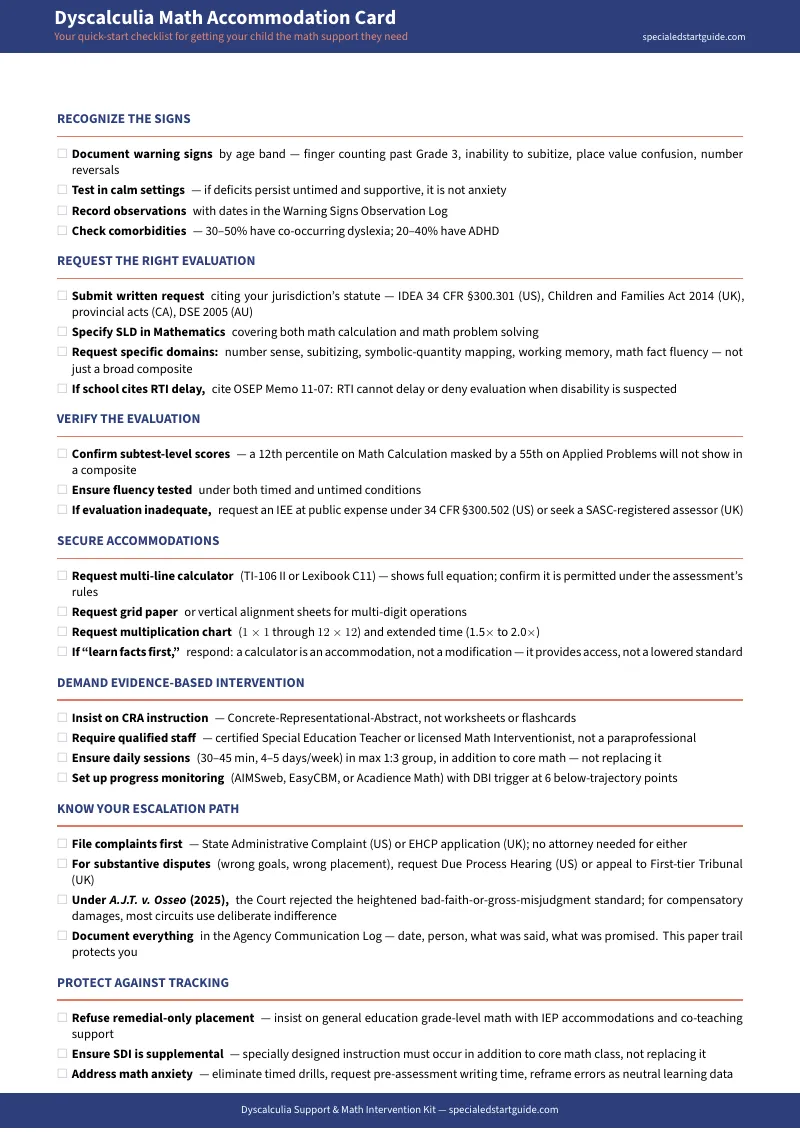
Instant PDF download — a 12-chapter advocacy guide plus 7 standalone printable tools and a Dyscalculia Math Accommodation Card (the free tier). The guide covers warning signs by age, the complete evaluation checklist, the SLD-math eligibility pathway across four jurisdictions, the evidence-based intervention comparison chart, IEP goal banks for number sense, calculator and testing accommodation requests, pushback scripts for every denial scenario, cross-jurisdiction legal frameworks, and co-occurring conditions coverage for ADHD, dyslexia, and dysgraphia. The standalone tools include an Evaluation Request Letter, a Warning Signs Observation Log, an Evaluation Adequacy Checklist, an IEP Meeting Preparation Worksheet, a Calculator Accommodation Request Letter, a Progress Monitoring Tracker, and an Agency Communication Log — all fillable PDFs designed to be printed, completed by hand, and brought to school meetings.
The free Accommodation Card is a one-page printable with the key math accommodations and the evaluation questions to bring to the next meeting. Download it now, use it at the table, and come back for the full toolkit when you need the complete advocacy system.
Full refund, no time limit. If the toolkit does not change how you advocate for your child's math support, email [email protected] for a complete refund.