Your Child Deserves More Than "Consult-Only" Band-Aids
The school says the eyes are fine. Or they say magnification is working. Or the Teacher of Students with Visual Impairments appears for fifteen minutes of "indirect consultation" each week — not to work with your child, but to leave a note for the classroom teacher. Meanwhile your child squints through headaches, reads at half the speed of their classmates, and has never been offered Braille instruction.
You have spent nights reading clinical reports, forum threads, and legal summaries trying to figure out what your child is actually entitled to. You have probably been told — by the school, by well-meaning relatives, by the internet — that if your child can see print with a magnifier, Braille is unnecessary. That normal eye exam results mean normal vision. That fifteen minutes of consultation is a reasonable level of service.
None of that is true. And you should not need a law degree to prove it.
The Vision Advocacy System: Everything in One Place
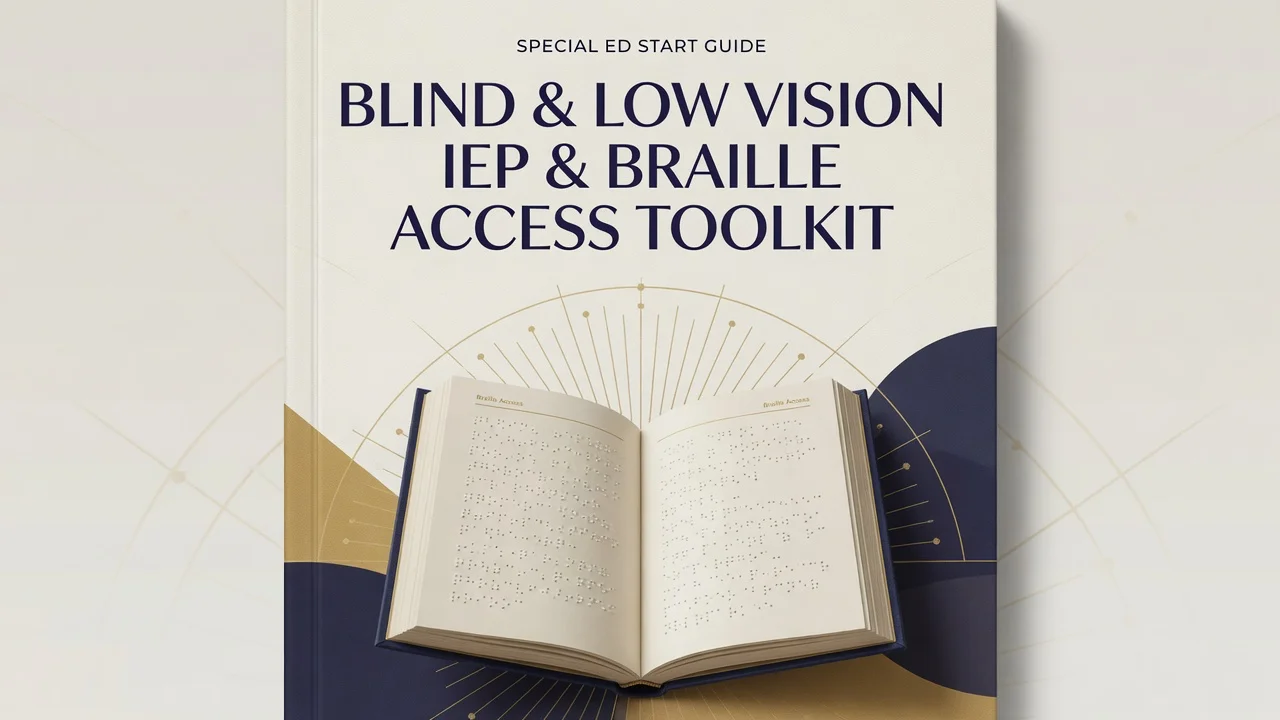
The Blind & Low Vision IEP & Braille Access Toolkit is a structured advocacy system that replaces the dozens of hours of research, the scattered forum advice, and the guesswork with a step-by-step operational framework. It gives you the legal citations, assessment audit tools, service minute worksheets, and word-for-word pushback scripts — the same materials a private special education advocate would use — organized so you can walk into an IEP meeting prepared.
This is not a collection of general tips. It is an operational system built around the specific arguments school districts actually make when they deny or reduce vision services, and the specific legal and clinical responses that work.
What makes this different from free resources
Free information on visual impairment and IEPs exists in abundance — Perkins CVI Now, Paths to Literacy, the National Federation of the Blind, FamilyConnect from APH. These are excellent sources. The problem is not that the information does not exist. The problem is that it is scattered across hundreds of articles, written for clinicians and educators rather than parents, and lacks the one thing you need most at an IEP meeting: fill-in-the-blank language that ties a legal right to a specific demand.
Perkins explains CVI visual behaviors in clinical detail but does not give you IEP wording. The NFB is authoritative on Braille presumption law but sparse on CVI profiles. Teachers Pay Teachers sells tracking logs designed for the TVI, not the parent challenging the TVI's caseload. Academic handbooks cost more and still assume you are a certified professional.
The toolkit synthesizes all of it into parent-facing operational documents: assessment audit checklists, service minute calculation worksheets, demand letter templates, and scripts keyed to the exact phrases districts use.
What's Inside
- The Vision Evaluation Triad explained — what a thorough Functional Vision Assessment, Learning Media Assessment, and Orientation & Mobility evaluation actually looks like, with audit checklists so you can tell when the district cut corners
- Braille Presumption framework — the law says Braille instruction is the default unless assessment proves otherwise. The toolkit shows you the exact legal citation (IDEA 34 CFR § 300.324), what a defensible "otherwise" looks like, and pushback scripts for when the LMA recommends print-only based on a child who can read isolated letters in a quiet, dark room
- CVI evaluation and support guide — how to connect CVI Range scores to enforceable IEP accommodations, why standard ocular-based assessments miss CVI, and how to request environmental and instructional modifications that address visual processing
- Expanded Core Curriculum (ECC) service planner — the nine skill domains (compensatory access, social interaction, independent living, recreation, career education, assistive technology, sensory efficiency, self-determination, orientation & mobility) with service-level recommendations and IEP goal language for each
- TVI and O&M service minute worksheets — concrete formulas that convert assessment results into recommended weekly direct instructional hours, so "consultation-only" has a number to answer to
- Accessible educational materials (AEM) toolkit — how to invoke NIMAS, APH Federal Quota, Bookshare, and other sources, with a tracking log and formal notification letters for when textbooks arrive six weeks late
- Assistive technology planning guide — from refreshable Braille displays and screen readers to tablet accessibility features and cloud-based alternate formats, matched to your child's profile
- IEP goal banks — measurable, standards-aligned goals across literacy, technology, orientation & mobility, daily living, and social skills, written in the language IEP teams accept
- Pushback Quick-Reference Card — word-for-word responses to "she reads print fine with magnification," "Braille is a last resort," "the eyes are normal," "orientation and mobility is not a school responsibility," and "accessible materials will arrive when the vendor provides them"
- Cross-jurisdictional guide — maps every US concept to the UK (EHCP, QTVI, SEND Tribunal), Canada (provincial TSVI, PRCVI, SET-BC), and Australia (DSE, NCCD, visiting teacher services)
Who This Is For
- Parents whose child was recently diagnosed with a visual impairment, CVI, or progressive eye condition and the school has not begun discussing services
- Parents whose child receives "consultation-only" TVI minutes — the specialist advises from a distance but never works directly with the child
- Parents told "magnification is enough" when their child experiences headaches, slow reading speeds, and visual fatigue
- Parents of a child with CVI whose school says the eyes are normal and refuses to evaluate for visual impairment
- Parents who need accessible textbooks delivered on the first day of school, not weeks into the year
- Families in the UK, Canada, or Australia navigating EHCPs, provincial IEPs, or NCCD-funded supports
Why Not Free Tools?
You could spend the next forty hours assembling this yourself. You would read Perkins CVI Now articles for the clinical background. You would dig through Paths to Literacy for ECC domain explanations. You would search Reddit and Facebook groups for the pushback phrases other parents have tried. You would study IDEA § 300.324 for the Braille presumption. You would call the NFB for their position on dual-media instruction.
And at the end of those forty hours, you would have a folder of bookmarks, some handwritten notes, and no fill-in-the-blank documents to bring to the meeting. Because free resources explain the law. They do not hand you the letter.
The toolkit does what the free resources cannot: it turns scattered knowledge into operational documents you can use at the table.
Satisfaction Guarantee
If the toolkit does not give you the preparation you need, email [email protected] for a full refund — no time limit, no questions.
Start Preparing for the Meeting That Matters
A private special education advocate charges between $60 and $300 per hour. The toolkit gives you the same templates, legal citations, and pushback scripts at a fraction of that cost — and you keep it for every IEP meeting, every annual review, every transition planning session for as long as your child is in school.
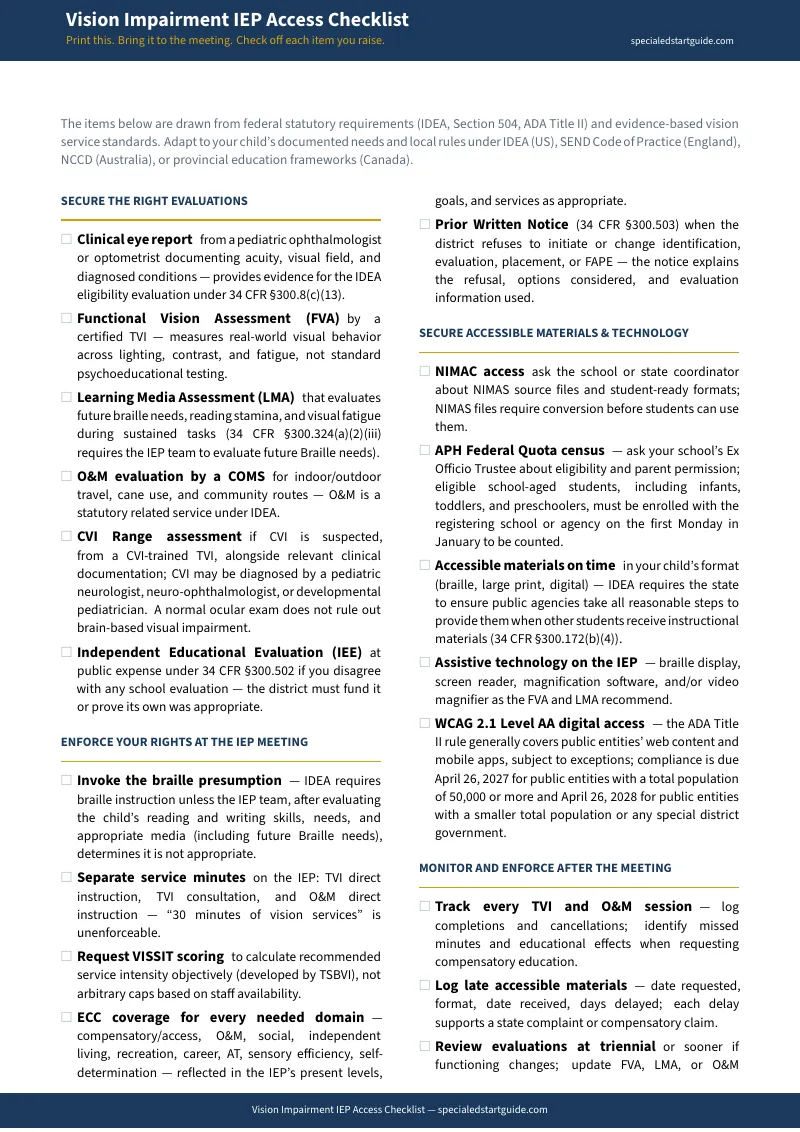
Download the free Vision Impairment IEP Access Checklist to see the evaluations, services, and material guarantees you should be raising. Or get the full Blind & Low Vision IEP & Braille Access Toolkit for the complete system — assessment audits, service minute worksheets, demand letters, and every pushback script.