You have the rating-scale report. You don't have the translation.
The evaluation came back with pages of BASC-3 scores — teacher ratings, parent ratings, maybe a self-report — full of phrases like "Anxiety: T = 72, Clinically Significant" and "Adaptive Skills composite falls in the At-Risk range." The meeting is this week. The school team has already reviewed every page and drafted their eligibility recommendation. You have a few days to understand what all of it means.
You've searched for answers. Understood.org's testing explainer uses the WISC-V as an example (Mean = 100, SD = 15) — the BASC-3 uses a different scale (Mean = 50, SD = 10), and applying the wrong metric makes every number unreadable. Reddit gave you conflicting takes from strangers, half of whom are mixing up the BASC-2 and the BASC-3. The publisher site lists the scales but tells you nothing about what to do with the results at the meeting. None of them answered the question keeping you up: why does the teacher's report say "Clinically Significant" when mine says "Average," and what exactly am I supposed to say about that discrepancy in the meeting?
The Rating-Scale Decoder: from classification labels to meeting-ready language
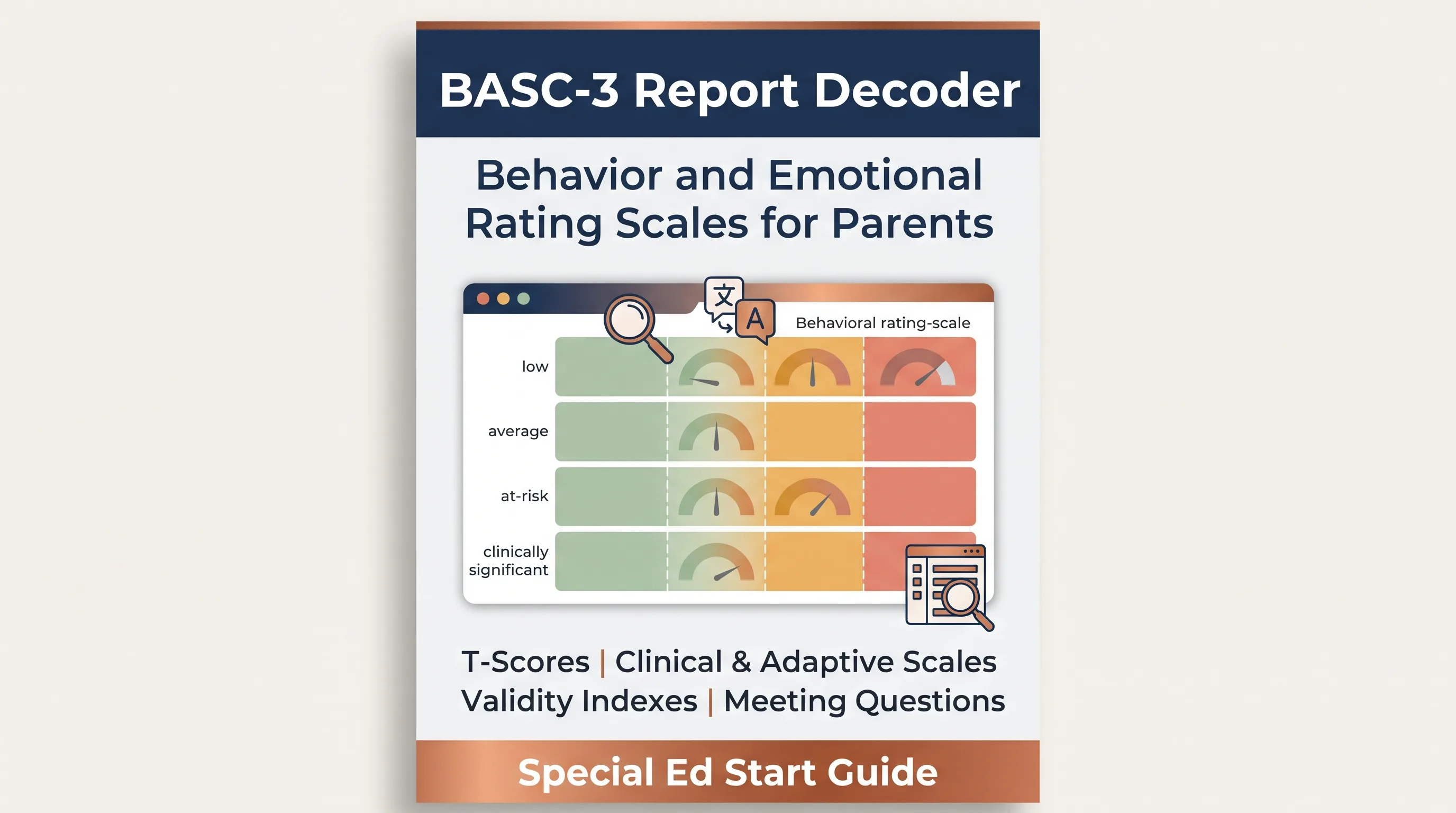
The BASC-3 Report Decoder is a structured translation system that takes the clinical output on your child's behavior rating scales and converts it into three things: what each score means in plain terms, what rating differences do and do not establish, and what to say and request at the meeting based on those patterns.
This is not a summary of what behavior rating scales measure — you can find that in any publisher brochure. This is the step-by-step decoder that explains every clinical scale, every adaptive scale (including the inversion that trips up most parents), every composite, every validity index, and every cross-informant discrepancy pattern, then connects each one to the specific accommodations and questions that turn a passive meeting into a productive one.
What's inside
- All three BASC-3 forms decoded — Teacher Rating Scales (TRS), Parent Rating Scales (PRS), and Self-Report of Personality (SRP), including which age levels each form covers, what the evaluator was measuring, and what it means when a form is included or missing from your child's evaluation.
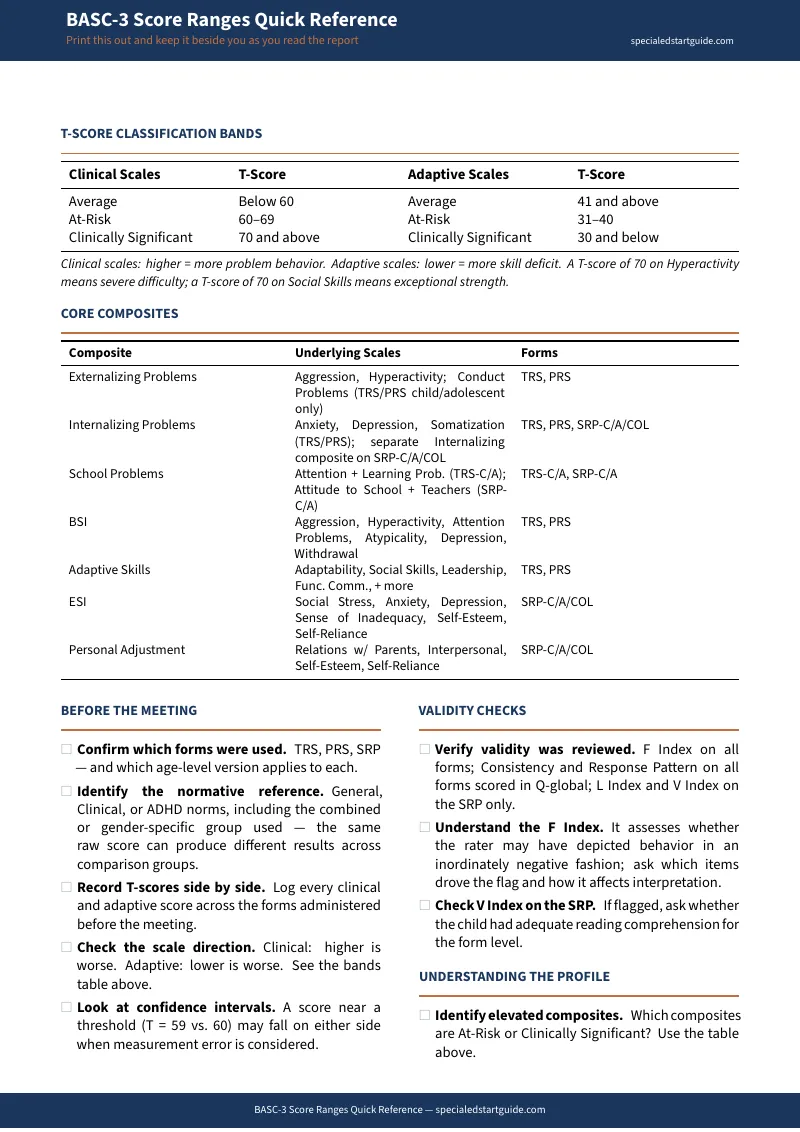
- T-scores and percentiles on the right metric — the BASC-3 uses a T-score scale (Mean = 50, Standard Deviation = 10), not the IQ metric most parent guides describe. The decoder gives you a visual reference that maps the classification bands — Clinically Significant, At-Risk, and Average — to T-score ranges, with what each band means in everyday terms.
- Clinical scale breakdowns — Hyperactivity, Aggression, Conduct Problems, Anxiety, Depression, Somatization, Attention Problems, Atypicality, Withdrawal, and more. Each scale explained in terms of what a high score looks like in real behavior, what it does not mean diagnostically, and which classroom accommodations and supports map to it.
- The adaptive scale inversion explained — on adaptive scales (Social Skills, Leadership, Adaptability, Functional Communication, Activities of Daily Living), scoring works in the opposite direction from the clinical scales. A low T-score signals difficulty, not strength. Many parents and even some meeting summaries misread these, because nobody warned them the scale flips. The decoder makes the inversion unmistakable and shows how low adaptive scores can inform IEP goals and skill-building interventions.
- Composite scores mapped — Externalizing Problems, Internalizing Problems, School Problems, Behavioral Symptoms Index (BSI), Emotional Symptoms Index (ESI), Personal Adjustment, and Adaptive Skills. Each composite explained: what subscales it bundles, when a broad composite masks a clinically significant subscale, and what to ask when the composite looks "Average" but the components tell a different story.
- Validity indexes demystified — the F Index, Consistency Index, and Response Pattern Index explained in human terms. What an elevated F Index is designed to assess (the possibility of an inordinately negative portrayal of the child's behavior), why the flag alone does not establish the rater's reason, and what to ask at the meeting about how it affects interpretation.
- Cross-informant divergence decoded — published meta-analytic data show low-to-moderate overall cross-informant correspondence (mean r = .28). That group average does not explain why a particular pair of parent and teacher ratings differs. The decoder frames the discrepancy as a prompt to compare observations, settings, and other evidence with the evaluator.
- Q-global content scales and executive functioning — the optional indexes your evaluator may have scored (Anger Control, Bullying, Developmental Social Disorders, Emotional Self-Control, Executive Functioning, Negative Emotionality, Resiliency), what each one adds to the clinical picture, and the specific questions to ask if they weren't scored.
- Emotional Disturbance Qualification (EDQ) scales — how the BASC-3's EDQ subscales align with five of the six IDEA criteria for Emotional Disturbance eligibility and what it means when a child scores At-Risk or Clinically Significant on those scales.
- Score-to-accommodation mapping across six jurisdictions — how elevated clinical scales and depressed adaptive scales translate into specific supports under US (IEP under IDEA, Section 504), UK (EHCP, SEND Support, ASN, IDP), Canadian (provincial IEPs), Australian (NCCD adjustments), Irish, and New Zealand frameworks. The right terminology and request language for the system you're in.
- The evaluator question list — specific, respectful questions about rater convergence, validity flags, adaptive skill goals, executive functioning, progress monitoring, and whether the evaluator's eligibility recommendation is consistent with the data. Designed to be printed and brought to the meeting.
- Report-language decoder — what phrases like "falls in the Clinically Significant range," "rater convergence was low," "results should be interpreted with caution," and "scores suggest At-Risk functioning" actually mean, translated from clinical shorthand into words you can act on.
Who this decoder is for
Parents and caregivers holding a BASC-3 report they cannot fully interpret, with a meeting approaching. Specifically:
- Your child's teacher ratings show "Clinically Significant" on nearly every clinical scale, and you're staring at that classification at midnight wondering whether it means a diagnosis — it doesn't, but nobody has told you that yet
- Your parent ratings came back Average while the teacher ratings are elevated, and the school is using the discrepancy to argue that your child doesn't qualify because "it's only happening in one setting"
- The evaluation includes a validity caution on the F Index, and you're worried that your honest answers were interpreted as exaggeration or that the entire rating scale is being dismissed
- Your child's adaptive skills — Social Skills, Functional Communication, Adaptability — scored low, but the feedback meeting focused entirely on the clinical scales, and nobody connected those low adaptive scores to relevant IEP goals and accommodations
- You're outside the United States — navigating EHCP provision in the UK, a provincial IEP in Canada, NCCD adjustments in Australia — and every BASC-3 resource you've found is written in IDEA and Section 504 language
- You've priced a private consultation with a psychologist at $150–$350 per hour and a special education advocate at $75–$200 per hour, and your meeting is Thursday
Why free resources aren't solving this
Understood.org's testing explainer uses the WISC-V as an example (Mean = 100, SD = 15), while the BASC-3 uses a different T-score metric (Mean = 50, SD = 10). Parents applying the WISC-V metric to their child's BASC-3 results get the magnitude of every score wrong. Pearson's publisher pages list the scales and composites for clinicians — deliberately technical, with no meeting strategy for parents. Wrightslaw covers the special education law but doesn't decode rating-scale outputs. Forum threads offer emotional support from parents who may be confusing the BASC-2 with the BASC-3, or the BASC with the Conners. The decoder replaces all of that with one structured walkthrough that connects scores to patterns to accommodations to meeting language — on the right metric, with the right scale directions, for the system you're actually in.
What the decoder does not do
It does not evaluate your individual child's scores. It does not provide a clinical diagnosis. It does not reproduce any proprietary test items, scoring protocols, or copyrighted norm tables. It gives you the structural literacy and the meeting-ready language so you walk in prepared — knowing what every scale measures, what the validity indexes mean, why the raters disagreed, and exactly what to ask for.
Format and guarantee
Instant PDF download. The paid decoder includes the main guide (covering every section of a BASC-3 report in order, with worked examples and jurisdiction-specific accommodation mapping) plus five printable meeting tools: a report-language question sheet, a score summary worksheet, a support-discussion record sheet, a post-meeting follow-up tracker, and a score-to-accommodation reference card. The free BASC-3 Score Ranges Quick Reference — a one-page card with T-score classification bands for clinical and adaptive scales, the main composites, and five meeting-ready questions — is available as a standalone download, no purchase required.
Full refund, no time limit. If the decoder doesn't change how you read the report, email [email protected].
The meeting is this week. The rating-scale report is in your hands. The decoder turns those T-scores, validity flags, and rater discrepancies into the questions and requests that change the outcome.
Get the BASC-3 Report Decoder →
Already have the free Score Ranges Quick Reference? Get the full decoder here →
Frequently Asked Questions
What if the rules change after I buy?
We update the guide when the rules change. Email us any time, even years later, and we'll send you the current edition free.