The School Said "Preferential Seating." Your Child Is Missing Half of Every Lesson. This Toolkit Gives You the Exact Scripts, Goals, and Legal Leverage to Get Full Communication Access.
Your audiologist confirmed the hearing loss. You brought the report to school expecting a plan. What you got was: "We'll put her in the front row." Or: "His hearing aids are working — he's fine." Or the one that still keeps you up at night: "She's passing all her classes, so she doesn't qualify for an IEP."
So you went home and searched. You found Hands & Voices, which publishes an outstanding accommodation checklist — but no instructions for what to do when the school refuses to check those boxes. You found Supporting Success for Children with Hearing Loss, which sells clinical assessment tools for audiologists at $69 to $106 — not scripts for parents sitting across the table from a team that outnumbers them. You found Parent Center Hub, which lists your rights in dense federal statute language. You found Reddit threads and Facebook groups where other parents gave empathetic but conflicting advice. And you found a $10 Etsy binder that helps you organize your paperwork but never tells you what to write in the email when the school says no.
You are not looking for another list of possible accommodations. You are looking for someone to hand you the exact words to write when the school denies the FM system, the exact IEP goals to demand when they offer "will improve listening skills," and the exact legal provisions that force the team to address your child's communication access — not just their grades.
The Deaf & Hard of Hearing IEP & Communication Access Toolkit is the Communication Access Defense System — the complete tactical framework that professional advocates and Teachers of the Deaf use (and charge $150–$300 per hour for), compressed into a single toolkit you can use before your next meeting. Every script, every goal, every template is mapped to your child's specific hearing profile and communication mode — spoken language, ASL, Cued Speech, or any combination — and your specific jurisdiction.
What's Inside the Toolkit
The "Preferential Seating" Pushback Framework
When the school offers front-row seating as the solution, they are handing you an accommodation that solves nothing. A child in the front row still misses the teacher's voice every time they turn toward the board, walk across the room, or speak while papers are shuffling. Background noise from the HVAC, hallway traffic, and 25 other students does not disappear at three feet. The toolkit gives you step-by-step documentation proving why seating alone fails, the Functional Listening Evaluation request that generates the data schools cannot ignore, and the exact script to demand a remote microphone system, acoustic modifications, or classroom captioning — citing both IDEA assistive technology requirements and ADA Title II effective communication standards.
Dual-Track Legal Integration — IDEA + ADA Title II
Most parents learn about one law and use it in isolation. Schools count on this. IDEA requires the IEP team to consider five DHH-specific "special factors" (34 CFR §300.324(a)(2)(iv)) — your child's language and communication needs, opportunities for direct communication with peers and staff, academic level, direct instruction in the child's language mode, and assistive technology. But when the school claims passing grades means no services, IDEA alone may stall. ADA Title II requires public schools to provide communication that is "as effective as" what hearing peers receive, and to give "primary consideration" to the specific aid the parent or student requests. The toolkit teaches you how to invoke both statutes in the same written request — forcing the school to address communication access regardless of the report card.
DHH IEP Goal Banks by Domain and Age
The school handed you an IEP with goals like "student will improve listening skills" and "student will participate in class." Those are not goals. Those are hopes. The toolkit provides measurable IEP goals across auditory skill development, language development, literacy, self-advocacy, social communication, and technology management — differentiated for elementary, middle, and high school. Each goal specifies the baseline, the technology condition, the performance criterion, the measurement method, and the evaluator. "Given a classroom discussion using a remote microphone system, the student will accurately repeat the main idea and two supporting details from a peer's contribution in four out of five opportunities, as measured by the Teacher of the Deaf."
Communication Plan Template
State requirements for DHH communication plans vary. Some states — Colorado, Louisiana, Pennsylvania, Florida — require a specific plan or model during IEP development. Others leave it to the team's discretion. The toolkit includes a fillable Communication Plan template covering primary and secondary communication modes, family home language, availability of language-proficient peers and staff, interpreter qualifications, emergency communication protocols, and visual alerting systems. Even in states without a communication plan statute, you can request one as a supplementary IEP attachment — and the toolkit shows you how.
Hearing Technology Request Letter
Your child needs a remote microphone system and the school says hearing aids are enough. The toolkit provides a fill-in-the-blank request letter for a remote microphone system (Roger technology, DM systems), soundfield amplification, classroom captioning (CART or automated speech-to-text), or a cochlear implant external-component check routine. The letter integrates Functional Listening Evaluation data, cites 34 CFR §300.105 (assistive technology) and 28 CFR §35.160 (ADA effective communication), and includes the counter-arguments for the three most common school refusals.
Interpreter and Captioning Standards
If your child uses sign language, the quality of the educational interpreter determines the quality of their education. Most states require interpreters to meet a minimum EIPA (Educational Interpreter Performance Assessment) score — typically 3.5 to 4.0 — but schools routinely assign paraprofessionals or unqualified staff to "interpret" in the classroom. The toolkit covers EIPA score requirements by state, how to verify an interpreter's credentials, the distinction between interpreting and non-interpreting duties (grading, tutoring, supervision), and what to do when the district claims no qualified interpreter is available. For students who use real-time captioning, it covers CART provider qualifications, automated captioning limitations, and how to write captioning requirements into the IEP.
Cross-Jurisdiction Legal Framework
If you are in the US, your rights come from IDEA, Section 504, and ADA Title II. In the UK, it is the Education Health and Care Plan, the SEND Code of Practice, and the Children and Families Act 2014 — with statutory assessment timelines that Local Authorities exceed in 50% of cases. In Canada, it varies by province: Ontario uses IPRCs, British Columbia uses designations, and itinerant Teacher of the Deaf availability is a chronic board-by-board problem. In Australia, it is Individual Learning Plans, the Nationally Consistent Collection of Data, and the Disability Standards for Education 2005 — with funding friction between school-based adjustments and NDIS therapeutic supports. The toolkit bridges all four systems with a cross-jurisdiction translation glossary, jurisdiction-specific timelines, and escalation pathways that work where you live.
The Part C to Part B Transition Guide
If your child received early intervention services, the transition to school-age services at age three is a cliff. Part C services are family-centered, delivered in natural environments, with a service coordinator navigating the system. At three, responsibility transfers to the local school district — and the district may conclude that a child who received three years of audiology and speech-language therapy suddenly "doesn't qualify." The toolkit covers the transition timeline, the IEP transition meeting request, and the documentation strategy that prevents a child from losing services at the exact moment the system changes hands.
Dispute Resolution Pathways
When the school will not budge, you need a clear escalation path. The toolkit covers state administrative complaints (60-day decision timeline), IDEA due process hearings, mediation, and — after the Supreme Court's decisions in Perez v. Sturgis (2023) and A.J.T. v. Osseo (2025) — ADA/504 claims for compensatory damages without exhausting IDEA procedures first. For UK families, it covers SEND tribunal appeal procedures and the statutory deadlines Local Authorities routinely miss. For Australian families, it covers DDA complaints and the Disability Standards review process.
Who This Toolkit Is For
- Parents of a child with any degree of hearing loss — mild, moderate, severe, profound, unilateral, fluctuating, or auditory processing disorder — whose school is not providing adequate communication access
- Parents preparing for an IEP, 504, EHCP, or ILP meeting who want specific, measurable goals and the legal knowledge to push back when the school offers preferential seating and nothing else
- Parents whose child uses hearing aids, bone-anchored hearing systems, or cochlear implants and is being denied a remote microphone system, captioning, or a Teacher of the Deaf
- Parents of signing children (ASL, BSL, Auslan) who need a qualified educational interpreter and are being offered a paraprofessional with basic sign skills
- Deaf parents of Deaf children advocating for full ASL access, Deaf peers, and culturally responsive programming in mainstream settings
- Parents told their child "doesn't qualify" for an IEP because their grades are passing — despite missing half of classroom instruction
- Parents navigating the Part C to Part B transition who are watching early intervention services vanish at age three
- Parents in the UK facing EHCP delays, refused assessments, or inadequate provision for a deaf child
- Parents in Canada dealing with inconsistent itinerant Teacher of the Deaf availability across school boards
- Parents in Australia navigating the gap between school-based NCCD adjustments and NDIS therapeutic supports
Why Not Free Resources?
Free DHH resources are well-intentioned and often excellent at explaining rights. They are also fragmented, passive, and they stop at the exact point where you need them most — when the school says no.
- Hands & Voices publishes the most comprehensive free accommodation checklist in the field — but it does not tell you what to say when the school refuses to follow it. Their ASTra volunteer advocates are exceptional, but wait times run 48 to 72 hours and volunteers cannot write custom IEP goals or draft emails for every family. The toolkit gives you immediate access to editable scripts and templates at the moment you need them — the night before the meeting, not two business days later.
- Supporting Success for Children with Hearing Loss hosts valuable articles on listening fatigue and classroom acoustics — but the actionable tools are locked behind $39 to $106 clinical reference books written for audiologists. The toolkit translates that clinical knowledge into parent-facing scripts and requests that work in an IEP meeting.
- The Laurent Clerc National Deaf Education Center (Gallaudet) produces gold-standard research — but its publications are dense academic reference manuals, not fill-in-the-blank advocacy tools. Parents of hard of hearing children in mainstream spoken-language settings find little tactical guidance for their specific scenario.
- NDCS (UK) provides outstanding EHCP guides — but only for the UK system. Parents in the US, Canada, or Australia cannot use UK-specific statutory timelines or tribunal procedures. The toolkit maps core communication access rights across all four jurisdictions.
- Teachers Pay Teachers sells $3 to $8 goal banks and teacher quick sheets — designed for itinerant Teachers of the Deaf, not parents fighting for a Teacher of the Deaf in the first place. A $10 Etsy binder organizes your folder. Neither tells you what to do when the case manager says "We don't offer that service in this district."
— Less Than Fifteen Minutes of an Educational Advocate's Time
Professional special education advocates charge $150 to $300 per hour in the US, £75 to £145 in the UK, and $150 to $250 AUD in Australia. Most families spend thousands before the first hearing. This toolkit gives you the same legal frameworks, pushback scripts, and goal banks those advocates use — for less than a single phone consultation. It does not replace an attorney for due process hearings or tribunal appeals. It equips you to handle the vast majority of school meetings, emails, and pushback scenarios independently, so you only need professional help for the fraction that requires legal representation.
Your download includes 11 PDFs:
- Complete Deaf & Hard of Hearing IEP & Communication Access Toolkit (guide.pdf) — 14 chapters covering why preferential seating fails, the legal architecture (IDEA + Section 504 + ADA Title II working together), the five IDEA special factors schools skip, state communication plans, hearing technology and remote microphone requests, evaluation strategies (FLE, IEE, classroom acoustics), interpreter and captioning standards (EIPA), Teacher of the Deaf and audiology service planning, language-development and self-advocacy IEP goal banks, the placement continuum compared, pushback scripts for the five most common school refusals, dispute resolution pathways (including post-A.J.T. ADA claims), and cross-jurisdiction frameworks for the US, UK, Canada, and Australia
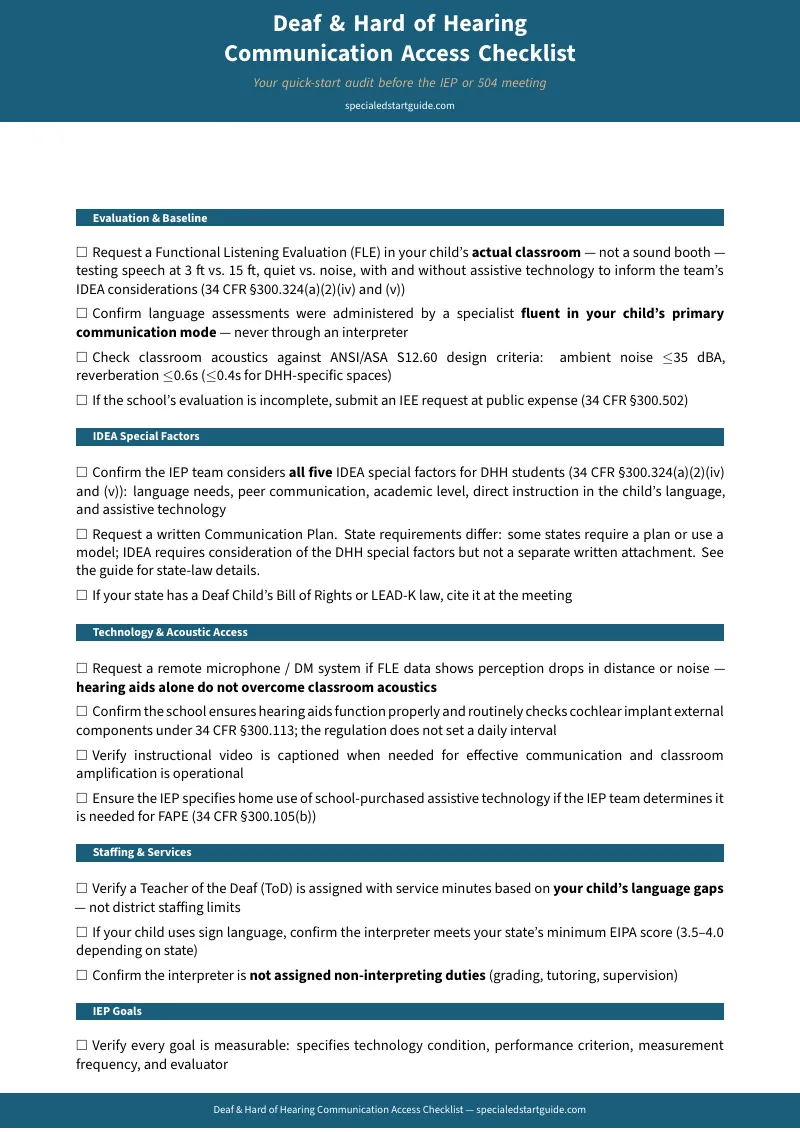
- Deaf & Hard of Hearing Communication Access Checklist (checklist.pdf) — A 2-page printable checklist of 23 evaluation, technology, staffing, goal, and legal-protection items to raise at your next IEP or 504 meeting
- Communication Plan Template (communication-plan-template.pdf) — Fillable plan covering modes, home language, language-proficient peers and staff, interpreter qualifications, emergency protocols, and visual alerting
- IEP Meeting Preparation Worksheet (iep-meeting-preparation-worksheet.pdf) — Agenda, records checklist, named requests, and the five IDEA special-factors questions
- Functional Listening Evaluation Request Letter (functional-listening-evaluation-request-letter.pdf) — Ready-to-send request for an eight-condition classroom FLE by an Educational Audiologist
- Technology Request Letter (technology-request-letter.pdf) — Fill-in letter for a DM system, soundfield, CART, captions, or device-check routine, with FLE data fields
- IEP Goal Bank (iep-goal-bank.pdf) — Five-domain SMART stems (auditory, language/ASL, literacy, self-advocacy, social) with blanks for baseline, criterion, and evaluator
- Prior Written Notice Request Template (pwn-request-template.pdf) — Fill-in request under 34 CFR §300.503 when the school proposes or refuses a change
- Pushback Script Cards (pushback-script-cards.pdf) — Verbatim responses to the five most common school refusals, with blanks for your child's FLE numbers
- Agency Communication Log (agency-communication-log.pdf) — Landscape dated log of every call, email, and meeting
- Teacher of the Deaf Service Request Letter (tod-service-request-letter.pdf) — Named minutes for direct and consultative ToD service, including when the district has no ToD on staff
You can also download the Communication Access Checklist for free — a 2-page audit of the supports, technology, and staffing your school should be providing, organized by evaluation, IDEA special factors, technology, staffing, goals, and legal protections.