The report landed. Now you need to know what every score actually means.
Your child's evaluation came back with a table of numbers: Adaptive Behavior Composite 68, Daily Living Skills standard score 72, Socialization v-scale 11, Community "Moderately Low." Nobody explained any of it. The school psychologist read the summary in four minutes and moved on. You are sitting at the kitchen table trying to figure out whether a v-scale score of 11 means the same thing as a standard score of 11 — and what either one means for your child's eligibility meeting next week.
If the report includes both a Vineland-3 and an ABAS-3, it gets worse. The two tests use different domain names, different subdomain metrics, and different form types. An ABAS-3 skill area scaled score of 10 is average. A Vineland-3 v-scale score of 10 falls in the Moderately Low range. The report puts them in the same table without explaining the difference — and the meeting is in four days.
The Two-Metric Translation System
The Adaptive Behavior Report Decoder is not another overview of adaptive behavior. It is a metric-by-metric translation system built for the parent staring at a table of scores they cannot read, in a report that uses two different scales on the same page without saying so.
It covers both the Vineland-3 and the ABAS-3, instrument by instrument, domain by domain, form type by form type — in plain language. Then it shows you how the findings connect to IEP goals, state agency eligibility, and the questions you should be asking the evaluator before the team makes decisions about your child.
What's Inside
- Domain-by-domain Vineland-3 decoder — Communication, Daily Living Skills, Socialization, and Motor Skills, with every subdomain explained. You learn what a v-scale score of 12 actually means (Moderately Low, not severe delay) and why it looks so different from a domain standard score of 72.
- Domain-by-domain ABAS-3 decoder — Conceptual, Social, and Practical composites, plus all 11 skill areas. Each skill area's scaled score (mean 10, standard deviation 3) is explained on its own terms so you stop confusing it with the Vineland-3 v-scale.
- The two-metric trap, solved — a side-by-side reference showing exactly which metric each test uses at each level, what "average" looks like on each scale, and how to read a combined table without mixing up the numbers.
- Form type guide — Vineland-3 Interview, Parent/Caregiver Form, and Teacher Form; ABAS-3 Parent, Teacher, and Adult Self-Report. What each form captures, why scores differ between forms, and what to do when the school only used one.
- Rater discrepancy framework — why the teacher's scores came back higher or lower than the parent's, what setting-specific adaptive behavior actually means, and how to discuss the gap at the meeting without it turning into a debate about whose answers were "right."
- Cognitive-adaptive discrepancy chapter — when the IQ score and the adaptive behavior score tell different stories. How the Vineland-3 and ABAS-3 relate to intellectual disability classification, why average IQ with low adaptive scores is a recognized clinical pattern, and what it means for eligibility determinations.
- Agency eligibility overview — how adaptive behavior scores are used in IDEA special education eligibility, New York OPWDD Front Door applications, California Regional Center eligibility under the Lanterman Act, and federal disability determinations where adaptive functioning evidence appears in the record.
- Report sentence translator — clinical sentences you will find in real evaluation summaries, translated into plain language. When the report says "significant discrepancy between cognitive and adaptive functioning," you know exactly what that means and what question to ask next.
- Evaluator Question Checklist — five non-confrontational questions for the psychologist, diagnostician, or school team, with space to write the answers in the room: form and informant, confidence intervals, observation opportunities, rater gaps, and age equivalents.
- Findings-to-Goals Planning Sheet — a one-page worksheet connecting adaptive behavior domain scores to functional skill areas you can discuss during IEP goal-setting and support planning.
- Printable meeting kit — Score Tracking Worksheet, Rater Comparison Worksheet, Evaluator Question Checklist, Findings-to-Goals Planning Sheet, and Agency Communication Log, each a 1–2 page form you fill in from the report.
Who This Is For
- Parents who received an adaptive behavior evaluation report and need to understand what the Vineland-3 or ABAS-3 scores mean before an IEP, 504, or eligibility meeting
- Parents whose child's report uses both tests and who need to know why the numbers from one do not match the numbers from the other
- Parents navigating a cognitive-adaptive discrepancy — when the IQ score says one thing and the adaptive behavior score says another
- Families preparing for state agency applications where adaptive behavior scores are part of the eligibility evidence for adult services
- Adult students and self-advocates reviewing their own adaptive behavior assessment
- Grandparents, foster parents, and kinship caregivers who stepped into the advocacy role mid-evaluation and need to get up to speed quickly
Why Free Resources Fall Short
Free articles on Wrightslaw and Understood.org explain what adaptive behavior means and what the law requires. They describe the Vineland-3 and ABAS-3 in general terms. What they do not do is help you decode the specific table in front of you: they do not separate v-scale scores from standard scores, explain why your child's Vineland-3 Communication score does not match the ABAS-3 Conceptual composite, or show you how to read a rater discrepancy without panicking.
Cheap score-reference PDFs on Etsy and Teachers Pay Teachers give you a bell curve and a range chart. Most of them cover only one test. Many conflate the ABAS-3 skill area metric with the Vineland-3 v-scale — the two use different means and standard deviations, so a "10" on one is average and a "10" on the other is below average. A generic reference card does not explain that.
Private clinical report reviews cost $150–$500 per hour, and a special education advocate runs $100–$300 per hour. The Decoder gives you the metric translation, rater-discrepancy framework, and meeting preparation that would otherwise cost you a full professional session — for a fraction of that fee.
Satisfaction Guarantee
If the Decoder does not help you understand your child's adaptive behavior report, email [email protected] for a full refund, no time limit. No forms, no hoops.
Get Started
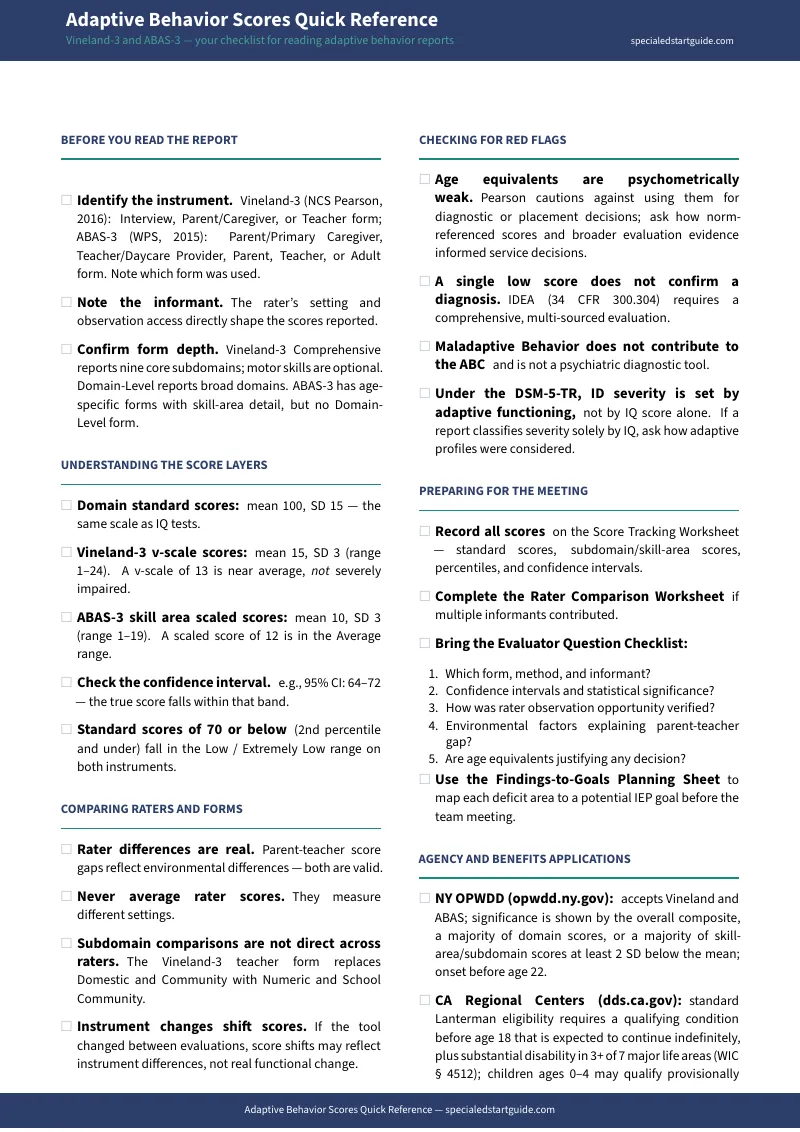
Download the free Adaptive Behavior Scores Quick Reference — a two-page card with the three score types, descriptive ranges, and five questions to ask the evaluator. If you need the complete two-test decoder, the rater discrepancy framework, and the Findings-to-Goals Planning Sheet, the full Adaptive Behavior Report Decoder is available for .
Frequently Asked Questions
What if the rules change after I buy?
We update the guide when the rules change. Email us any time, even years later, and we'll send you the current edition free.