Inclusion Is Not a Gift the School Gives Your Child — It Is the Legal Baseline They Must Meet
Only 28% to 33% of students with Down syndrome in the United States spend 80% or more of their school day in general education classrooms. That number has nothing to do with what children with Down syndrome can learn. It has everything to do with school teams that hear a diagnosis and skip straight to the self-contained classroom — before anyone asks what supports would make general education work.
You've been to the meeting where six professionals explained why your child "needs a smaller setting" or "would be happier with peers who are more like her." You've gotten the clinical letter from your pediatrician and watched the school dismiss it as "informative but not educationally binding." You've downloaded the free IEP binder from the national organizations and found twelve pages of rights you already know — but zero scripts for what to say when those rights are denied.
The Down Syndrome IEP & Inclusion Toolkit is the Inclusion Defense System that fills the gap between knowing your child's rights and being able to enforce them at the meeting table. It gives you the exact pushback scripts, accommodation menus, goal banks, and health plan checklists that professional advocates charge $75–$150 per hour to prepare — built specifically for the Down syndrome learning profile and mapped across four legal systems.
What You Get
- Placement and LRE Pushback Scripts — because the school has a script for every excuse, and you need one for every response. Verbatim wording for "she'd be better in a self-contained class," "we can't modify the curriculum that extensively," "he'll be overwhelmed," "she's not ready for reading instruction," and "we don't have the staffing or funding" — each paired with the specific legal standard that requires them to try supports before removing your child
- Teacher Briefing Template — because most general education teachers receive a diagnosis label and nothing else. A one-page fillable handout summarizing your child's visual learning strengths, auditory working memory constraints, communication modalities, fine motor needs, and medical accommodations — designed to hand to every teacher, substitute, and paraprofessional at the start of the year
- Visual Literacy Roadmap — because your child learns to read through sight-word recognition first, and a teacher who waits for phonological readiness before introducing reading is wasting your child's strongest learning channel. The roadmap bridges visual word learning to systematic phonics, countering the assumption that students with Down syndrome cannot achieve functional literacy
- IEP Goal Bank by Domain — because "will match 5 sight words with 80% accuracy across 3 sessions" is not the same goal as "will follow a two-step classroom routine with a visual schedule." SMART-formatted goals for literacy, math, communication, social skills, fine motor, self-care, and transition, each designed for the Down syndrome cognitive and motor profile
- Inclusion Support Menus — because requesting "more support" gets you nothing, but requesting "a prompt-fading hierarchy from full physical to gestural prompts, reviewed every six weeks, with a designated peer buddy rotated biweekly" gets you a plan. Accommodation menus organized by curriculum modification, paraprofessional role definition, peer support structures, sensory environment, and alternative output methods
- Health and Medical Plan Checklists — because the school nurse knowing about your child's cardiac condition is not the same as the IEP containing a legally binding accommodation for stamina-based rest breaks. Checklists for translating sleep apnea, hearing loss, hypothyroidism, cardiac monitoring, atlanto-axial instability guidance, and toileting needs into enforceable educational provisions
- AAC and Communication Plan — because too many schools treat a speech-generating device as an add-on that goes into a drawer after speech class. This chapter specifies which modalities to request, who programs and maintains the device, how data is collected across every class period, and how to ensure speech therapy is delivered in the general education classroom — not exclusively in a pull-out room
- Diploma Pathway Safeguard — because by the time you realize the school has shifted your child to an alternate assessment track, the credits needed for a standard diploma may already be out of reach. Questions to ask at every transition meeting, the data to request before any assessment change, and the documentation that keeps the standard diploma pathway open through high school
- Down Syndrome Regression Disorder (DSRD) Guidance — because rapid skill loss in an adolescent or young adult with Down syndrome is a medical emergency that most school teams have never encountered. How to recognize the signs, coordinate between the school and the medical team, and ensure the IEP reflects the temporary support intensification this condition requires
- Cross-Jurisdiction Legal Framework — because a family in Ontario needs to know that "Least Restrictive Environment" translates to "placement in a regular class" under Regulation 181/98, and a family in Melbourne needs to know that "reasonable adjustments" under the Disability Standards for Education 2005 carries the same enforceable weight. Full coverage of the US (IDEA/Section 504), England (EHCP/Children and Families Act 2014), Canada (provincial IEP/IPRC systems), and Australia (NCCD/DSE 2005)
- Behavior as Communication — because a child who runs from the cafeteria is communicating sensory overwhelm, not "being defiant." The Positive Behavior Support framework, discipline protections, and the evidence trail that prevents your child from being punished for disability-related behavior
- Worksheets and Planning Tools — the IEP Meeting Preparation Worksheet, Paraprofessional Role Clarity Worksheet, Accommodation Menu, IEP Goal Tracking Log, Agency Communication Log, Diploma Pathway Safeguard Checklist, Health and Medical Accommodation Checklist, Placement and LRE Pushback Scripts, and IEP Goal Bank for Down Syndrome Learners, so you walk into every meeting with printables you can fill in
Why Not the Free Resources?
You have probably already downloaded the free IEP guides from NDSS, Down Syndrome Australia, or Down Syndrome UK. Those resources do an important job: they explain what the law says. But they stop at the threshold of the meeting room.
Free resources tell you that speech therapy "must be provided." The Inclusion Defense System tells you to write "speech-language therapy, 45 minutes, 3 times per week, in a direct 1:1 push-in setting, with 15 minutes weekly consultation and AAC device programming review" — because vague provision wording is how schools commit to nothing while appearing to comply.
Free resources tell you that placement must be individualized. This toolkit gives you the verbatim script for when the special education director says "we've considered the regular class, and we believe the self-contained setting is appropriate" — including the specific data questions that force the team to document which supplementary aids and services were tried before proposing a more restrictive placement.
Who It's For
Parents of children with Down syndrome — from early intervention through high school — who are navigating any of these situations:
- Your child's team is proposing a self-contained classroom and you want to argue for inclusion with supports
- Your child was included in elementary school but the middle school team wants to shift them to a "Life Skills" track
- The school treats literacy goals as optional for your child and focuses exclusively on self-care and compliance
- Your child uses AAC and the school treats communication access as an add-on, not a core accommodation
- Your child's medical conditions affect classroom performance and the school's response is informal rather than formally documented in the IEP
- You're outside the US and every resource you've found is written exclusively for American IDEA law
The Inclusion Defense System vs. a Private Advocate
A special education advocate charges $75–$150 per hour, typically requiring a retainer of $400–$800 to review files and attend a single meeting. A special education attorney charges $350–$450 per hour with retainers starting at $3,500.
This toolkit delivers the same structural preparation — the pushback scripts, the accommodation menus, the goal templates, the legal framing — for a fraction of a single advocate consultation hour. For 90% of IEP meetings, that preparation is enough. For the remaining 10%, you arrive at the advocate's office with an organized evidence file and a documented record instead of a stack of frustration — which means fewer billable hours even when you do need professional help.
Satisfaction Guarantee
Full refund, no time limit. If you open the toolkit and decide it's not what your family needs, email [email protected] and we'll process the refund. No form, no justification, no waiting period.
The Free Tier
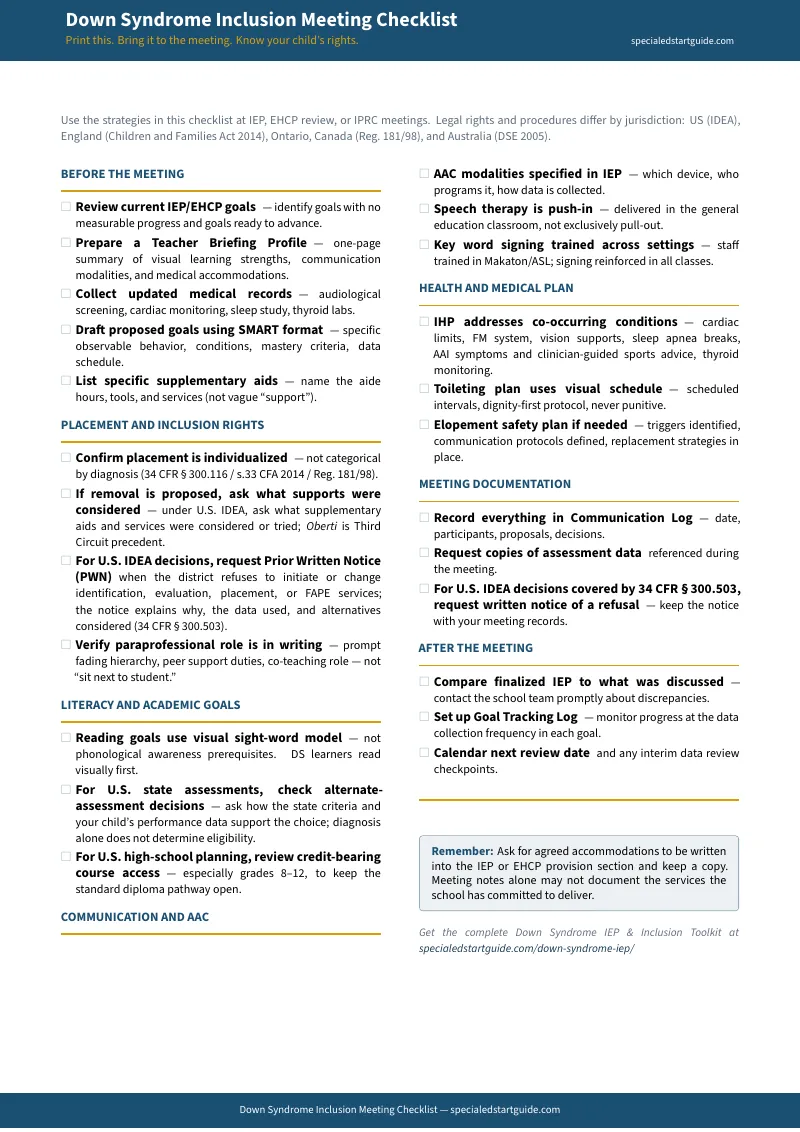
Not sure if you're ready for the full toolkit? Start with the Down Syndrome Inclusion Meeting Checklist — a printable one-page checklist of inclusion questions, support requests, and least-restrictive-environment rights to bring to your next IEP, EHCP Review, or IPRC meeting. It's free, it's immediate, and it works on its own. The full toolkit goes deeper — but the checklist is a powerful first step.