Smart Kid, Painful Writing: The School Advocacy System That Turns Clinical Reports into Enforceable Accommodations
Your child explains complex ideas at dinner, argues their case like an attorney, and reads above grade level. Then they sit down to write and the gap is devastating: one agonizing sentence where there should be a paragraph, illegible scrawl where there should be organized thinking, and a child who now believes they are stupid — because every adult in their life keeps calling it laziness.
You have probably already tried the reasonable approach. You talked to the teacher ("they just need to slow down and try harder"). You got a private OT evaluation ("interesting, but we don't see educational impact"). You read every article on Understood.org and scrolled every dysgraphia thread on Reddit at midnight. You have information. What you do not have is the fill-in-the-blank demand letter you can send tomorrow morning that cites the specific regulation and requests the evaluation the school is quietly hoping you will never ask for.
The Clinical-to-IEP Bridge
This is the core of the kit — and it is what separates it from every free resource and every $3 Teachers Pay Teachers worksheet. Most parents who have a private OT or psychoeducational report already have the evidence they need. The problem is translation. The school's evaluation team speaks a different language than the private clinician, and they exploit that gap to dismiss your documentation.
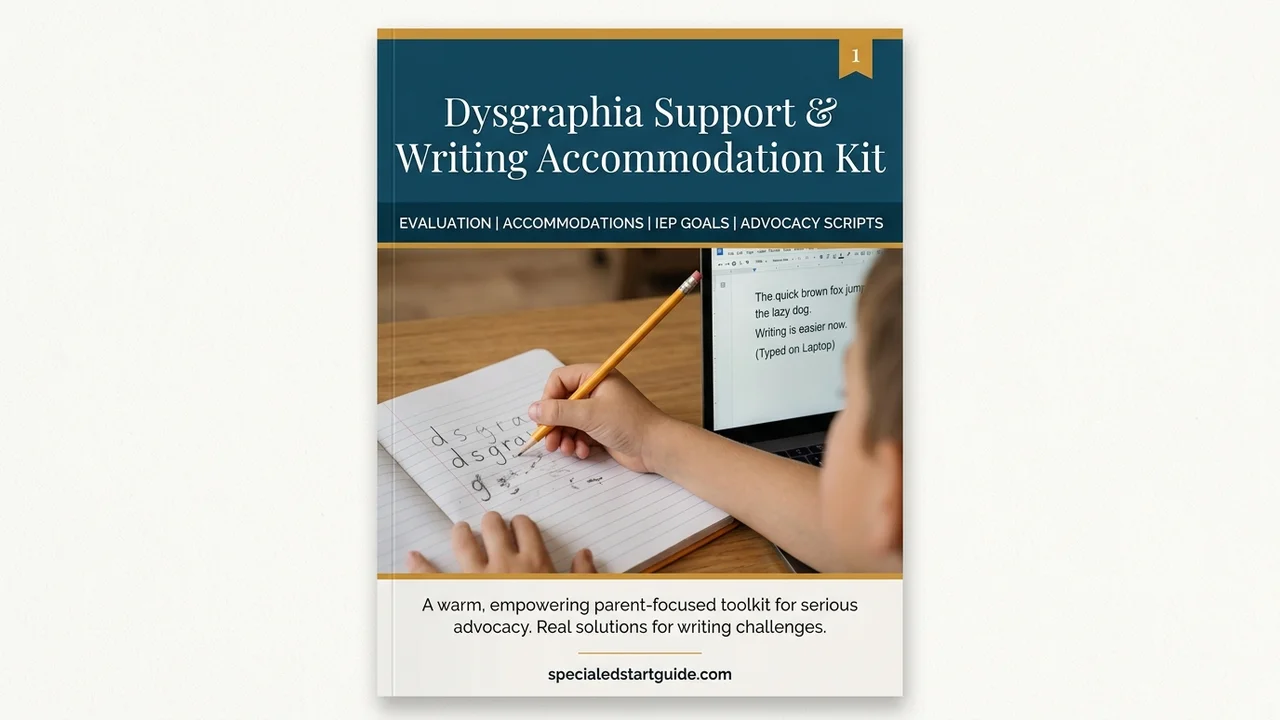
The Dysgraphia Support & Writing Accommodation Kit includes a structured translation matrix that converts standardized evaluation scores — Beery VMI, WIAT-4 Written Expression, DASH handwriting speed, BOT-2 fine-motor subtests — into the exact IEP accommodation language and measurable annual goals that satisfy the "adverse educational impact" standard. You bring the scores from your private report. The kit provides the bridge the school refuses to build.
What's Inside
- Evaluation battery decoder — every psychoeducational and OT assessment your child needs, what each subtest measures, what a low score means for school accommodations, and how to request the specific tests the school conveniently omits from its own evaluation
- Clinical-to-IEP translation matrix — maps each standardized score to legally binding accommodations and measurable IEP goals, so the school cannot dismiss private evaluation results as "educationally irrelevant"
- SLD written-expression eligibility strategy — the regulatory path for qualifying under Specific Learning Disability when the school deflects with "dysgraphia isn't an IDEA category," including the exact cite (34 CFR §300.309) and the evaluation language that closes the door
- Assistive technology trial plan with behavioral safeguards — a structured AT request for keyboarding, speech-to-text, and predictive text software with clauses that require the school to use software lockdowns (Guided Access, GoGuardian) instead of revoking the laptop when your child goes off-task
- IEP goal banks — SMART-formatted objectives for handwriting fluency, spelling accuracy, sentence construction, and paragraph organization at elementary, middle, and high school levels
- Testing accommodation request templates — formal letters requesting speech-to-text, extended time, a human scribe, or a separate testing environment for standardized assessments
- The "Messy & Lazy" pushback scripts — word-for-word email templates and meeting scripts for the five most common school refusals, including "reading scores are fine," "using a computer is unfair," and "they just need to practice"
- Three-subtype intervention framework — separate strategies for motor-based, spelling-based, and language-based dysgraphia, because a pencil grip will not fix a phonological processing problem
- Cross-jurisdiction coverage — US (IDEA/504), UK (EHCP/SEND), Canada (IEP/IPRC), and Australia (DSE/NCCD/NDIS) with a translation glossary
Who It's For
Parents of a bright, verbal child — typically between ages 7 and 14 — whose written output does not match what they know. You may have a diagnosis or a private evaluation that mentions dysgraphia, fine-motor delays, Disorder of Written Expression, or low visual-motor integration. You need to turn that documentation into classroom accommodations that actually get implemented.
This kit is built for the families who cannot afford a private special education advocate at $75–$250 per hour — or who want to arrive at that first consultation with an organized case instead of a folder of frustration.
Why Not Free Resources?
Free sites like Understood.org and Reading Rockets explain what dysgraphia is. They list accommodations. They describe how an IEP works. What they deliberately omit are the operational tools: the demand letter templates, the clinical score translation tables, the scripted responses for hostile meeting scenarios, the AT behavioral protection clauses, and the regulatory citations that force compliance.
Teachers Pay Teachers worksheets are designed for teachers delivering motor instruction — highlighted paper, letter formation drills, handwriting practice sheets. They contain no legal advocacy language, no IEP goal banks, and no multi-jurisdiction frameworks. They are classroom tools, not parent advocacy tools.
A private advocate delivers all of this — and charges $75 to $250 per hour, with a typical IEP cycle costing $1,500 or more. This kit delivers the same frameworks in a self-service format, for a fraction of the cost.
Satisfaction Guarantee
Full refund, no time limit. If the kit does not give you the tools to walk into your next school meeting with confidence, email [email protected] and you get your money back. No questionnaire, no hoops.
Stop Losing Meetings You Should Be Winning
The pre-written IEPs, the dismissed evaluations, the revoked laptops, the "they just need to practice more" deflections — none of it changes until you walk in with the clinical translation, the statutory citations, and the exact words that reframe the conversation.
Your child is not lazy. Their writing is not messy because they are not trying. And the school's refusal to evaluate is not the final word — it is the opening of a process they are counting on you not knowing how to start.
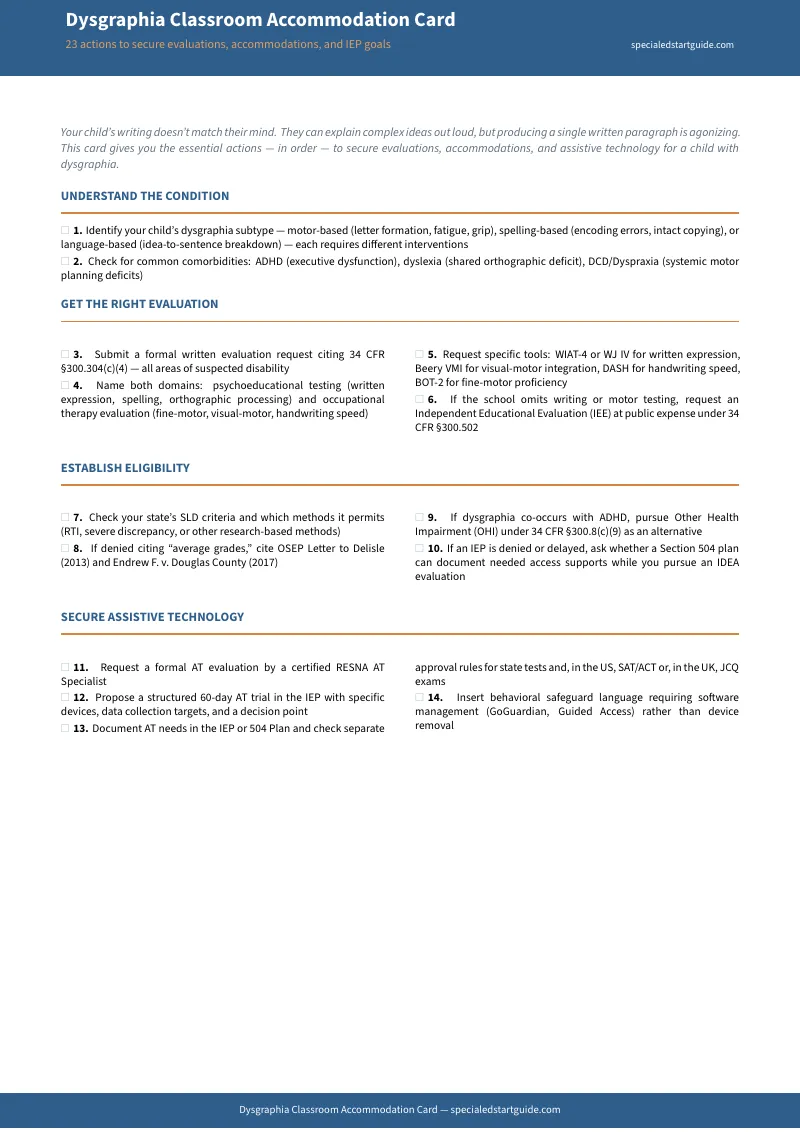
Get the free Dysgraphia Classroom Accommodation Card — a one-page printable of writing accommodations and assistive technology options to bring to your next meeting — and see why thousands of families trust this system for the full advocacy toolkit.
The full Dysgraphia Support & Writing Accommodation Kit — — includes the 50-page advocacy guide plus 9 standalone printable PDFs: clinical score translation matrix, AT trial plan, IEP goal bank, pushback script library, evaluation request letter, testing accommodation letter, meeting prep checklist, homework accommodation letter, and communication log. Instant PDF download.