You got the report. Now what do the numbers mean?
Your child's evaluation came back with pages of T-scores, percentile ranks, validity indexes, and clinical labels — "Elevated," "At-Risk," "Clinically Significant" — and nobody sat you down to explain any of it. The pediatrician had ten minutes. The school psychologist handed you a summary and moved on. You're left Googling "BASC-3 T-score 72 meaning" at midnight while the eligibility meeting is next week.
Meanwhile the teacher's Conners form came back "Average," and now the school is using that to argue your child doesn't need support — even though your form shows scores in the Very Elevated range and home life is in crisis every afternoon.
The Rater Discrepancy Decoder
The ADHD Rating Scale Decoder is not another general ADHD guide. It is a psychometric translation system — built for the parent sitting at the kitchen table with a report they cannot read, a meeting they cannot prepare for, and a gap between what they see at home and what the school sees in the classroom.
It covers every major ADHD rating scale used in evaluations today, instrument by instrument, subscale by subscale, in plain language — then connects each elevated score directly to the classroom accommodations and support pathways it justifies.
What's Inside
- Scale-by-scale decoder for six instruments — Conners 4, BASC-3, BRIEF-2, Vanderbilt, ADHD-RS-5, and SNAP-IV. Each chapter translates the subscales, T-score ranges, and clinical labels into language you can actually use at a meeting.
- Publisher label comparison table — because a T-score of 66 reads as "Elevated" on one test and "At-Risk" on another. One table shows you the real comparison so you stop confusing the labels.
- Rater discrepancy framework — why the teacher's scores were lower than yours, what classroom masking and rater desensitization look like, and how to present home-setting evidence when the school relies on the teacher form to deny services.
- Validity scale decoder — Inconsistency, Negativity, and Infrequency indexes on the BASC-3, BRIEF-2, and Conners 4. What triggers them, what an elevated validity index actually means, and how to respond if the school questions your ratings.
- Co-occurring symptom guide — when the BASC-3 flags Anxiety, Depression, or Somatization alongside ADHD. How to read internalizing elevations, how they affect eligibility, and how to make sure they are addressed in the plan.
- Scores-to-accommodations map — a matrix linking specific elevated subscales to enforceable 504 Plan accommodations and IEP goal language. Not a generic list of "extra time" suggestions — specific supports tied to the clinical findings in your child's report.
- Continuous performance test primer — what CPT-3, TOVA, and QbTest results mean when they appear alongside rating scale data, including how to read omission errors, commission errors, and reaction time variability.
- Multi-jurisdiction pathways — how rating scale scores connect to support systems in the United States (IEP and 504 Plan), the United Kingdom (EHCP and Right to Choose), Canada (provincial IEPs), and Australia (DSE, NCCD, and NDIS).
- Evaluator question list — the questions to ask the psychologist, pediatrician, or school team before, during, and after the evaluation, organized by the type of instrument used.
Who This Is For
- Parents who received an ADHD evaluation report and need to understand what the scores mean before an IEP, 504, or EHCP meeting
- Parents whose child's teacher ratings came back lower than theirs — and who need to explain why that discrepancy does not mean the child is fine at school
- Parents navigating prescribing barriers because a teacher's Vanderbilt or Conners form returned un-elevated scores
- Parents whose child's BASC-3 report flags anxiety or depression alongside ADHD and who need to make sure both are addressed
- Parents who want to walk into the eligibility meeting knowing exactly which accommodations their child's scores support
Why Free Resources Fall Short
Free articles on Understood, CHADD, and ADDitude explain what rating scales are. They define T-scores. They describe what the Conners and Vanderbilt measure. What they do not do is help you read your child's specific report. They do not explain why the teacher's scores are lower, how to interpret a BRIEF-2 Inconsistency index, or which elevated subscale justifies which specific accommodation. They describe the instrument; they do not decode the results.
Existing products on Etsy and Teachers Pay Teachers are written by clinicians for clinicians — report templates, scoring spreadsheets, auto-fill evaluation documents. They save the psychologist time. They do not help the parent sitting across the table understand what the psychologist wrote.
Private special education advocates charge $100–$300 per hour, and a full case runs $1,500–$3,000. A neuropsychological evaluation costs $2,000–$4,500 out of pocket. The Decoder gives you the score translation and meeting preparation that would otherwise cost you hours of professional time — for less than a single co-pay.
Satisfaction Guarantee
If the Decoder does not help you understand your child's rating scale report, email [email protected] for a full refund, no time limit. No forms, no hoops.
Get Started
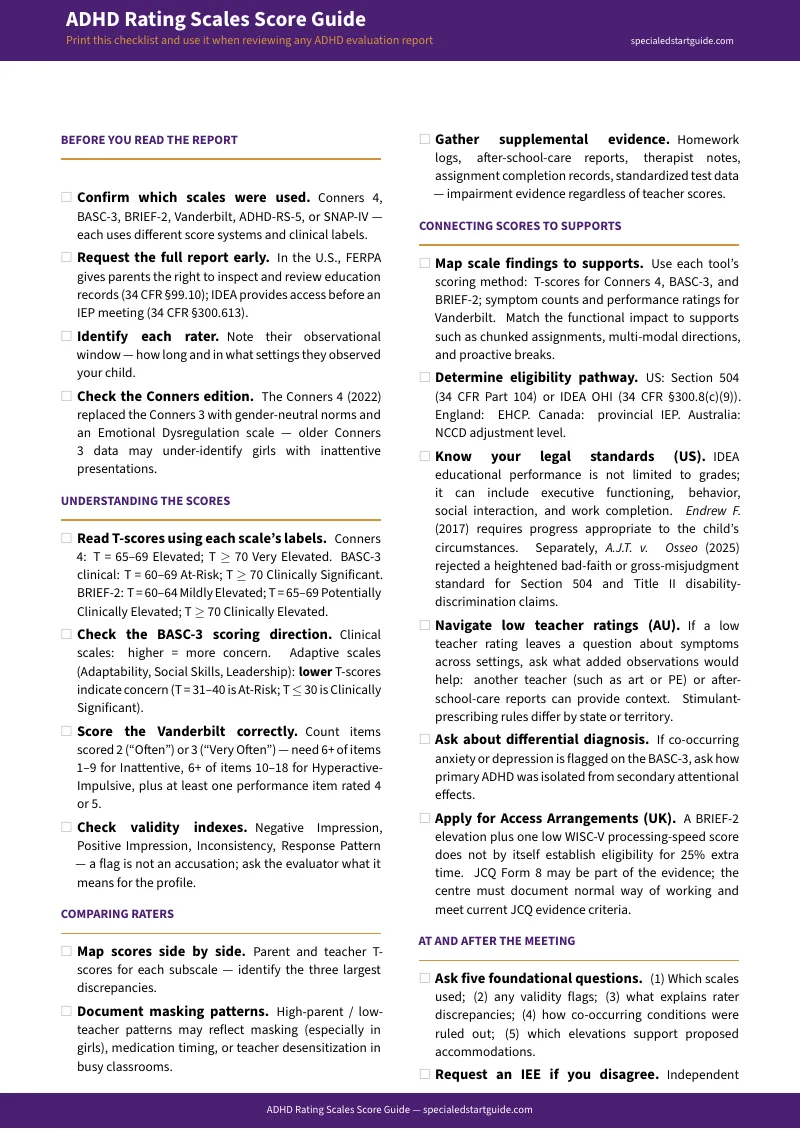
Download the free ADHD Rating Scales Score Guide — a one-page reference with T-score ranges, symptom count thresholds, and five questions to ask the evaluator. If you need the complete scale-by-scale decoder, the rater discrepancy framework, and the scores-to-accommodations map, the full ADHD Rating Scale Decoder is available for .