The ADOS-2 Says "Non-Spectrum." The SRS-2 Says Severe. Which One Is Right?
You paid for an evaluation expecting a clear answer. What you got is a document full of calibrated severity scores, T-scores, percentile ranks, and a conclusion that might contradict what you see at home every single day.
The feedback session was thirty minutes of clinical language while you were still processing the word "autism." Now there is a school meeting on the calendar, and you are holding a report you cannot translate into the supports your child actually needs.
This is the problem the Autism Evaluation Report Decoder solves — not by giving you another opinion, but by teaching you to read the opinion you already have.
The Cross-Tool Discrepancy Framework
The reason your child's scores seem contradictory is not a mistake in the evaluation. Different autism assessment tools measure different things, under different conditions, through different lenses. The ADOS-2 is a forty-minute observation in a quiet, one-on-one clinical room — the lowest-demand social environment your child ever encounters. The SRS-2 is weeks of naturalistic observation in classrooms, playgrounds, and at home. When a high-masking, verbally fluent child aces the structured observation and struggles everywhere else, these instruments should disagree.
The decoder explains why they disagree, which tools are right about what, and how to present those discrepancies at a school meeting so your child's full picture gets heard — not just the one score the district finds convenient.
What the Decoder Covers
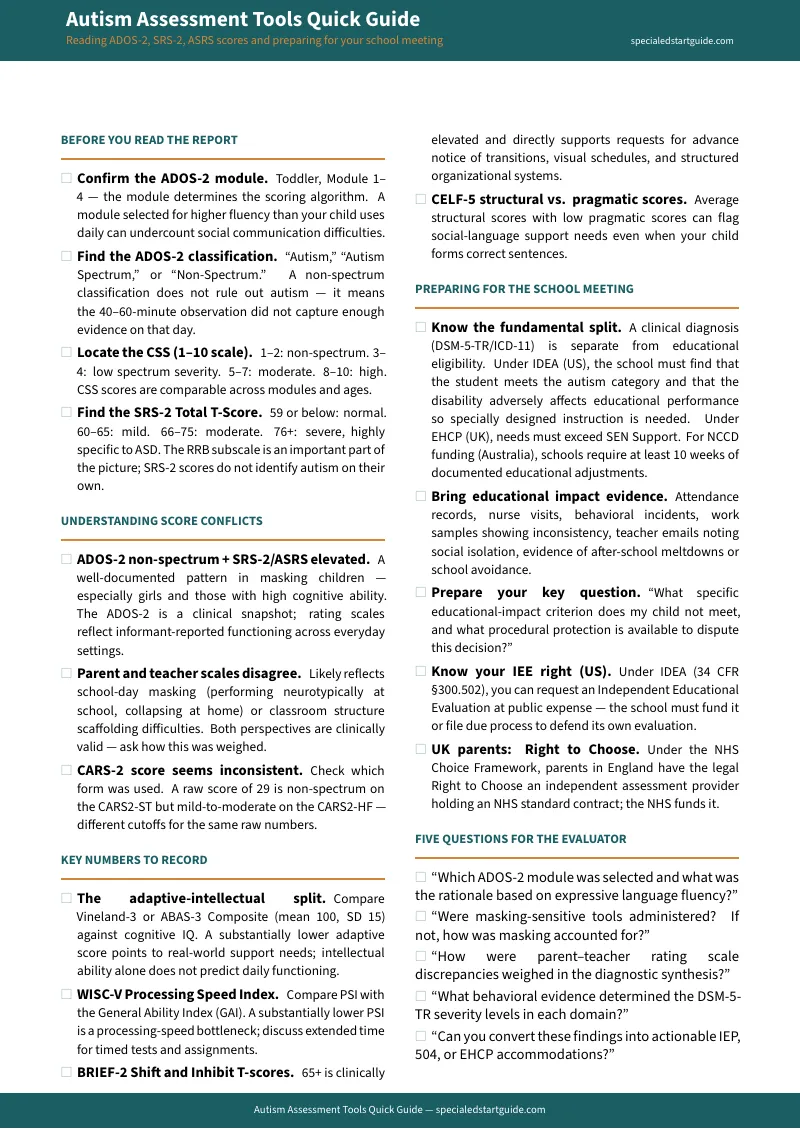
- ADOS-2 modules, domains, and severity scores — which module was used, what the Social Affect and Restricted and Repetitive Behaviors domain scores mean, what Calibrated Severity Scores actually measure, and why a "Non-Spectrum" classification does not rule out autism
- Rating scales in plain language — SRS-2 T-scores and the five treatment subscales, ASRS, CARS-2, GARS-3, SCQ, and the ADI-R parent interview, each with the clinical thresholds your report uses and the known blind spots
- Cognitive, adaptive, and executive function profiles — why a high IQ does not mean a child does not need support, how adaptive functioning scores reveal the gap between what a child can do and what they do do, and what a spiky cognitive profile tells the school team
- Cross-tool discrepancy explanations — a structured framework for the scenarios that confuse families most: ADOS-2 low but SRS-2 severe, school eligible but not clinically diagnosed, clinically diagnosed but school ineligible
- Masking, AuDHD, and PDA profiles — how these presentations systematically confuse standardized instruments and what compensatory data to present when standard tools miss them
- Clinical diagnosis versus educational eligibility — how DSM-5-TR criteria and school eligibility standards differ in the US (IEP and 504 under IDEA), England (EHCP), Canada (IPRC), and Australia (NCCD and NDIS)
- Evaluator question bank — specific questions to ask the psychologist, the school team, or the Local Authority, chapter by chapter, so you walk in prepared instead of reactive
- Findings-to-Supports Map — a practical template linking each subscale deficit to the classroom accommodations it justifies, turning abstract scores into concrete IEP goals, 504 accommodations, EHCP provisions, or NDIS functional supports
Who This Is For
Parents and caregivers who have an autism evaluation report — from a developmental paediatrician, clinical psychologist, neuropsychologist, NHS team, school evaluation team, or private practitioner — and need to understand it before a meeting. Especially useful if:
- Your child's results seem contradictory across different instruments
- Your child is a girl, verbally fluent, or has co-occurring ADHD or anxiety — presentations that standardized tools routinely undercount
- The school acknowledged the clinical diagnosis but denied eligibility, or found your child eligible when the clinic did not diagnose
- You paid for a private evaluation and the school district or Local Authority will not accept it
- You need to prepare for an IEP eligibility meeting, a 504 evaluation, an EHCP needs assessment, an IPRC, or an NDIS planning session
Why Free Resources Do Not Solve This
The test publishers — Western Psychological Services, Pearson — deliberately withhold interpretive guides from non-clinicians. Their product pages describe what the tools measure but not what the numbers mean. Parent forums give you one person's experience with one score in one jurisdiction, contradicted by the next comment. Advocacy sites explain the process at a high level without touching the psychometrics.
You could reconstruct what this guide covers from forty browser tabs, four academic databases, and a copy of the DSM-5-TR. Or you could open one document that puts every major assessment tool in order, explains each score type with the actual thresholds your report uses, and ends every chapter with the specific questions and accommodation requests those scores support.
What You Get
The full decoder is a 49-page PDF covering twelve chapters — from reading the evaluation narrative and understanding the ADOS-2, through every major rating scale and supplementary measure, to the jurisdictional cross-walk and the Findings-to-Supports Map. It comes with six printable companion worksheets: an Evaluation Summary Matrix, a Score Conflict Tracker, a Findings-to-Accommodations Planner, a Meeting Preparation Checklist, an Agency Communication Log, and an Evaluator Question Bank. The free checklist is a two-page quick reference with the common tools, score types, and five essential evaluator questions.
All files are immediate PDF downloads. No waiting list, no subscription, no login portal. The decoder and every worksheet are yours to print, highlight, and bring to every meeting.
Full Refund, No Time Limit
If the decoder does not help you understand your child's evaluation report, email [email protected] for a full refund. No time limit, no questions, no forms.
Your child's evaluation report is not a verdict. It is a negotiation document — and you are about to learn how to read every line of it.