You have the report. You don't have the translation.
The WISC-V evaluation came back with twelve pages of standard scores, scaled scores, confidence intervals, and index composites — and a meeting this week where the school team will use those numbers to decide whether your child receives support or gets sent back to class with a "they're doing fine."
You've searched for answers. Understood.org gave you a bell curve. Wrightslaw gave you a statute. Reddit gave you a stranger's anecdote about their child's scores, which may or may not have anything to do with yours. None of them answered the question that actually matters: what do I do with these specific numbers before the meeting?
The Score-to-Action Decoder: from numbers to meeting-ready language
The WISC-V Score Report Decoder is a structured translation system that takes the clinical language on your child's evaluation and converts it into three things: what each score means in plain terms, what the score pattern reveals about your child's learning profile, and what to say and request at the meeting based on exactly those numbers.
This is not a summary of what the WISC-V measures — you can find that anywhere. This is the step-by-step decoder that connects each index deficit to the classroom struggles you're actually seeing, identifies when a composite score is statistically meaningless, and gives you the accommodation language and evaluator questions that turn a passive meeting into a productive one.
What's inside
- All five primary indexes decoded — Verbal Comprehension, Visual Spatial, Fluid Reasoning, Working Memory, and Processing Speed explained in terms of what your child actually does in the classroom, not what a normative sample did in a lab. Each index maps to specific accommodations so you request the right support for the right deficit.
- The FSIQ validity check — step-by-step scatter rules that determine when a Full Scale IQ is psychometrically unreliable. When your child's Verbal Comprehension is 128 and Processing Speed is 82, the "Average" FSIQ of 103 doesn't represent any ability they actually have. The decoder shows you exactly when and how to challenge a composite that's being used to deny services.
- GAI, CPI, and NVI breakdowns — the ancillary indexes the school may not have mentioned. The General Ability Index removes Processing Speed and Working Memory from the composite — critical for twice-exceptional children whose reasoning ability is masked by a slow processing score. The decoder tells you when to request each alternative composite, with the specific language for each jurisdiction.
- Score-pattern profiles — high reasoning with depressed processing speed (the classic 2e/gifted-with-LD profile), uniformly low scores, a single isolated deficit pulling down an otherwise average profile, and the classroom presentation each pattern predicts. Match your child's combination against the patterns and understand what the school should be seeing.
- Metric conversion tables — standard scores to percentiles, scaled scores to standard scores, confidence intervals to classification boundaries. One reference instead of cross-referencing three different websites at midnight.
- Report sentence translations — what "should be interpreted with caution," "within normal limits," "statistically significant difference," and "clinically meaningful discrepancy" actually mean. The exact phrases from your child's report, decoded into language you can act on.
- The evaluator question list — specific questions about testing conditions, score validity, subtest scatter, alternative composites, and whether the evaluator's conclusions are actually supported by the data. Designed to be printed and brought to the meeting.
- Index-to-accommodation mapping across four jurisdictions — how each index deficit translates into enforceable supports under US (IEP/504), UK (EHCP/SEND), Canadian (IEP/IPRC), and Australian (NCCD/NDIS) systems. The right terminology and request language for the system you're in.
Who this decoder is for
Parents holding a WISC-V report they cannot fully interpret, with a meeting approaching. Specifically:
- You received a report that says "Average" overall, but one or two indexes are Low Average or below — and you know something is wrong because you see the struggle every night, but the school is using the composite to say your child doesn't qualify
- Your child scored far above average on reasoning and far below on processing speed, missed a gifted program cutoff, and nobody mentioned the General Ability Index
- You're outside the US — navigating EHCP provision in the UK, an IPRC in Canada, or NCCD adjustments in Australia — and every resource you've found so far is written in IDEA and Section 504
- You've priced a private debrief with an educational psychologist or a meeting with a special education advocate, and you need to understand this report before you can decide whether that expense is necessary
Why free resources aren't solving this
Free sites explain what Processing Speed is. They don't tell you what to do when your child's Processing Speed is 78 and the school is averaging it with a Verbal Comprehension of 125 to produce a "fine" FSIQ of 103. Pearson's parent pages define the indexes — deliberately neutrally, without any meeting strategy. Wrightslaw is rigorous but dense, heavily US-centric, and still references the WISC-IV structure in places. Forum threads give you one parent's experience with scores that may be nothing like your child's. The decoder replaces forty browser tabs with one structured walkthrough that connects scores to patterns to accommodations to meeting language.
What the decoder does not do
It does not provide a clinical diagnosis. It does not replace the psychologist who administered the test. It does not reproduce any proprietary test items, stimulus materials, or copyrighted norm tables. It gives you the interpretive framework and the meeting-ready language so you walk in prepared — knowing what every score means, which numbers may be misleading, and exactly what to ask for.
Format and guarantee
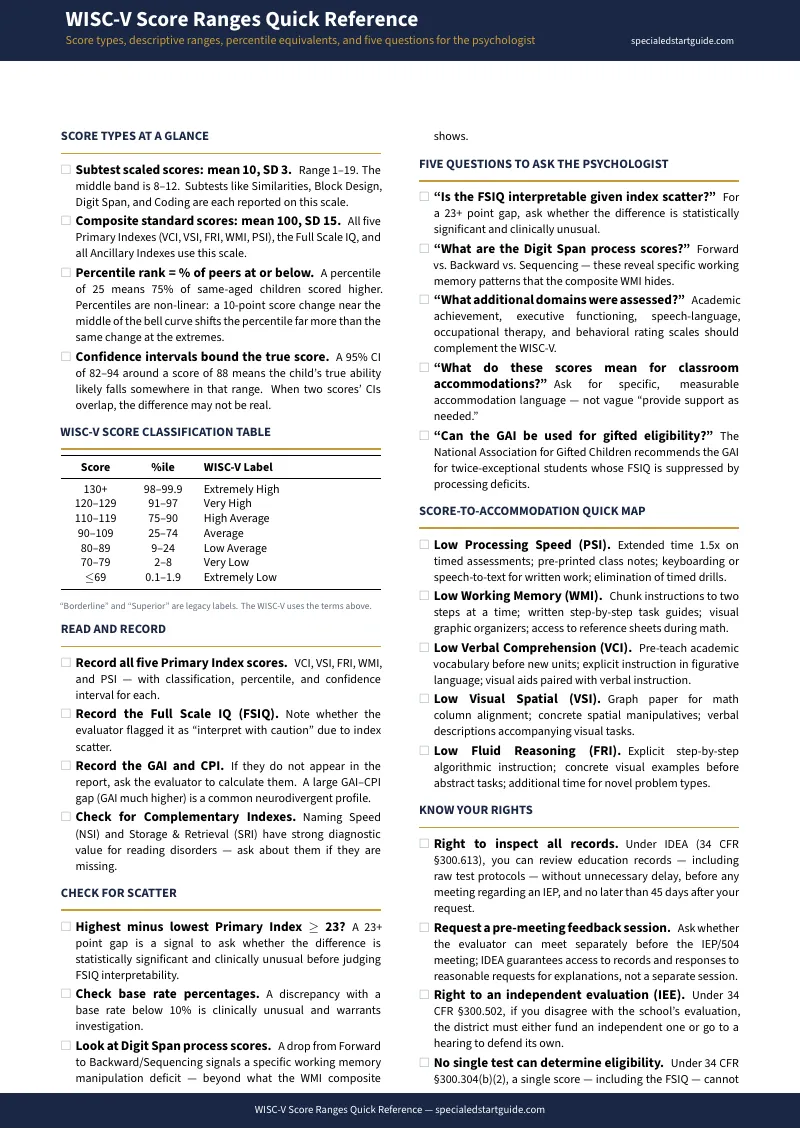
Instant PDF download. The paid kit includes seven PDFs: the main guide walks through every section of a WISC-V report in order, plus a score summary worksheet, an evaluator question list with write-in space, an accommodation request builder, a meeting notes log, and an agency communication log. The free quick-reference card — a printable two-page summary of score types, classification ranges, and five meeting-ready questions — is available as a standalone download, no purchase required.
Full refund, no time limit. If the decoder doesn't change how you read the report, email [email protected].
The meeting is this week. The report is in your hands. The decoder turns those numbers into the questions and requests that change the outcome.
Get the WISC-V Score Report Decoder →
Already have the free Score Ranges Quick Reference? Get the full decoder here →