Your Child Struggles to Speak. The Report Says "Average."
Your child cannot follow a two-step direction in class. They lose the thread halfway through a sentence they are trying to say. Their teacher pulls you aside every term to talk about falling behind. You waited months for the speech-language evaluation, expecting answers — and instead you received a document full of composite indexes, scaled scores, percentile ranks and confidence intervals that reads like it was written for someone with a graduate degree in psychometrics.
Then the eligibility team delivered the line you were not prepared for: "Your child's Core Language Score is 86. That falls within the average range. They don't qualify for speech services."
You know something is wrong. The report says otherwise. And you have a meeting in days.
The Composite Score Trap — and Why It Matters
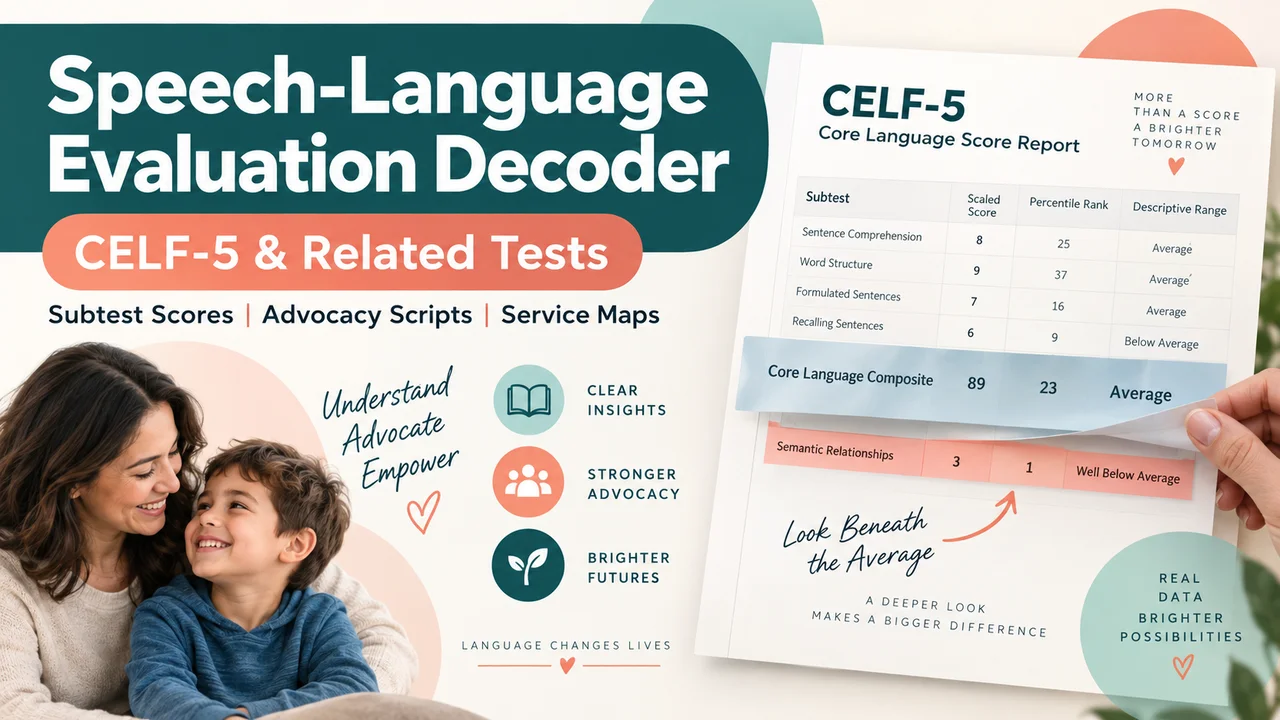
Here is what the eligibility team will not explain: a Core Language Score is an average of averages. It blends your child's performance across multiple subtests into a single number. A child who scores in the 84th percentile on vocabulary tasks and the 2nd percentile on Recalling Sentences — a subtest that directly predicts classroom comprehension — can still produce a composite score the school calls "average."
The Speech-Language Evaluation Decoder is a Composite Score Trap Decoder. It walks you through your child's report subtest by subtest, translates every number into plain English, and gives you the exact questions to ask the SLP so a single composite score cannot be used to deny services your child needs.
What's Inside the Decoder
- Score-Metric Translation Tables — standard scores, scaled scores, percentile ranks and confidence intervals explained once and referenced throughout, so you understand every number on the report without needing a statistics background
- CELF-5 Subtest-by-Subtest Breakdown — what each task actually measures, what a low score means for the classroom, and the specific question to ask the SLP about that subtest's result
- Quick-Reference Sections for Related Tests — PPVT-5 and EVT-3 (vocabulary), GFTA-3 (articulation), DEMSS and DEAP (apraxia), CASL-2, CCC-2 and TOPL-2 (pragmatics), and several other batteries your child may have been given
- The Findings-to-Services Map — connects specific score patterns directly to therapy minutes, IEP goals, AAC accommodations and classroom supports, so you walk into the meeting knowing not just that a score is low but what services that score justifies
- Multi-Jurisdiction Advocacy Scripts — word-for-word questions and request language tailored to US IEPs and 504 Plans, UK EHCPs (including Section B and Section F guidance), Canadian IPRCs and Australian NCCD adjustment categories
- Three Worked Case Studies — real composite-score-masking scenarios showing how families identified hidden subtest deficits and secured services the school initially refused
- Five Printable Worksheets — separate PDFs for recording scores, spotting subtest discrepancies, compiling meeting questions, bridging findings to services and logging communications — fill in and bring to the meeting
Who the Decoder Is For
- Parents who just received a speech-language evaluation report and cannot make sense of the scores before an upcoming meeting
- Parents whose child was told they do not qualify for speech services despite obvious real-world communication struggles
- Families holding a private diagnosis — Developmental Language Disorder, Childhood Apraxia of Speech, ASD-related language disorder — that the school refuses to recognize
- UK parents preparing for an EHCP panel or tribunal who need to challenge vague Speech and Language Therapy provision in Section F
- Canadian and Australian families translating a clinical report into the terminology their school board or NCCD process requires
Why Free Resources Leave You Stranded
ASHA's parent portal tells you what "receptive language" means. It does not tell you what to do when your child's Receptive Language Index is 91 but their Following Directions scaled score is 4. Parent forums give you six contradictory interpretations of the same score from strangers who have never seen your child's battery. Wrightslaw covers the legal framework but does not decode the psychometrics.
The gap is not information — it is translation and application. The Decoder takes the specific numbers on your child's report, explains what each one means in the classroom, maps them to the services those numbers justify, and puts the right questions in your hands before you walk through the door.
Satisfaction Guarantee
If the Decoder does not help you understand your child's evaluation report, email [email protected] for a full refund — no time limit, no questions, no hoops.
Get Started
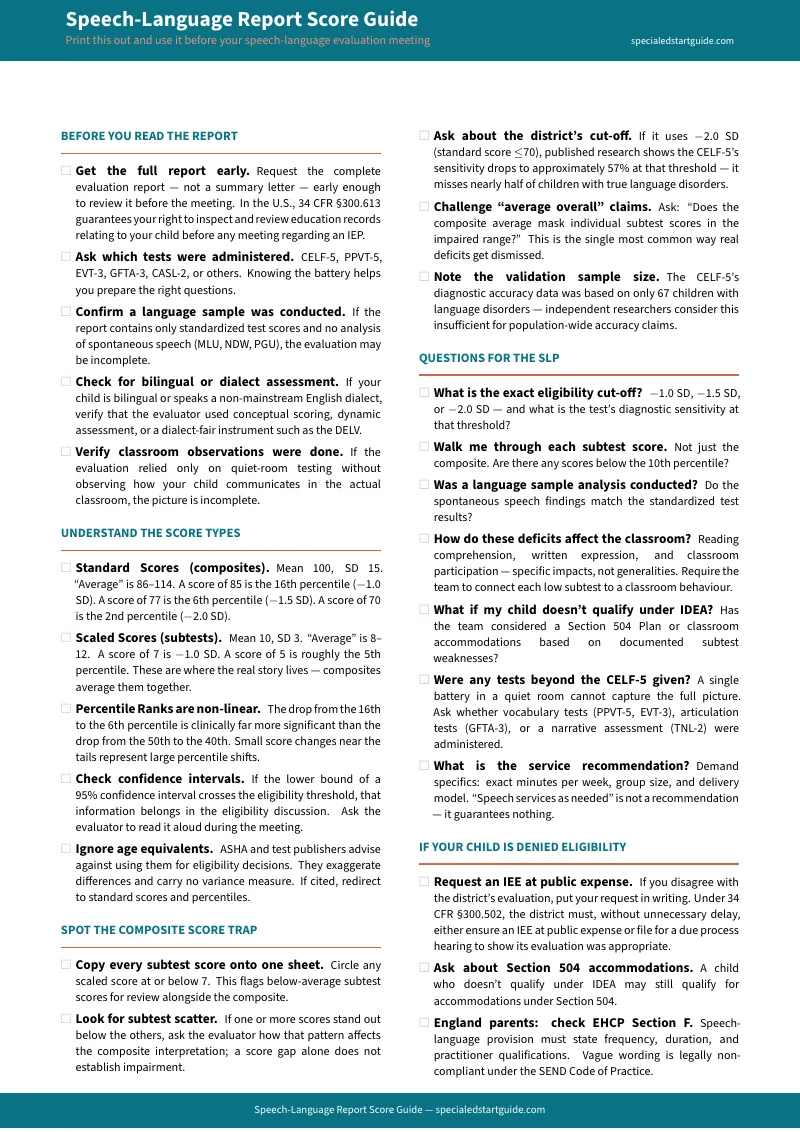
Download the free Speech-Language Report Score Guide — a one-page overview of the score types, common test names and five questions to ask the SLP. Ready for the full subtest-by-subtest decoder, advocacy scripts and findings-to-services map? Get the complete Speech-Language Evaluation Decoder — .