Every morning is a crisis. The school's only response is a countdown to court.
Your child wakes up shaking. Or crying. Or frozen in the doorway unable to move. By 7:45 you've already negotiated, pleaded, and tried every strategy the parenting blogs recommend — and none of them work when a child's nervous system has decided school is a physical threat.
The school sees absences. You see a child in distress. And somewhere in the gap between those two perspectives, an automated truancy system is quietly counting unexcused days until the next letter arrives — the one that mentions fines, court, or child protective services.
You've already tried the basics. The pediatrician's note that the attendance office dismissed. The email to the guidance counselor asking for "help" that got a reply about being "firmer at home." The Facebook group where you found solidarity but not a strategy.
What you need is not more information about what school refusal is. You need the exact words — in writing, with legal weight — that change what happens next.
The Attendance Defence System: turn a truancy threat into a legally protected accommodation plan
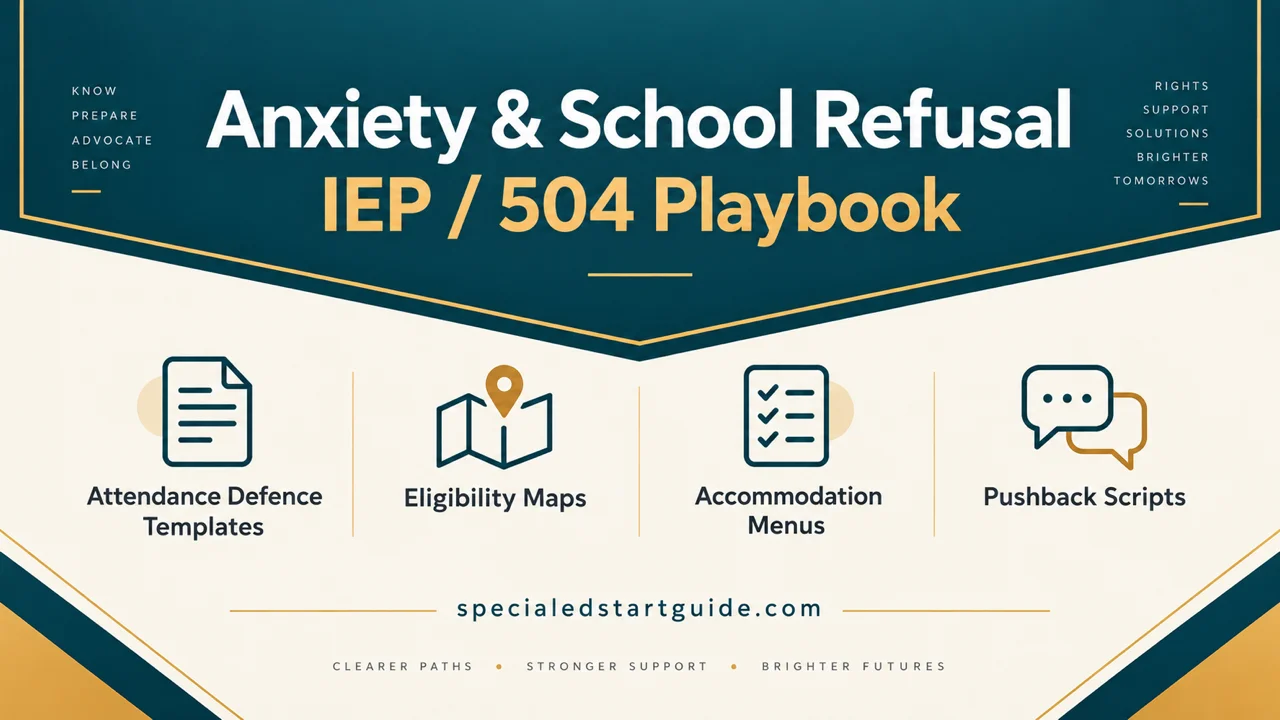
The Anxiety & School Refusal IEP/504 Playbook is a fill-in-the-blank advocacy toolkit that does what free online articles and $5 Etsy printables cannot: it gives you the pre-drafted legal response letters, eligibility arguments, accommodation menus, and meeting scripts that professional special education advocates charge $150–$300 an hour to produce.
It is built around one system: the Attendance Defence System — a three-stage framework that moves your family from reactive panic to documented protection.
- Stage 1 — Freeze: Stop truancy escalation immediately with pre-drafted letters that invoke your child's disability protections and trigger the school's legal evaluation duties
- Stage 2 — Qualify: Navigate the eligibility maze (504, IEP under OHI or ED, EHCP, provincial IEP, DSE adjustments) using the exact regulatory citations that counter the school's objections
- Stage 3 — Build: Construct a graded return-to-school plan with legally protected accommodations — partial days counted as excused, safe-space access, modified timetables — so your child re-enters school at a pace their nervous system can sustain
What's inside
- Attendance-letter response templates — fill-in-the-blank letters for truancy warnings, penalty notices, court referral threats, and "your child must attend full-time immediately" demands. Each template cites the specific statute that protects your family in your jurisdiction.
- The anxiety eligibility map — step-by-step walkthrough of how anxiety qualifies under Section 504, IDEA IEP (Other Health Impairment and Emotional Disturbance), England's EHCP system, Canadian provincial frameworks, and Australia's Disability Standards for Education. Includes the "poor attendance exclusionary factor" rebuttal with the exact federal citation.
- Formal evaluation request letters — templates that trigger Child Find (US), EHC needs assessment (England), or equivalent provincial/state processes, written to create a paper trail that protects your timeline rights.
- Graded return-to-school framework — a customizable re-entry protocol that translates therapist recommendations into enforceable plan language, with benchmarks, timeline flexibility, and instructions for ensuring partial attendance is coded as medically excused.
- 50+ anxiety-specific accommodations — organised by domain (classroom environment, transitions, testing, social, sensory, communication) so you can select what matches your child's profile instead of accepting the school's standard list.
- "It's a parenting issue" pushback scripts — word-for-word conversation scripts and email templates that reframe the narrative from parental failure to unaddressed disability accommodation using statutory language. Covers the five most common dismissals parents hear.
- Home and hospital instruction requests — when attendance at any school setting is not currently possible, these templates invoke your child's right to alternative education provision (Section 19 in England, homebound services in the US, distance education provisions in Australia).
- Selective mutism accommodation menu — specific accommodations for children whose anxiety manifests as an inability to speak at school, covering classroom participation alternatives, assessment modifications, and social communication supports.
- Neurodivergent overlap evaluation requests — evaluation language designed to capture the autism, ADHD, PDA, and sensory processing differences that frequently drive the anxiety underneath the refusal, so the assessment evaluates root causes rather than surface behaviour.
- Cross-jurisdiction translation glossary — maps equivalent legal concepts across the US, England, Canada, and Australia, so you know exactly which framework applies to your family and which terminology to use in correspondence.
- Key court decisions and legal citations — Endrew F. v. Douglas County, Perez v. Sturgis, A.J.T. v. Osseo Area Schools, Equality Act 2010 Section 15, and the 2023 Australian Senate Inquiry findings, with plain-language explanations of what each means for your advocacy.
Who this playbook is for
- Parents whose child has a diagnosed anxiety disorder (GAD, social anxiety, panic disorder, selective mutism, OCD) and whose school is treating absences as truancy rather than disability
- Families of neurodivergent children (autism, ADHD, PDA profiles) whose school refusal stems from sensory overload, masking exhaustion, or executive function collapse
- Parents who have just received a truancy warning, penalty notice, or court referral and need a legally assertive response before the deadline
- Families whose school has said "anxiety doesn't qualify for an IEP" or "your child needs to attend to be evaluated"
- UK parents whose child has been out of school for weeks or months while the EHCP process stalls
- Canadian and Australian families whose child is on an undocumented reduced timetable with no plan, no re-entry criteria, and no funded support
Why this works where free resources don't
Free online resources — Understood, Child Mind Institute, Anxiety Canada, EBSA charity guides — do an excellent job explaining what school refusal is. They validate your experience. They describe the psychological mechanisms. And then they stop.
When you receive a truancy letter giving you five business days to respond before legal escalation, a blog article explaining that "anxiety can cause school avoidance" gives you no administrative defence. What you need at that moment is an editable letter you can fill in and send before Friday — one that cites the specific law, names the school's legal obligation, and creates a paper trail that protects your family if the situation escalates further.
That is the gap this playbook fills. Not more education about anxiety. Execution tools — templates, scripts, frameworks — that turn what you already know about your child into documented, enforceable protection.
Etsy printables (typically $4–$15) offer morning routine scripts or counsellor intake forms. Books on school refusal ($22–$30) offer clinical frameworks and exposure therapy guidance. Neither gives you the legal response letters, statutory eligibility arguments, or accommodation menus that force the school system to act.
Full refund, no time limit
If the playbook doesn't give you what you need, email [email protected] and you'll get a full refund. No time limit, no conditions. Your family is dealing with enough — a purchase decision shouldn't add to the stress.
Your child's nervous system is not the problem. The school's response is.
School refusal driven by anxiety is a neurobiological crisis, not a behavioural choice. The administrative system was not designed for your child — but the law was. You have rights. Your child has protections. This playbook gives you the exact words to use them.
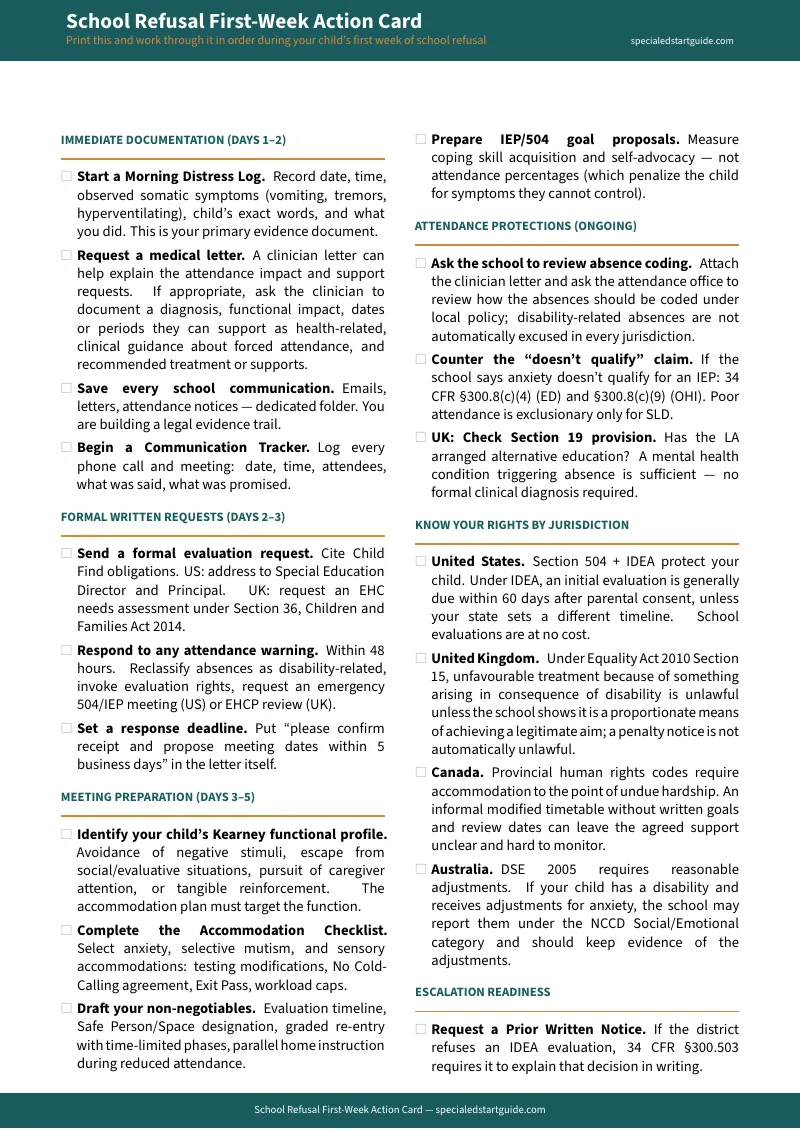
The free checklist gives you the first-week action steps: what to put in writing, which meetings to request, and the evaluation and attendance protections to ask about. The full playbook gives you every template, script, and accommodation menu you need to move from crisis to a documented, legally protected plan.