The School Offers 30 Minutes a Week in a Group of Four. For a Motor Planning Disorder That Needs 100 Trials a Session. This Toolkit Gives You the Evidence, the Law, and the Exact Scripts to Change That.
Your child's private speech-language pathologist diagnosed Childhood Apraxia of Speech and prescribed three to five short individual sessions per week, each packed with 50 to 100 motor speech trials. The school team looked at the same child, saw passing grades, and wrote an IEP offering 30 minutes of group speech therapy once a week — with three other children who have completely different conditions. Or the team told you your child "does not qualify" because academic performance is adequate.
You have spent months Googling "how to fight for more speech therapy at school." You have read Wrightslaw articles about IDEA eligibility and OSEP policy letters about grades. You have scrolled through Reddit threads where other parents describe the same fight, the same dismissive phrases from the IEP team, the same 30-minute default. What you still do not have is the actual execution toolkit: the service-intensity worksheet that converts clinical data into defensible IEP minutes, the word-for-word scripts for the exact pushback phrases school teams use, and the goal bank that pairs clinical SMART goals with plain-language translations a parent can actually evaluate.
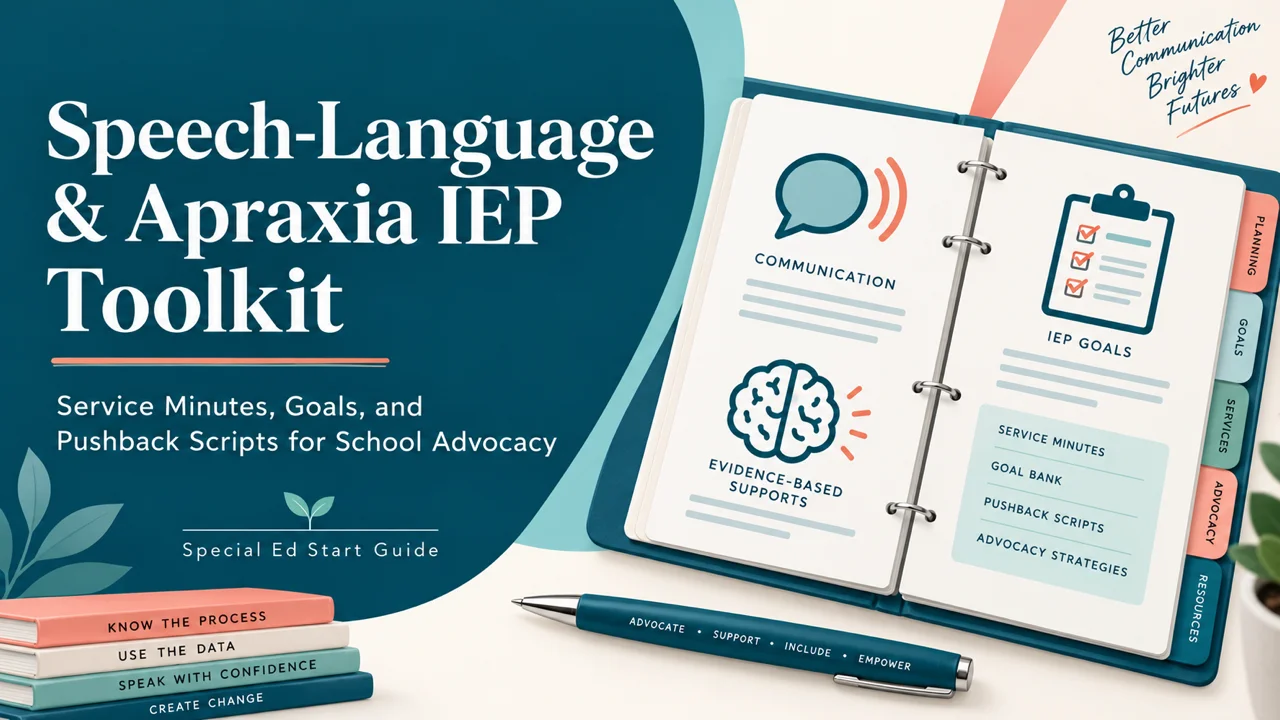
The Speech-Language & Apraxia IEP Toolkit is the Motor Speech Advocacy System — the complete framework that translates clinical evidence and special education law into meeting-ready documents. It covers eight diagnostic categories across four national legal systems, and it is built around the one structural gap that every free resource, every legal textbook, and every Teachers Pay Teachers download leaves open: the bridge between knowing your child needs more than what the school is offering and proving it in the language the IEP team is required to act on.
What's Inside the Toolkit
The CAS Motor Speech Service-Intensity Worksheet
This is the toolkit's centerpiece. Schools set speech therapy minutes based on SLP caseload capacity, not on your child's clinical needs. The worksheet walks you through calculating the weekly motor practice repetitions your child requires — based on the private SLP's data and validated CAS protocols like DTTC, ReST, and NDP3 — and translating that number directly into a service-minute request the IEP team can evaluate. When the school offers 30 minutes a week in a group, you respond with a documented clinical rationale showing that your child's motor planning disorder requires four 15-minute individual sessions per week to achieve the trial density the evidence demands. The worksheet turns the conversation from "we need more" into "here is exactly how much, and here is why."
Seven Pushback Scripts for District Denial Language
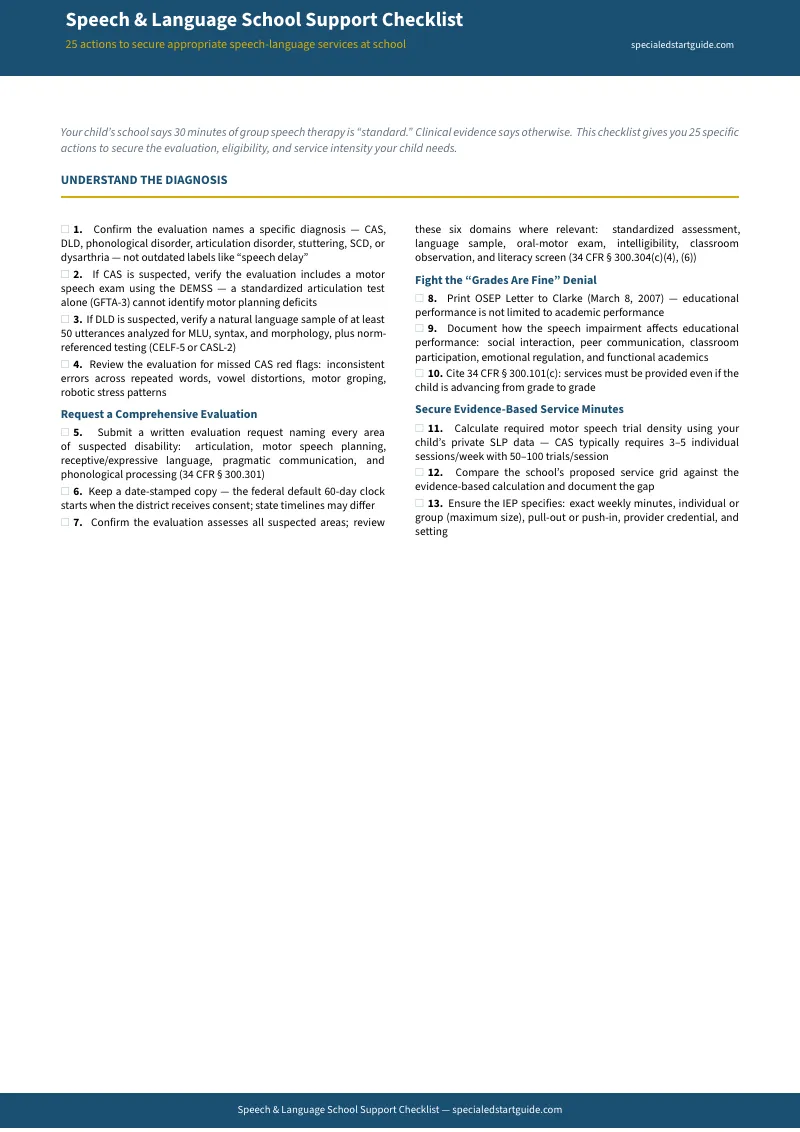
School teams use the same phrases in every district. "Her grades are fine, so she doesn't qualify." "We only offer group therapy — that's our standard model." "He needs to demonstrate readiness before we evaluate for an AAC device." "The medical diagnosis doesn't mean the school has to do anything." Each script gives you the specific federal regulation, the OSEP policy letter, or the case law citation that directly refutes the denial — formatted as a fill-in-the-blank response you bring to the meeting or send as a follow-up email. The "grades are fine" script alone cites 34 CFR § 300.101(c) and the Letter to Clarke, explaining that educational performance includes social interaction, functional communication, and classroom participation — not just test scores.
Dual-Perspective IEP Goal Bank
Teachers Pay Teachers sells SLP-authored goal banks written in clinical notation that only clinicians can parse. This goal bank is different. Every goal is presented in two columns: the measurable SMART goal in clinical language on the left, and a plain-English explanation of what the goal actually means for your child's day on the right. Goals cover seven domains — articulation, phonology, CAS motor planning, expressive and receptive language, AAC implementation, fluency, and social-pragmatic communication — with age-appropriate variants and sample baselines. You choose the goals that match your child's diagnosis, print the page, and bring it to the IEP meeting as a starting point for the team.
AAC Evaluation Request and Device Advocacy Templates
If your child is minimally speaking or severely unintelligible, the school is required to consider whether Assistive Technology is needed as part of the IEP — and "readiness testing" before evaluating for a speech-generating device violates the no-prerequisites standard endorsed by ASHA and ISAAC. The toolkit includes the formal AT/AAC evaluation request letter, the pushback script for when the school insists your child must "prove readiness" with low-tech picture cards first, and IEP goal templates for core vocabulary modeling, aided language input, and device access across settings including home use.
Six-Domain Evaluation Demand Checklist
Most school evaluations test too few areas and use the wrong instruments. The toolkit maps each diagnosis to the specific assessment battery the evaluation should include: DEMSS for motor speech, GFTA-3 for articulation, CELF-5 for language, a natural language sample of at least 50 utterances, a classroom observation, and a phonological processing screen when literacy is affected. When you submit your written evaluation request, you name every area of suspected disability explicitly — so the school cannot claim it assessed the child adequately by running a single articulation test.
Cross-Jurisdiction Legal Framework
One toolkit covering four legal systems. In the US: IDEA eligibility criteria, 34 CFR § 300.304 evaluation requirements, Prior Written Notice rights, IEE at public expense, state complaints, mediation, and due process. In England: EHCP Section F quantification requirements, the legal standard from L v Clarke & Somerset County Council establishing that speech therapy is educational provision, and appeal rights to the First-tier Tribunal (SEND). In Canada: provincial IEP processes and school board SLP service models. In Australia: Disability Standards for Education reasonable adjustments, NCCD adjustment levels, and the boundary between school obligations and NDIS-funded private therapy. The clinical arguments are universal; the legal delivery mechanisms are jurisdiction-specific.
Part C to Part B Transition Guide
When your child turns three, early intervention services end and the school district takes over. For many families, this transition is where speech therapy minutes collapse — from multiple weekly home-based sessions to one 30-minute school group. The toolkit covers the transition timeline, the evaluation requirements under Part B, how to document the service gap between what early intervention provided and what the school proposes, and how to use that documentation to argue for comparable service intensity in the preschool IEP.
Who This Toolkit Is For
- Parents whose child has a private diagnosis of Childhood Apraxia of Speech (CAS) and is being offered inadequate school speech therapy — 30 minutes a week in a group, consultation-only tracking, or no services at all
- Parents told their child "does not qualify" for speech services because grades are at or near grade level — even though the child cannot be understood by peers, avoids speaking in class, or struggles with social communication
- Parents of children with Developmental Language Disorder (DLD) whose structural language deficits are dismissed because the child can hold a conversation — masking comprehension gaps, syntax errors, and written language breakdowns that compound every year
- Parents of minimally speaking or non-speaking children who have been denied an AAC evaluation, told their child must "demonstrate readiness" before accessing a speech-generating device, or given only low-tech picture boards when a robust AAC system is clinically indicated
- Parents of preschoolers about to transition from Part C early intervention to Part B school services — facing a proposed IEP that offers a fraction of the therapy minutes their child currently receives
- Parents in the UK whose child's EHCP Section F says "access to speech and language therapy as required" — vague wording that is unenforceable and allows the Local Authority to reduce or withdraw services without notice
- Parents in Australia navigating the divide between NDIS-funded private therapy and school-based adjustments under the Disability Standards for Education — when the school insists that speech support is "an NDIS matter, not a school matter"
- Parents who cannot afford $150 to $300 per hour for a professional special education advocate and need to self-advocate effectively at IEP meetings
Why Not Free Resources?
Free speech and language resources exist in volume. They are also generic, clinician-facing, and structurally unable to arm parents for an adversarial IEP meeting. Here is where each one stops short:
- ASHA publishes gold-standard clinical descriptions of CAS, DLD, AAC, and articulation milestones — but ASHA is professionally neutral toward school districts and does not instruct parents on how to legally challenge a service allocation that ignores the evidence base. ASHA tells you what CAS is. It does not give you the service-intensity worksheet to prove that 30 minutes a week in a group is clinically indefensible.
- Apraxia Kids offers IEP roadmap webinars and parent guides from the leading CAS non-profit — but the content is scattered across separate PDF downloads and web articles, without fillable templates, without a service-minute calculator, and without the pushback scripts a parent needs when the school team says "that's our standard delivery model." Apraxia Kids validates the clinical need. This toolkit operationalizes it.
- Wrightslaw is the gold standard for US special education law — and its archive of OSEP policy letters on grades and eligibility is invaluable. But Wrightslaw covers all disabilities broadly in 400 pages of legal narrative. You cannot extract a CAS motor trial calculation, a DLD assessment checklist, or an AAC device request letter from a legal reference library the night before a meeting.
- Teachers Pay Teachers sells SLP-authored goal banks for $3 to $30 — written in clinical notation for clinicians managing caseloads, not for parents challenging district decisions. These products assume the child is already receiving services and the question is which goals to target. They offer zero advocacy guidance for the parent whose child has been denied services entirely.
- Speech and Language UK (formerly I CAN) and RADLD offer excellent clinical awareness resources for UK and international families — but neither provides the legal-grade templates specifically needed for drafting enforceable EHCP Section F provision or appealing unquantified therapy wording to the First-tier Tribunal.
Free resources explain what speech disorders are. This toolkit gives you the clinical calculations, legal citations, and word-for-word scripts to force the school to deliver the services the evidence demands.
— Less Than Ten Minutes of a Private Speech Therapy Session
Private speech-language therapy costs $150 to $250 per session in the US, £60 to £100 in the UK, and $150 to $200 AUD in Australia. Most families with a child with CAS or DLD spend thousands per year on private therapy to supplement what the school refuses to provide. A single consultation with a professional special education advocate costs more than this entire toolkit. An attorney retainer for due process starts at $3,000 to $5,000 and can exceed $50,000.
This toolkit provides the same clinical evidence framework, legal citations, and advocacy scripts that professional advocates use — so you can handle most school disputes yourself and reserve professional help for situations that genuinely require legal representation.
Your download includes the complete 54-page guide, the printable checklist, and seven standalone worksheets and reference cards you can print and bring to meetings:
- Speech-Language & Apraxia IEP Toolkit (guide.pdf) — 13 chapters covering clinical profiles and diagnostic categories, comprehensive evaluation demands, eligibility arguments against grade-based denials, the CAS motor speech service-intensity worksheet, AAC evaluation requests and device advocacy, dual-perspective IEP goal bank across seven domains, classroom accommodation menus, Part C to Part B transition guidance, UK EHCP and Australian DSE frameworks, Canadian provincial IEPs, dispute resolution and escalation, and international cross-reference tables
- Speech & Language School Support Checklist (checklist.pdf) — 25-item action checklist covering evaluation demands, "grades are fine" denial response, evidence-based service minutes, AAC access, accommodation essentials, and three pushback scripts ready to use at the next meeting
- CAS Motor Speech Service-Intensity Worksheet (service-intensity-worksheet.pdf) — fillable worksheet to calculate your child's required motor practice trials and compare them against the school's offer
- Seven Pushback Scripts (pushback-scripts.pdf) — fill-in-the-blank responses for the seven most common school denials, each citing the regulation that refutes it
- Dual-Perspective IEP Goal Bank (iep-goal-bank.pdf) — eight goal templates with clinical SMART goals on the left and plain-English explanations on the right, plus a defective-goal spotter checklist
- AAC Evaluation Request (aac-evaluation-request.pdf) — formal request letter template, prerequisite-skills pushback script, and AAC IEP goal templates
- Six-Domain Evaluation Demand Checklist (evaluation-demand-checklist.pdf) — name every area of suspected disability in your written request so the school cannot claim a single test was comprehensive
- Accommodation Reference Card (accommodation-menu.pdf) — classroom accommodations by clinical profile with checkboxes and write-in space for IEP language
- Dispute Resolution Roadmap (dispute-resolution-roadmap.pdf) — Prior Written Notice checklist, IEE request checklist, three formal dispute paths compared, missed session tracking log, and key legal precedents
Full refund, no time limit. If it does not help, email [email protected] and you will get your money back.
Frequently Asked Questions
Is this just a list of IEP goals I can find on Teachers Pay Teachers?
No. TpT goal banks are written by SLPs for SLPs — clinical shorthand for clinicians managing documentation. This toolkit starts before the goals: it covers whether your child qualifies, how to fight a denial, how many minutes of therapy to request and how to justify that number with clinical evidence, and then provides goals in dual format — clinical language paired with a plain-English explanation of what each goal means for your child's classroom experience. The goal bank is one chapter in a 13-chapter advocacy system.
My child has DLD, not apraxia. Is this relevant?
Yes. Developmental Language Disorder has its own dedicated sections throughout the toolkit — evaluation instruments (CELF-5, natural language sampling), eligibility arguments specific to DLD (proving that subtle oral language deficits directly impair reading comprehension, written expression, and social communication even when grades appear adequate), service delivery models (direct push-in classroom support versus pull-out), and a goal bank covering syntax, morphology, narrative structure, and tier-2 vocabulary.
We already have an IEP but the service minutes were just cut. Does this help?
Yes. The toolkit includes a chapter on annual review service cuts — the scenario where the school reduces individual speech minutes or transitions your child from individual therapy to a group setting due to SLP staffing constraints. It covers how to use Prior Written Notice to document the change, how to challenge the reduction with clinical evidence, and the escalation path if the team refuses to restore services.
Is this legal advice?
No. This toolkit is an educational resource that helps parents understand and navigate the special education process. It provides legal citations, statutory references, and advocacy templates based on publicly available law. It is not a substitute for an attorney. A family heading to due process, a formal complaint hearing, or court should consider a special education attorney or advocate.