
Your Child Isn't "Behind." They're Being Failed by a Reading Program That Doesn't Work for Their Brain. This Toolkit Gives You the Intervention Matrix, IEP Goals, and Advocacy Scripts to Force What the Science Says Works.
Your child is smart. They can explain how volcanoes work, retell a movie scene-by-scene, argue why bedtime should be later with the persuasive clarity of a trial lawyer. But ask them to read the word "because" and they freeze. Three years into school, they are still guessing words from the pictures. The school keeps telling you "they'll catch up." They are not catching up. The gap is getting wider every semester, and the light in your child's eyes is going out.
You finally got a private evaluation. It confirmed what you already knew: dyslexia. You handed the report to the school expecting action. Instead, you got excuses. "They don't qualify — their grades aren't low enough." "We already have a reading program." "Let's wait and see how they respond to our interventions." Meanwhile, those "interventions" are the same leveled readers and guessing-from-context strategies that caused the problem in the first place.
The International Dyslexia Association publishes fact sheets explaining the neurobiology. Sally Shaywitz's Overcoming Dyslexia gives you 400 pages of science. Your state's dyslexia handbook provides flowcharts written for school administrators. None of them hand you the side-by-side comparison chart proving the school's reading program has no evidence base, the IEP goal you can copy word-for-word that targets phonemic decoding instead of speed-based guessing, or the exact email to send when the principal claims your child is "not low enough to qualify." Professional special education advocates who carry those tools charge $150 to $300 per hour. A private Orton-Gillingham tutor costs $113 per session — $4,400 per school year.
The Dyslexia Support & Reading Intervention Kit is the Structured Literacy Advocacy System — the complete tactical framework that translates the Science of Reading into the comparison matrices, copy-and-paste IEP goals, and adversarial meeting scripts that parents actually need when the school treats dyslexia as a patience problem instead of a teaching failure.
What's Inside the Toolkit
The Intervention Comparison Matrix
The school says they have a "research-based reading program." But is it Structured Literacy — or just Balanced Literacy with a new label? This side-by-side matrix evaluates Orton-Gillingham, Wilson Reading System, Barton, Lindamood-Bell, SPIRE, and Lexia Core5 across methodology, target population, training requirements, evidence ratings, and critical considerations. It also lists the programs that do NOT work for dyslexia — Balanced Literacy, three-cueing systems, leveled readers, colored overlays, vision therapy — with the specific research citations that prove it. Print this chart and slide it across the IEP table when the school claims their program is "evidence-based."
The Structured Literacy IEP Goal Bank
The school writes: "Student will improve reading comprehension to grade level." That goal is unmeasurable, untethered to any intervention methodology, and completely useless. The toolkit provides copy-and-paste IEP goals organized by skill domain — phonemic awareness, phonics and decoding, reading fluency, spelling and written expression, and reading comprehension — that specify measurable targets, accuracy criteria, and data collection methods. Every goal is designed to demand the explicit, systematic phonics instruction that the Science of Reading requires. It also includes a table of goals the school will propose and why you should reject each one.
The Curriculum Audit Checklist
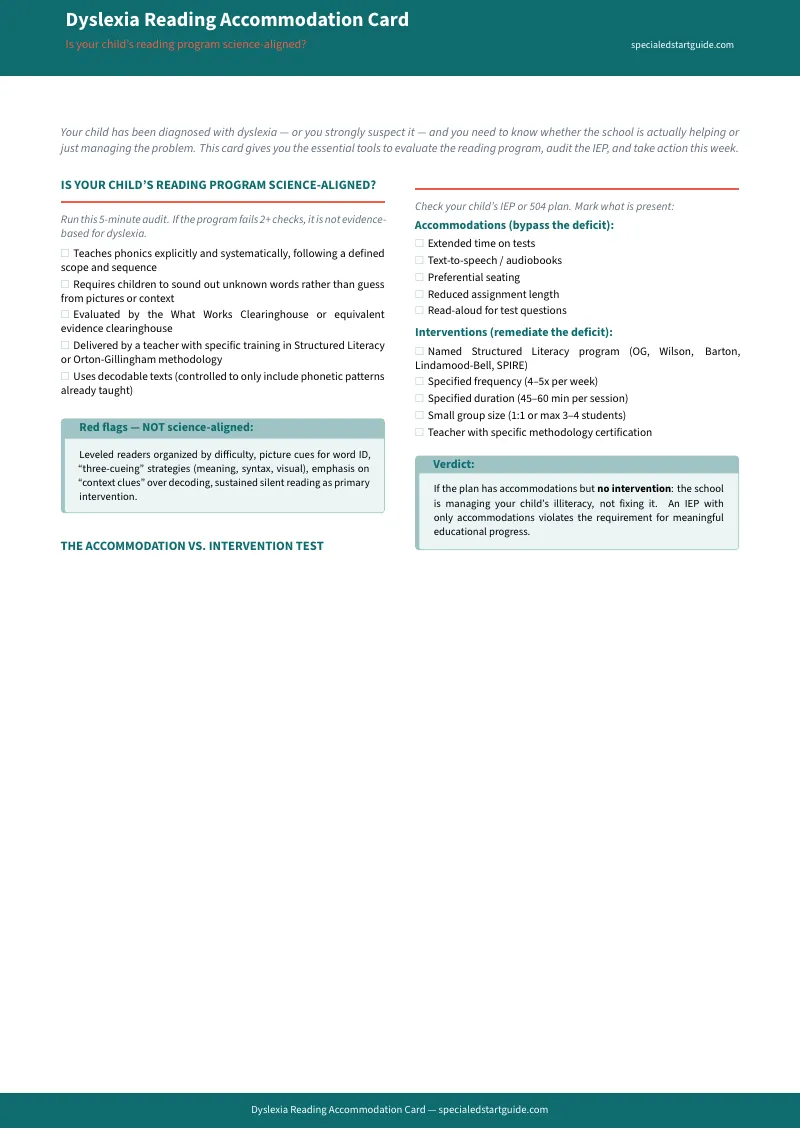
A five-minute printable tool to determine whether your child's reading program is aligned with the Science of Reading or still teaching them to guess. Five yes-or-no questions. If the program fails two or more, you have documented evidence that the intervention is not science-aligned — regardless of what the school calls it. Includes red flags to watch for: leveled readers, picture cues, "context clues" strategies, and sustained silent reading as a primary intervention.
Adversarial Pushback Scripts and Email Templates
Every major confrontation has a fill-in-the-blank template. The school refuses to evaluate? Here is the exact written request that triggers legal timelines, with the IDEA citation. The school says your child is "not low enough" for services? Here is the script citing Endrew F. v. Douglas County and your state's dyslexia legislation. The school insists on using Balanced Literacy? Here is the email demanding they provide the What Works Clearinghouse evidence rating for their program — knowing it does not exist. Each template includes follow-up language that turns verbal conversations into legal records.
The Stealth Dyslexia Exposure Guide
When a gifted child compensates so well that their reading comprehension scores look "average," the school denies services. This section teaches you exactly which evaluation instruments expose stealth dyslexia — the CTOPP-2 for phonological processing, the Pseudoword Decoding subtest for pure phonetic decoding ability — and how to present the discrepancy between cognitive potential and phonological processing to force the IEP team to explain how a child with severe decoding deficits is receiving an adequate education.
Cross-Jurisdiction Legal Framework
One toolkit covering four legal systems. In the US: IDEA, Section 504, state-by-state dyslexia legislation, and the Endrew F. standard. In the UK: SEND Code of Practice, EHCPs, and SEND Tribunal rights. In Canada: provincial education acts, the Ontario Human Rights Commission's Right to Read inquiry, and IPRC processes. In Australia: the Disability Discrimination Act, Disability Standards for Education, NCCD framework, and SPELD assessment pathways. Includes a terminology translation matrix so you know that an "IEP" in the US is an "EHCP" in the UK, an "ILP" in Australia, and has provincial variants across Canada.
Co-Occurring Conditions Coverage
Dyslexia rarely travels alone. The toolkit covers the 30-50% comorbidity rate with ADHD and the impact on executive function accommodations, dysgraphia and its distinct handwriting and encoding challenges, dyscalculia overlap, and the emotional toll — anxiety, school refusal, and the self-esteem devastation that comes from years of being told you are not trying hard enough.
High School, Testing, and Transition Planning
For older students: how to secure SAT/ACT accommodations with documentation, navigating the shift from IDEA (K-12) to Section 504 / ADA in college, self-advocacy frameworks for students old enough to speak at their own IEP meetings, and career planning that leverages dyslexic strengths in spatial reasoning, creative problem-solving, and entrepreneurial thinking.
Who This Toolkit Is For
- Parents who just got the dyslexia diagnosis and the school is telling them "we already have a reading program" — but that program is Balanced Literacy, leveled readers, or three-cueing strategies that actively contradict the Science of Reading
- Parents whose child has been stuck in a "wait to fail" loop — the school refuses to evaluate, insists on more time in RTI, or claims the child is "not low enough" for services despite a private diagnosis confirming dyslexia
- Parents with an IEP that lists only accommodations — audiobooks, extended time, read-aloud — and zero named Structured Literacy interventions targeting the actual phonological deficit
- Parents of "stealth dyslexic" children — bright kids who compensate so well that standardized comprehension scores mask severe decoding deficits — who need the specific evaluation instruments to expose the underlying disability
- Parents preparing for an IEP meeting who need copy-and-paste goals that specify decoding accuracy instead of vague "improve reading" language, and scripts for when the team pushes back
- Parents who discovered their child's school is using a reading curriculum with no evidence base — and need the comparison matrix, the audit checklist, and the advocacy letter to demand a change
- Parents in the US, UK, Canada, or Australia who need advocacy tools that work across jurisdictions with region-specific legal frameworks and terminology
- Parents who cannot afford $150 to $300 per hour for a professional educational advocate or $4,400 per year for a private Orton-Gillingham tutor — and need to self-advocate effectively
Why Not Free Resources?
Free dyslexia resources are well-intentioned and educational. They are also passive, theoretical, and carefully neutral toward the school systems that fail children daily. Here is where each one fails at the moment you need it most:
- The International Dyslexia Association defines the gold standard for structured literacy — but has a strict policy against evaluating or comparing specific commercial reading programs. The IDA will never tell you that Wilson Reading System is What Works Clearinghouse-validated while your school's program is not. This toolkit includes the comparison matrix that the IDA cannot publish.
- Sally Shaywitz's Overcoming Dyslexia is the definitive neurobiological reference — but it is a 400-page narrative book, not a tactical meeting tool. It explains how the dyslexic brain processes language. It does not give you the five-sentence email to send when the principal refuses to provide an intervention that addresses it.
- State dyslexia handbooks (Texas, Colorado) contain exact legal timelines and evaluation flowcharts — but they are 100-page compliance manuals written for school administrators. The Texas Dyslexia Handbook tells the school its obligations. This toolkit gives you the script to use when the school ignores them.
- SPELD Australia curates excellent decodable reader lists and at-home phonics tools — but lacks the adversarial scripts for when the school refuses adjustments. SPELD tells you what "reasonable adjustments" means under the DDA. This toolkit gives you the letter to send when the school claims the adjustments are unreasonable.
- The British Dyslexia Association provides broad parent awareness guides — but explicitly directs parents to external charities (IPSEA, SOS!SEN) for legal templates and EHCP tribunal documentation. The BDA tells you support exists. This toolkit puts the templates in your hands.
Free resources explain the science of dyslexia. This toolkit gives you the comparison matrices, IEP goals, and adversarial scripts to enforce it — at the table, in writing, in the meeting where your child's education is decided.
— Less Than Fifteen Minutes of an Educational Advocate's Time
Professional special education advocates charge $150 to $300 per hour to attend IEP meetings. A private psychoeducational evaluation costs $2,000 to $5,000. A private Orton-Gillingham tutor costs $113 per session — $4,400 for a basic nine-month school year, and up to $8,000 to $20,000 annually for intensive remediation. This toolkit provides the evaluation guidance, intervention comparison matrices, IEP goals, and advocacy scripts that professional advocates use — so you can handle most meetings yourself and only engage a professional for the cases that genuinely require legal representation.
Your download includes 10 PDFs — the complete guide plus 8 standalone printable tools and the free accommodation card:
- Complete Dyslexia Support & Reading Intervention Kit (guide.pdf) — 12 chapters covering why schools fail dyslexic readers, the neuroscience you need to win the argument, getting the right evaluation, evidence-based reading interventions with the comparison matrix, writing IEP goals that target decoding instead of guessing, accommodations vs. interventions, adversarial advocacy scripts for every denial scenario, international legal frameworks (US/UK/Canada/Australia), co-occurring conditions, high school and transition planning, building your documentation file, and a 30-day action plan
- Intervention Comparison Matrix (intervention-matrix.pdf) — Side-by-side analysis of Orton-Gillingham, Wilson, Barton, Lindamood-Bell, SPIRE, and Lexia Core5 with evidence ratings, dosage requirements, and the programs that do NOT work — print this and slide it across the IEP table
- Structured Literacy IEP Goal Bank (iep-goal-bank.pdf) — Copy-and-paste measurable goals organized by skill domain with checkboxes — select before your next IEP meeting
- Curriculum Audit Checklist (curriculum-audit.pdf) — A one-page 5-minute tool to determine whether the reading program is Science of Reading-aligned, with red flags to watch for
- Pushback Script Library (pushback-scripts.pdf) — Fill-in-the-blank email templates for every denial scenario: refused evaluations, "not low enough" dismissals, unvalidated programs, accommodation-only IEPs, and IEE requests — with statutory citations
- Cross-Jurisdiction Legal Framework (legal-framework.pdf) — Your rights across the US, UK, Canada, and Australia with a terminology translation guide mapping equivalent concepts across all four systems
- Accommodation vs. Intervention Audit (accommodation-audit.pdf) — A printable test to check whether the IEP has actual Structured Literacy intervention or only accommodations that bypass the deficit without fixing it
- 30-Day Action Plan (action-plan.pdf) — Week-by-week checklist from gathering intelligence to executing at the IEP meeting — print it and check items off as you go
- Documentation Tracker (documentation-tracker.pdf) — Fillable advocacy binder worksheet with communication log, progress monitoring tracker, and the follow-up email template that turns conversations into legal records
- Dyslexia Reading Accommodation Card (checklist.pdf) — A printable quick-reference with the 5-minute curriculum audit, the accommodation-vs-intervention test for auditing IEPs, 5 IEP goal red flags to reject, 5 questions to ask at the meeting, and 3 immediate next steps
Instant PDF download. Print the standalone tools before your next meeting. Walk in with the curriculum audit completed, the intervention matrix ready, the IEP goals selected, and the pushback scripts customized.
Money-back guarantee, no time limit. If the toolkit doesn't change how you advocate for your child's reading instruction, email us for a full refund.
Not ready for the full toolkit? Download the free Dyslexia Reading Accommodation Card — a printable quick-reference covering the curriculum audit, accommodation-vs-intervention test, IEP goal red flags, and meeting questions. It shows you what to look for — and the full toolkit gives you the comparison matrices, goal banks, and advocacy scripts to act on what you find.
Your child is not broken. The reading program that was supposed to teach them is broken — and the Science of Reading proves it. Now you have the tools to force the fix.