The report says "Average." The homework says otherwise.
Your child's achievement test came back — fifteen pages of clusters, composites, standard scores, percentiles, and a number called the Relative Proficiency Index that nobody bothered to explain. Broad Reading: 92. The eligibility team says that's within normal limits. But you watch your child struggle through every paragraph, guess at words they should know, and shut down when writing assignments land on the table.
You've searched for answers. Understood.org explained what a bell curve looks like. Wrightslaw covered the legal framework. Teachers Pay Teachers sold you a template designed for the psychologist writing the report, not the parent reading it. Reddit gave you fragments from parents guessing about their own child's scores. None of them answered the question that matters before Thursday's meeting: how can a child who cannot decode a two-syllable word score "Average" in Broad Reading — and what do I say to the team relying on that number to deny services?
The Composite Decoder: what the cluster scores are hiding
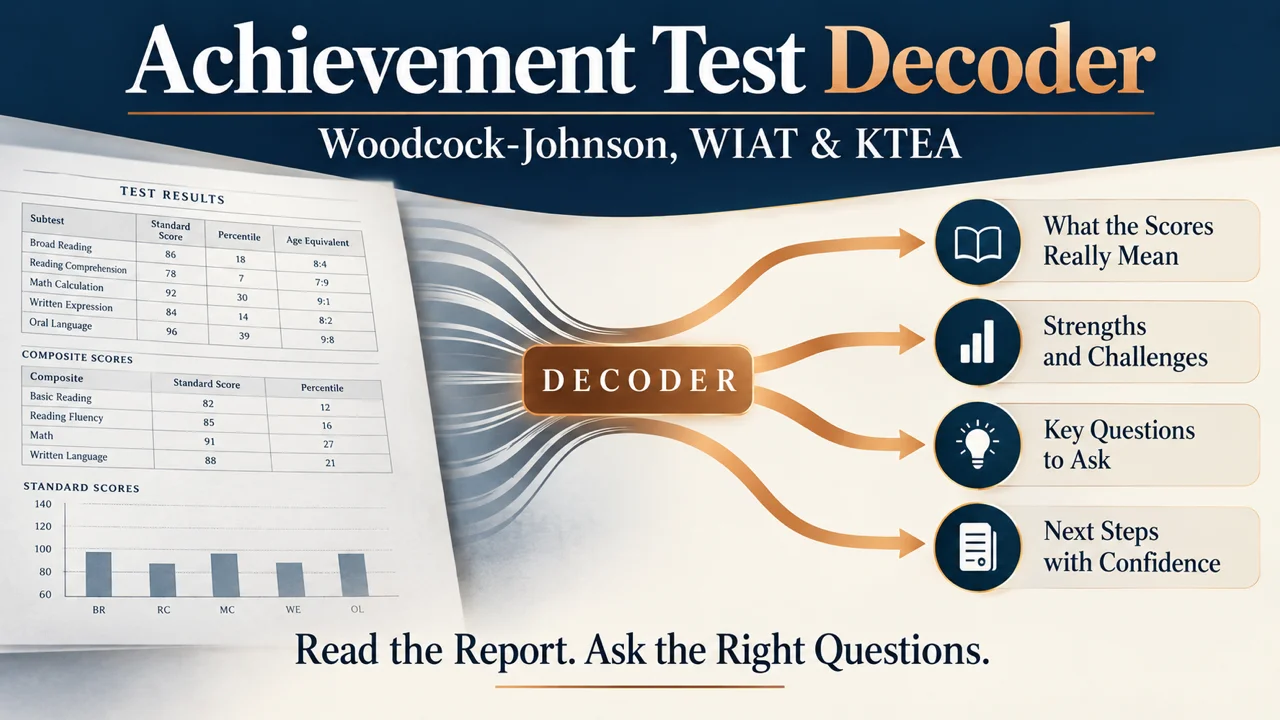
The Achievement Test Decoder is a cross-battery translation system covering the Woodcock-Johnson IV and V, WIAT-4, and KTEA-3 — the three test families that generate nearly every school-based and private achievement evaluation. It converts the clinical language on your child's report into three things: what each score means in plain terms, what the score pattern reveals about your child's learning profile, and what to say and request at the meeting based on exactly those numbers.
This is not a glossary of what "standard score" means — you can find that anywhere. This is the decoder that shows you how a strong vocabulary subtest inflates a Broad Reading cluster score while a severe decoding deficit hides underneath, identifies when timed and untimed scores diverge in ways that point to a processing problem, and gives you the evaluator questions and accommodation language that turn a passive eligibility meeting into a productive one.
What's inside
- All three major test batteries covered side by side — Woodcock-Johnson IV/V, WIAT-4, and KTEA-3, with each battery's clusters, composites, and subtests explained. Whichever test your child was given — or if the school used one battery and a private evaluator used another — the decoder covers both and shows you how to compare them directly.
- The composite masking walkthrough — how a strong oral comprehension or vocabulary subtest pulls a Broad Reading or Broad Written Language cluster into the "Average" range while phonemic decoding, spelling, or fluency subtests sit far below. The decoder shows you exactly how the math works and gives you the language to request subtest-level analysis when the composite is hiding the deficit.
- Timed versus untimed score splits — why your child might score at the 60th percentile on untimed word identification but drop to the 10th on a fluency measure, what that gap reveals about retrieval speed and processing, and how to present it as evidence of a disability that the untimed score alone would mask.
- The Relative Proficiency Index decoded — unique to the Woodcock-Johnson, the RPI predicts your child's mastery level when average peers demonstrate 90% proficiency. An RPI of 62/90 means your child will demonstrate 62% mastery on a task that typical peers complete at 90%. The decoder translates every RPI value into classroom terms and shows you how to use it when a standard score alone doesn't tell the story.
- Grade norms versus age norms — when and why evaluators switch between norm types, how the choice can make a retained or young-for-grade child's performance appear closer to expectations, and the specific question to ask when you suspect the norm selection flatters the score.
- Learning profile patterns — recognizable score combinations across all three batteries that point to dyslexia (speed/fluency subtype and compensated profile), dysgraphia, dyscalculia, and mixed profiles, with the specific subtest evidence that supports each identification and the interventions each pattern calls for.
- Subtest-to-deficit-to-intervention mapping — a cross-battery reference table connecting specific low subtests to suspected learning profiles, classroom impacts, and evidence-based instructional approaches including Structured Literacy, Orton-Gillingham, and multisensory math. Take it to the meeting and point to the intervention that matches the subtest result on your child's report.
- Four-jurisdiction eligibility frameworks — how achievement test scores feed into eligibility decisions under US (IDEA SLD categories, Section 504), UK (EHCP and SEND Support), Canadian (provincial IEPs, Ontario IPRC), and Australian (Disability Standards for Education, NCCD adjustments, NDIS funding context), with the procedural language and request templates each system expects.
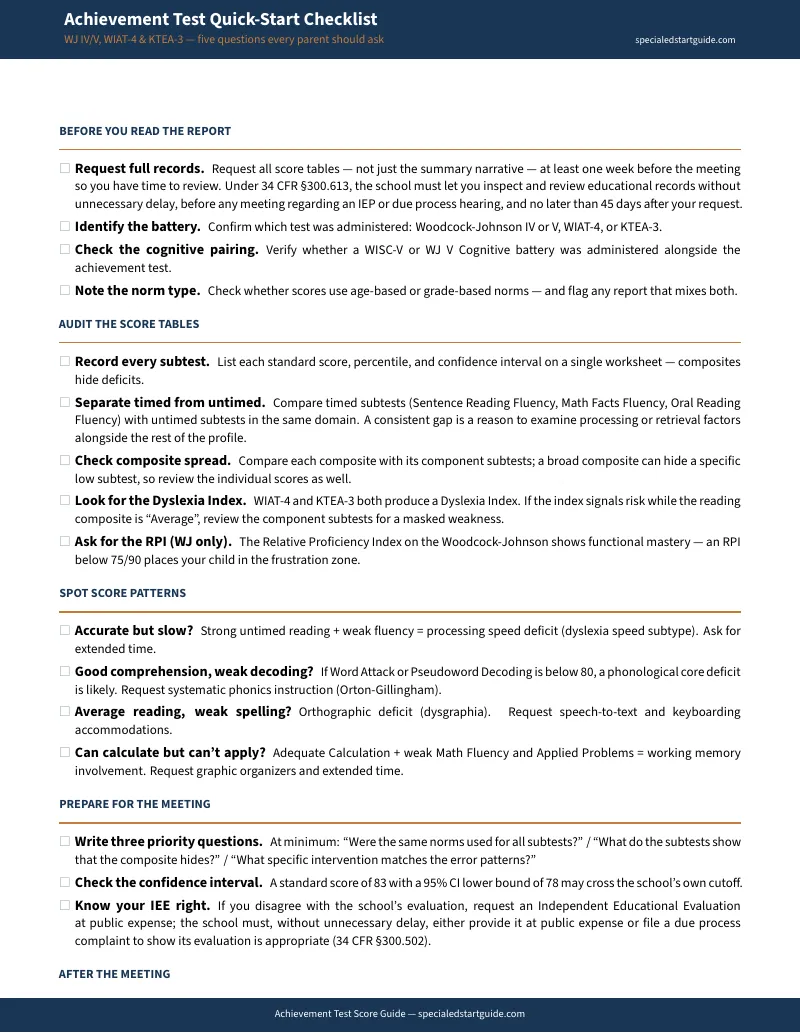
- The evaluator question list — targeted questions about composite construction, subtest scatter, norm selection, testing conditions, administration format, and whether the evaluator considered alternative score interpretations before writing the eligibility recommendation. Designed to be printed and brought to the meeting.
- Woodcock-Johnson V coverage — the February 2025 release with its digital-only iPad administration, post-pandemic norms, restructured clusters, and new subtests. Whether your child was tested on the WJ-IV or WJ-V, the decoder covers both editions and flags what changed between them.
Who this decoder is for
Parents holding an achievement test report they cannot fully interpret, with a school meeting approaching. Specifically:
- Your child's report shows Broad Reading 92 — "Average" — and the school says they're within normal limits, but the Word Attack subtest on page eight is 74, and the cluster score averaged it away
- The school tested with the Woodcock-Johnson and a private psychologist used the WIAT-4, the Broad Reading scores are fifteen points apart, and you don't know whether the gap is meaningful or a difference in test construction
- Your child scored well on untimed word identification but collapsed on every timed fluency measure, and the report describes this as "variable performance" without explaining what it means for instruction
- You've seen "Relative Proficiency Index 62/90" in the Woodcock-Johnson report and have no idea what it means or whether it helps your case
- You're outside the US — navigating EHCP provision in England, an IPRC in Ontario, or NCCD adjustments in Australia — and every resource you've found speaks only in IDEA and Section 504
- You've priced a private advocate at $150–$300 per hour and need to understand this report before the meeting, not six weeks from now when someone has an opening
Why free resources aren't solving this
Free sites explain what a standard score is and where it sits on a bell curve. They don't walk you through what happens when a strong vocabulary subtest inflates a Broad Reading cluster, hiding a severe phonological deficit underneath. Pearson's and Riverside's parent pages define their tests — deliberately neutrally, with no meeting strategy. Wrightslaw is rigorous but dense, heavily US-centric, and covers testing in broad legal terms rather than walking you through the specific subtests on your child's report. Teachers Pay Teachers sells templates designed for evaluators writing reports, not parents decoding them. The decoder replaces forty browser tabs with one structured walkthrough that connects scores to patterns to accommodations to meeting language.
What the decoder does not do
It does not provide a clinical diagnosis. It does not replace the psychologist who administered the test. It does not reproduce any proprietary test items, stimulus materials, or copyrighted norm tables. It gives you the interpretive framework and the meeting-ready language so you walk in prepared — knowing what every cluster, subtest, and proficiency index means, and exactly what to ask for when the composite score the school is relying on doesn't match what you see at home.
Format and guarantee
Instant PDF download. The paid kit includes the full decoder guide — a 57-page walkthrough of all three test batteries with cross-battery score tables, composite masking analysis, learning profile identification, subtest-to-intervention mapping, the evaluator question list, and planning worksheets — plus the checklist and standalone printables. The free Achievement Test Score Guide — a printable single-page reference with score types, common subtests across all three batteries, and five evaluator questions — is available as a standalone download, no purchase required.
Full refund, no time limit. If the decoder doesn't change how you read the report, email [email protected].
The meeting is this week. The report is in your hands. The decoder turns those numbers into the questions and requests that change the outcome.
Get the Achievement Test Decoder →
Already have the free Achievement Test Score Guide? Get the full decoder here →