You've got the application meeting next week. The SENCO mentioned "functional evidence." Your child's psych report is 14 pages of percentiles. And nobody has explained what the verifiers are actually looking for.
The Ongoing Resourcing Scheme is the highest tier of learning support in New Zealand — specialist teachers, therapist time, and teacher aide hours for students with the most significant ongoing needs. About 12,100 students receive it. Getting there means satisfying at least one of nine criteria, evaluated by a panel of three independent Ministry of Education verifiers. If they cannot decide from the information provided, two verifiers may visit the school to observe your child.
The Ministry publishes the criteria. Schools submit the application. But between those two facts is a gap wide enough to lose months of work in: the gap between listing a diagnosis and demonstrating functional classroom need.
That gap is where applications fail. Verifiers don't reject applications because a child isn't struggling. They reject them because the evidence doesn't show the struggle in the specific functional language the criteria require. A 14-page psychometric report might demonstrate severe cognitive delays — and still not address a single ORS criterion, because the criteria ask about what happens in the classroom, not what a test score says.
The Criterion Mapping System: nine criteria, translated into the evidence verifiers actually need
The ORS Decoder takes each of the nine criteria and breaks it down into the functional evidence categories verifiers evaluate. Instead of reading dense Ministry policy and guessing what counts, you get a structured mapping between daily classroom reality and the official threshold language — so you can help the school team build an application that speaks the verifiers' language from the start.
This isn't a form-filler or an application template. Schools handle the submission through the Education Sector Logon. This is the translation layer between your child's daily experience and the bureaucratic framework that decides whether they get support.
What's inside
- Nine criteria decoded — each one explained in plain language with the functional evidence verifiers look for, what distinguishes "high needs" from "very high needs" at each level, and the common reasons applications fall short of the threshold
- Evidence mapping worksheets — structured templates to organise observations, specialist reports, and classroom examples against each criterion area before the school submits
- Application process walkthrough — who submits, what goes in the application, how the three-verifier panel reviews it, what happens when verifiers cannot decide from the application, and what the timeline looks like
- Decision letter reading framework — a step-by-step method for analysing a decline letter, identifying which criteria lacked sufficient evidence, and structuring the conversation with the school about next steps
- Funding mechanics explained — what ORS actually provides at each needs level, with two worked examples showing how Pourato staffing entitlements translate into real teacher and specialist hours in the classroom
- Review, reapplication and Section 47 appeal guide — the three options when an application is declined, what each process involves, timelines, and when each one is worth pursuing
- Alternative support map — a side-by-side comparison of In-Class Support, the School High Health Needs Fund, RTLB services, Early Intervention, and the Intensive Wraparound Service for families who need support but may not meet the ORS threshold
- Budget 2025 policy landscape — what the $645.8 million operating investment and forecast of more than 1,700 additional ORS learners by 2028/29 mean for the families applying now
- Meeting preparation checklists — structured question lists for IEP meetings, ORS planning sessions, and post-decision conversations with the school team
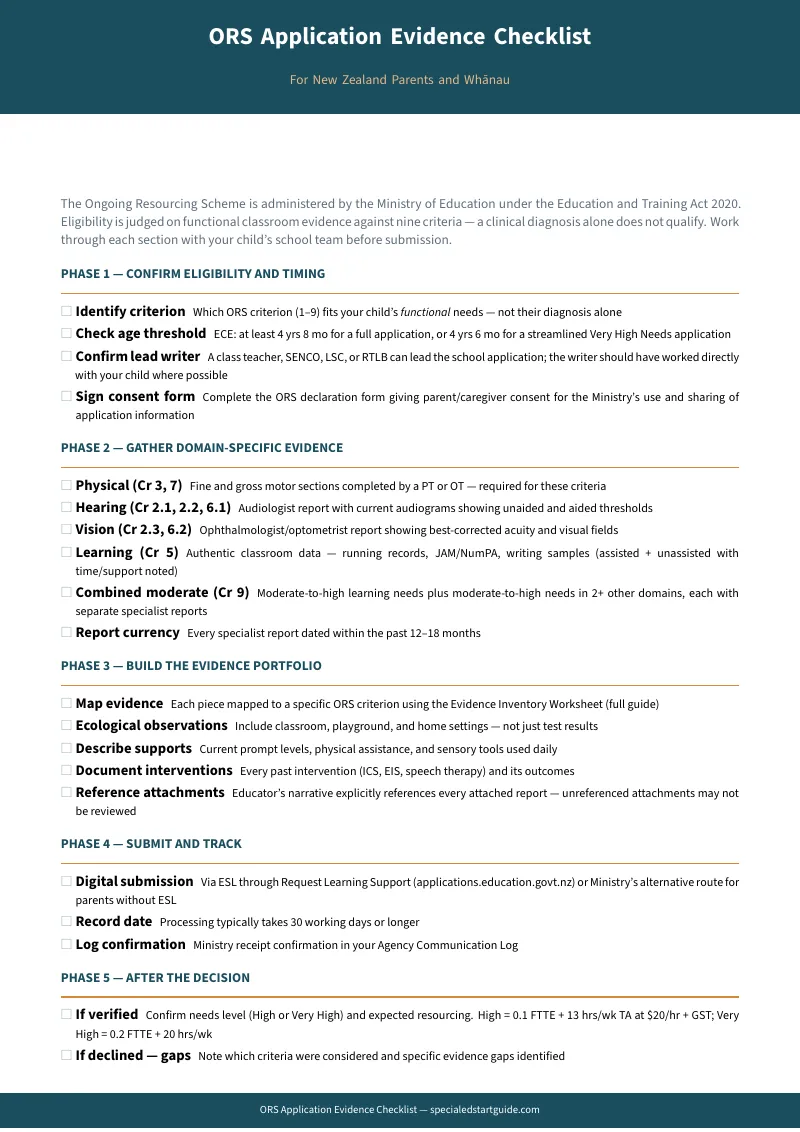
Plus the free ORS Application Evidence Checklist — a two-page overview of the five criteria areas, the evidence an application typically needs, and the steps after a decision. Useful on its own as a quick reference before a school meeting.
Who this is for
- Parents preparing an ORS application with the school — you want to understand the criteria before the SENCO starts gathering evidence, so your family can contribute meaningfully and make sure nothing critical is missed
- Families whose application was declined — you've received a decision letter and need to work out what the verifiers found, whether a review or reapplication makes sense, and what alternatives exist
- Whānau supporting a child through the process — grandparents, extended family, or foster parents who need a plain-language reference for school meetings and planning conversations
- Parents of young children transitioning to school — a specialist has suggested ORS may be appropriate and you want to understand what the process involves before it starts
Why not just use the Ministry website?
The Ministry of Education publishes the ORS criteria and application rules. Those pages are written for school administrators and learning support professionals, not for a parent trying to understand why the verifier panel might consider a speech-language report insufficient evidence for Criterion 5.
Free international resources — Understood, Wrightslaw, TPT templates — are built around US federal law (IDEA, Section 504) or UK frameworks (EHCPs). They have no bearing on New Zealand's Education and Training Act 2020, the ORS verification process, or the Ministry's functional evidence requirements.
AI tools will give you a summary. They'll also confuse ORS criteria with NDIS categories, hallucinate a "30-day guarantee" that doesn't exist, and mix up the Ministry of Education's learning support with the Ministry of Social Development's Disability Support Services. The specifics matter when your child's support depends on them.
This guide sits in the space between the official rules and the school meeting — translating policy into the structured, plain-language preparation that helps you show up knowing what to ask and what the evidence needs to demonstrate.
Satisfaction guarantee
Full refund, no time limit. If the guide doesn't help, email [email protected] and we'll refund you — no form, no deadline, no conditions.
Frequently Asked Questions
Will this guide tell me whether my child qualifies for ORS?
No. Eligibility is decided by an independent verifier panel based on functional evidence specific to your child. The guide explains the criteria, shows what strong evidence looks like, and gives you worksheets to organise that evidence with the school — but no resource can predict a verifier panel's decision.
My child has a formal diagnosis. Does that guarantee ORS funding?
No. The Ministry of Education is explicit: cognitive assessments and medical diagnoses are not required for ORS verification and do not guarantee it. Verifiers assess functional need in the classroom. A diagnosis may support an application, but it doesn't replace functional evidence.
Can I use this for an early learning ORS application?
The guide focuses on school-age applications (Years 1–13). The criteria framework is the same for early learning, but the application forms and submission process differ. The evidence-mapping principles and criteria explanations apply to both pathways.
Is this guide affiliated with the Ministry of Education?
No. Special Ed Start Guide is an independent publisher. This guide has no affiliation with the Ministry of Education, any school, or any test publisher. It translates publicly available policy into plain-language tools for families.
What if our application was already declined?
The guide includes a decision letter reading framework and a full chapter on the three options after a decline — informal review, reapplication with new evidence, and the formal Section 47 appeal process. It's designed to be useful whether you're preparing a first application or responding to a decline.
How current is the information?
The guide reflects the Education and Training Act 2020, current Ministry of Education ORS criteria and application processes, and Budget 2025 learning support commitments including the forecast of more than 1,700 additional learners accessing ORS by 2028/29.
Frequently Asked Questions
What if the rules change after I buy?
We update the guide when the rules change. Email us any time, even years later, and we'll send you the current edition free.