
The School Relies on You Not Knowing What Section 34 Actually Says.
You sat in the IEP meeting while the SENCO explained that funding hasn't come through yet and the school is "doing its best with limited resources." You asked why your child is only attending until midday and the principal said something about safety concerns and staffing shortages. You went home and Googled "special education rights New Zealand." You found the Ministry of Education website. You read about the Ongoing Resourcing Scheme. You found IHC's advocacy toolkit — last updated around 2015. You opened Community Law's manual on school problems. You read the Ombudsman's case notes on suspensions. Twelve browser tabs later, you still couldn't answer the question that brought you here: what exactly do I say to the principal tomorrow morning?
Then you found the Facebook groups. VIPS — Equity in Education NZ. Other parents posting the same desperate questions at 11 PM: "Is the school allowed to send my kid home at noon every day?" and "Can they really refuse to enrol my autistic son?" You discovered you are not alone. You also discovered that nobody in those groups has a clear, step-by-step answer — because the legal information is scattered across six different government websites, none of which were designed to tell you what to do when the school breaks the law.
The New Zealand Special Education Parent Rights Compass is a legal enforcement system that maps the five statutes protecting your disabled child — the Education and Training Act 2020, the Human Rights Act 1993, the NZ Bill of Rights Act 1990, the Privacy Act 2020, and the Official Information Act 1982 — directly to the school situations where those rights are being violated. It gives you the exact legal citations, the fill-in-the-blank complaint templates, and the six-step escalation pathway from your first email to the principal through to the Human Rights Review Tribunal, so you stop asking whether the school is breaking the law and start proving it in writing.
What's Inside the Guide
Five Statutes, One Reference — The Legal Arsenal You Actually Need
Right now, you'd need to cross-reference the Ministry of Education website, the Community Law manual, the Human Rights Commission guidelines, and the Ombudsman's case notes to piece together your child's full legal protections. This guide synthesises all five statutes into a single source: Section 33 (free education), Section 34 (equal rights for disabled students), Section 42 (the only lawful reduced timetable mechanism), Sections 79-89 (formal discipline), Section 47 (Ministry decision appeals), Section 57 of the Human Rights Act (disability discrimination in education), and the Privacy Act provisions that let you access every record the school holds about your child.
Section 34 Decoded — The Law the School Hopes You Never Read
Section 34 of the Education and Training Act 2020 is the single most important provision in New Zealand education law for parents of disabled children. It says students with special educational needs have the same rights to enrol, attend, and receive education as students without special educational needs. That one word — "attend" — means the school cannot send your child home at midday because the teacher aide called in sick. It means the school cannot limit your child to mornings only because of a funding shortfall. It means the school cannot tell you a different school would be "better equipped." This chapter shows you exactly how to cite Section 34 in every scenario where the school tries to circumvent it.
Informal Exclusions — The Illegal Practice Schools Don't Put in Writing
The phone call at 11 AM asking you to collect your child because "we can't guarantee safety." The "suggestion" that your child stay home until the new teacher aide starts. The camp invitation that never arrives. These are Kiwi Suspensions — informal exclusions that bypass every legal safeguard in the Education and Training Act. They are unlawful, but schools rely on the fact that most parents don't know this. This chapter gives you the documentation system, the verbal response scripts, and the Board of Trustees complaint template that transforms each instance from an off-the-record phone call into a paper trail the school cannot deny.
IEP Meetings — From Bulldozed to Prepared
You walk in expecting collaboration. The SENCO, the RTLB, and the principal present a unified front. Goals are vague. Timelines are missing. Your input is acknowledged and then ignored. The principal claims he has the "last say." This chapter gives you the pre-meeting data requests under the Privacy Act, the agenda-setting framework that prevents the school from controlling the conversation, the SMART goal standards your child's IEP should meet, and the follow-up email template that documents exactly what was agreed — so the school cannot claim next term that "we never said that."
ORS Funding — Eligibility, Applications, and the Section 47 Appeal
The Ongoing Resourcing Scheme funds the highest-needs students, but the criteria are opaque and the application process favours schools that know the system. If your child's application was declined, you have the right to a formal reconsideration under Section 47 — led by an independent arbitrator, not the Ministry official who made the original decision. This chapter walks you through ORS eligibility criteria, the application process, the Supplementary Learning Support alternative, and the Section 47 appeal pathway step by step.
The Escalation Blueprint — Six Steps From Your Principal's Office to the Human Rights Review Tribunal
A verbal complaint to the principal is air. A written complaint citing the Education and Training Act is a legal liability. This chapter maps the entire escalation funnel: (1) Principal, (2) Board of Trustees formal complaint, (3) Ministry of Education, (4) Office of the Ombudsman for administrative failures, (5) Human Rights Commission for disability discrimination, and (6) Human Rights Review Tribunal for binding decisions and financial damages. Each step includes the filing requirements, expected timeframes, what evidence you need, and the exact template to use.
Discipline and Disability — Challenging Suspensions for Behaviour Your Child Cannot Control
A sensory meltdown is not gross misconduct. A dysregulated response to inadequate accommodation is not continual disobedience. When schools suspend children for disability-related behaviour, they breach both the Education and Training Act and the Human Rights Act. This chapter explains the formal stand-down and suspension process, the caps (five days per term, ten per year), the Board of Trustees meeting requirements, and the grounds for challenging any disciplinary action where the school failed to provide reasonable accommodation before resorting to punishment.
NCEA Special Assessment Conditions
If your child is approaching NCEA, they may be entitled to Special Assessment Conditions — reader/writer assistance, extra time, rest breaks, separate accommodation, use of a computer, or alternative assessment formats. This chapter covers the eligibility criteria, the evidence requirements, the application process through the school's SAC coordinator, and what to do if the school delays or fails to apply.
Privacy Act Requests — Your Transparency Weapon
Under Information Privacy Principle 6, you can access every record the school holds about your child: KAMAR entries, teacher notes, pastoral care records, SENCO files, internal emails, incident reports, IEP documents, and Ministry records. The school must respond within 20 working days. If those records contain inaccuracies — an incident report that blames your child for a meltdown caused by inadequate support — Principle 7 gives you the right to demand a correction. This chapter includes the Privacy Act request template and the correction request template.
Legal Templates — Fill In the Blanks and Send Tonight
Nine fill-in-the-blank templates citing the specific legislation for each situation: enrolment enforcement letters, informal exclusion complaint to the Board of Trustees, IEP dispute letters, ORS appeal submissions, Privacy Act data requests, Official Information Act requests, Ministry of Education complaints, Ombudsman complaints, and Human Rights Commission complaints. Replace the bracketed details with your child's information. Send by 8 AM.
Culturally Responsive Advocacy for Māori and Pasifika Whānau
Te Tiriti o Waitangi imposes obligations on schools that go beyond the Education and Training Act. Section 127 requires every school Board to give effect to Te Tiriti. Māori and Pasifika disabled students face compounding barriers — cultural bias layered on top of disability discrimination. This chapter addresses tikanga-informed advocacy strategies, the role of whānau hui, and how to invoke Te Tiriti obligations when the school's cultural competence is failing your child alongside its legal obligations.
Who This Guide Is For
- Parents whose school is sending their child home early, reducing their timetable, or asking them to "stay home until the aide starts" — and who need to know that this is illegal under Section 34
- Parents about to walk into an IEP meeting where the school will set the agenda, propose vague goals, and claim the principal has the final say
- Parents whose child has been suspended or stood down for behaviour that is a direct manifestation of their disability
- Parents whose child was discouraged from enrolling at a state school because of their disability — nearly 30% of disabled children experience this
- Parents whose ORS application was declined and who don't know they have the right to a formal Section 47 reconsideration
- Parents who've been told "we don't have the funding" and need to know the legal difference between a funding shortfall and disability discrimination under the Human Rights Act
- Māori and Pasifika whānau navigating a system that compounds cultural bias with disability discrimination
- Parents in rural New Zealand — Gisborne, Whakatāne, Kaikōura, Gore — where there is one school, no local advocate, and no margin for the relationship to break down
- Parents approaching NCEA who need to secure Special Assessment Conditions before the application deadline passes
Why Not Just Use the Free Resources?
The Ministry of Education website explains the system's rules. IHC's advocacy toolkit gives general life-span guidance. Community Law's manual outlines legal rights in plain language. The Human Rights Commission provides discrimination guidelines. None of them tell you what to say when you are standing in the school reception at 11 AM and the deputy principal is insisting you take your child home.
- The Ministry of Education advises you to "start with an informal discussion." That delays legal documentation. This guide starts with putting everything in writing — because verbal promises vanish and written complaints create legal obligations.
- IHC's Advocacy Toolkit covers 25 life topics. Education is one section. It was last substantially updated around 2015 — before the Education and Training Act 2020 replaced the 1989 Act, before the 2025 IHC settlement validated everything parents have been saying for decades. This guide is built entirely on current law.
- Community Law explains where to complain. This guide gives you the exact words to put in the complaint — fill-in-the-blank templates with the specific statutory citations that force a formal response.
- Wrightslaw and US guides dominate search results. They reference IDEA, Section 504, and FAPE — none of which exist in New Zealand law. Quoting American statutes in a Board of Trustees meeting destroys your credibility. This guide cites the correct New Zealand legislation.
- An education lawyer charges $300+ for an initial consultation and $400+ per hour after that. This guide gives you the legal framework, escalation pathway, and correspondence templates that education lawyers and professional advocates use — for less than the cost of a takeaway dinner.
Free resources tell you what the law says in theory. This guide gives you the exact words, templates, and escalation strategy to use when the school breaks that law in practice.
— Less Than 15 Minutes With an Education Lawyer
A specialist education lawyer in New Zealand charges $300+ for an initial consultation and $400+ per hour ongoing. A private advocate charges $100 to $150 per hour. Ninety percent of school disputes resolve when a parent simply demonstrates they know the law. This guide gives you the legal knowledge to resolve disputes at the school level — before you need to spend thousands in legal fees.
Your download includes 5 PDFs, instant download:
- The New Zealand Special Education Parent Rights Compass (13 chapters) — five statutes decoded with section-by-section analysis, Section 34 enforcement strategies, informal exclusion documentation system, IEP meeting preparation and follow-up framework, ORS funding guide with Section 47 appeal pathway, NCEA Special Assessment Conditions, discipline and disability protections, Privacy Act and OIA request guides, the six-step escalation blueprint from principal to Human Rights Review Tribunal, nine fill-in-the-blank legal templates, culturally responsive advocacy for Māori and Pasifika whānau, ECE rights and post-16 transitions, and a complete support organisation directory
- Advocacy Letter Templates — nine standalone fill-in-the-blank templates extracted from the guide, ready to print: enrolment enforcement, informal exclusion complaint, IEP dispute, ORS appeal, Privacy Act request, OIA request, Board of Trustees complaint, Ministry complaint, and Ombudsman complaint
- Escalation Pathway Quick Reference — the six-step complaint pathway on a printable card: who to contact at each stage, what to include, expected timeframes, and the trigger for escalating to the next level
- Key Contacts Reference Card — every advocacy organisation, free legal service, and statutory oversight body in one printable page: phone numbers, websites, and what each organisation helps with
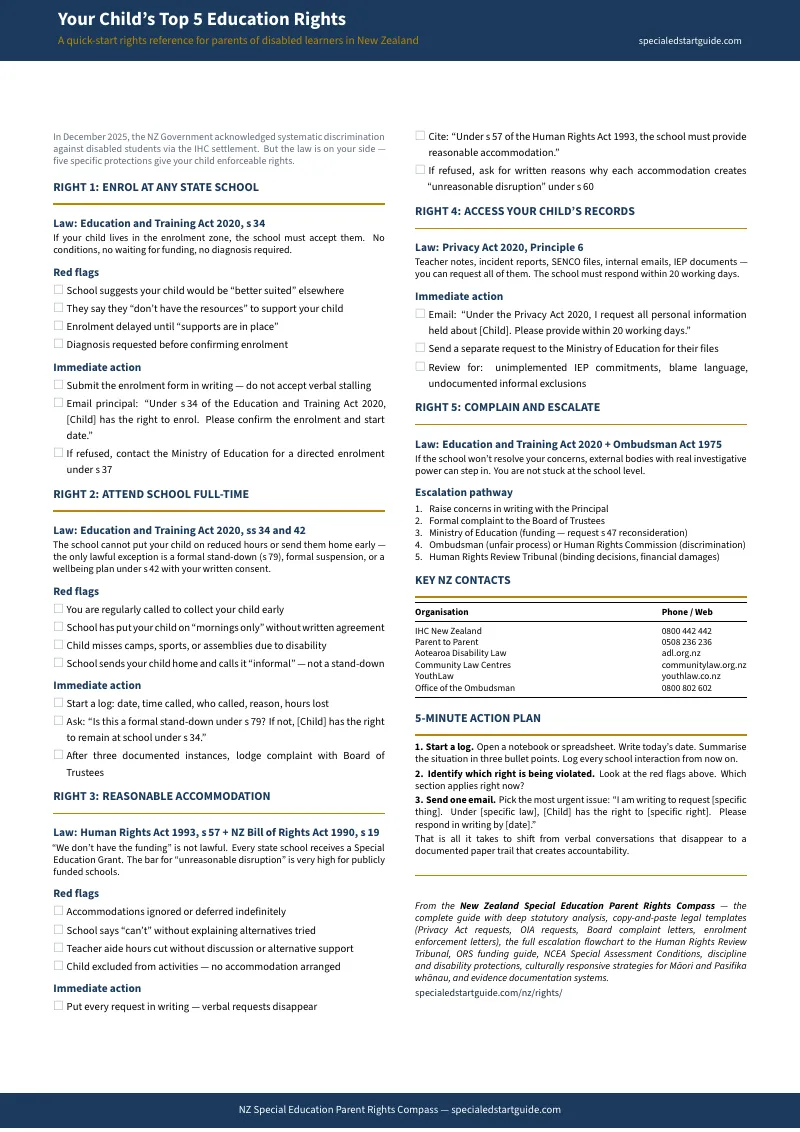
- Your Child's Top 5 Education Rights Under NZ Law (free) — a quick-start rights checklist covering the five core legal protections, red flags for each right, immediate actions, the escalation pathway overview, and key support contacts across New Zealand
Instant PDF download. Fill in a complaint template tonight. Send it before your next school meeting.
Money-back guarantee, no time limit. If this guide doesn't change how you navigate the school system, email us for a full refund. No questions asked.
Not ready for the full guide? Download the free Your Child's Top 5 Education Rights Under NZ Law — a rights checklist covering the five core legal protections under the Education and Training Act 2020 and the Human Rights Act 1993, with red flags that indicate a violation, immediate actions for each right, and support contacts. Enough to walk into your next meeting knowing your rights. Free.
The next time a school says "we don't have the funding," you'll know exactly what Section 34 says — and where to send the letter when they don't listen.