
The IEP Says "Improve Social Skills." The ORS Application Was Declined. The SENCO Can't Meet You Until Next Term. This Blueprint Gives You the Exact Tools to Fix All Three Tonight.
You've been sitting in IEP meetings where the goals say things like "will improve her social skills" and "will make progress in reading" — phrases that commit the school to nothing measurable, create no accountability, and give you nothing to point to when your child is still struggling next term. You've asked the SENCO for more support and been told the Special Education Grant is already spent. You've applied for ORS funding and been declined with a form letter that didn't explain which of the nine criteria your child failed to meet.
Meanwhile, the RTLB has a six-week waitlist. The teacher aide hours keep getting reallocated. And you're Googling "IEP goals New Zealand" at 10pm, finding American resources about 504 Plans and IDEA that have zero relevance to your child's school.
Here's the structural problem: New Zealand has excellent free resources that explain what an IEP is and what your rights are in principle. Parent to Parent publishes a wonderful booklet. The Ministry of Education has pages of guidelines. Autism NZ covers diagnosis pathways. But none of them hand you the actual tools — a goal bank written for the New Zealand Curriculum, the specific ORS verification criteria with evidence formatting advice, the email template that cites Section 34 of the Education and Training Act 2020 when the school asks your child to stay home because the aide is absent.
The New Zealand ORS & Learning Support Blueprint is the single, tactical playbook that fills that gap. Not philosophy. Not policy summaries. The actual scripts, goal banks, checklists, and escalation pathways that private educational advocates charge $150–$210 per hour to deploy on your behalf — formatted so you can use them at the kitchen table tonight.
What's Inside the Blueprint
NZ Curriculum-Aligned IEP Goal Bank
The Ministry tells parents to "contribute to goal setting." It doesn't hand you examples. This guide provides ready-to-use SMART goals mapped to the New Zealand Curriculum (Levels 1–4) and Key Competencies — Managing Self, Relating to Others, Participating and Contributing. Each goal follows the formula: "Given [adjustment], [child] will [specific action] [measurable criterion] by [date], as measured by [method]." Bring three printed goals to your next meeting and you'll be the most prepared person in the room — because vague goals like "will improve behaviour" cannot survive a direct comparison with specific ones.
The ORS Application Strategy
ORS funding supports roughly 1.4% of New Zealand students. The application process is opaque, and the verification panel uses nine specific criteria that the Ministry publishes but doesn't explain in tactical terms. This guide breaks down exactly what the verifiers look for — how to document frequency, intensity, and duration of needs, how to format the evidence portfolio, and why successful ORS applications must focus on deficits rather than the strength-based narrative schools prefer. When the application is declined, the guide maps the reconsideration process step by step.
The Vague-Goal Audit
Open your child's current IEP and scan it against the audit checklist. Every goal that says "improve," "develop," or "make progress" without a specific skill, a measurable criterion, a timeline, and a named measurement method is a goal that protects the school from accountability. The audit identifies these phrases and provides the specific replacement language to request at the next review. A vague IEP is not just unhelpful — it's evidence of a system that isn't actually planning for your child.
Communication Templates That Cite the Right Laws
Four cut-and-paste letter templates, each loaded with the specific New Zealand legal citations that transform a "concerned parent email" into a formal record that triggers obligations. Request an IEP meeting (citing the school's duty under the Education and Training Act 2020). Request a Privacy Act disclosure of all records held about your child. Escalate to the Board of Trustees when agreed accommodations aren't being implemented. Follow up on undelivered IEP commitments with a deadline and a paper trail. These aren't American templates with the terminology changed — they address New Zealand schools, cite New Zealand legislation, and follow New Zealand escalation procedures.
The Escalation Pathway
When the school says "we're already doing everything we can," you need to know the next step immediately. The guide maps the complete New Zealand escalation pathway: Principal → Board of Trustees → Ministry of Education Regional Office → Education Review Office → Human Rights Commission → the Ombudsman. Each step includes who to contact, what evidence to present, what the body can actually compel, and when to escalate further. Most parents never need to go past Step 2 — because a school that knows you understand the pathway responds differently.
NCEA Special Assessment Conditions (SAC)
If your child is in Years 11–13, SAC accommodations — reader-writer support, extra time, separate rooms, use of a computer — can be the difference between NCEA achievement and NCEA failure. The guide explains which accommodations are available, who can apply, what evidence is required, and the application timeline schools must follow. Many parents don't know SAC exists until it's too late in the academic year to apply.
Culturally Responsive IEPs Using Te Whare Tapa Whā
IEPs written only through an academic lens miss the holistic needs that New Zealand's own health and education frameworks recognise. The guide shows how to frame goals using Te Whare Tapa Whā (taha tinana, taha hinengaro, taha wairua, taha whānau) and Ka Hikitia – Ka Hāpaitia, ensuring your child's IEP reflects all dimensions of their wellbeing — not just the ones that fit neatly into a school timetable.
Accommodations by Disability Type
Specific classroom strategies and IEP accommodations for Autism/sensory processing, ADHD/executive function, Dyslexia, Dysgraphia, Intellectual Disability, and Twice-Exceptional (2e) learners. Not generic suggestions — each section provides the language to write into the IEP so the accommodation becomes a documented commitment, not a verbal understanding that evaporates when the teacher changes.
Who This Blueprint Is For
- Parents whose child's IEP contains vague goals like "will improve social skills" or "will make progress in literacy" — and who need the exact replacement language to demand measurable, time-bound targets
- Parents whose ORS application was declined and who were told their child is "not high-needs enough" — but who receive no support for the "missing middle" where mainstream is failing without funding
- Parents who have been told the school has "no funding left" for teacher aide hours — and who need to understand how the Special Education Grant works and what In-Class Support funding the school may not have applied for
- Parents whose SENCO or LSC is wonderful but stretched across 40+ students and cannot meet more than once a term — leaving you to navigate the system alone between meetings
- Parents who've been Googling "IEP resources NZ" and finding American products about 504 Plans, IDEA, and Common Core that have zero relevance to the New Zealand Curriculum or the Education and Training Act 2020
- Parents approaching the Early Childhood to Primary or Primary to Secondary transition who know the wrap-around support disappears and need to prepare before it happens
- Parents who've been asked to keep their child home because the teacher aide is absent — and who need the legal citation that makes this indefensible
- Whānau members, grandparents, and support people attending IEP meetings who want to understand the system before they walk in
Why Not Just Use the Free Resources?
New Zealand has genuinely excellent free resources for families navigating learning support. Here's why parents still struggle after consulting all of them:
- The Ministry of Education website explains how the system is supposed to work — not what to do when it doesn't. MoE guidelines present IEPs as harmonious, collaborative documents. They don't acknowledge that schools frequently use vague language to avoid accountability, or that SENCOs are systemically overloaded. The Blueprint gives you the tactical tools for when the system stalls — because that's when you actually need help.
- Parent to Parent provides outstanding philosophical guidance — without done-for-you templates. Their IEP Booklet advises you to "be prepared to discuss goals." It doesn't provide a goal bank with 80+ SMART goals already written for the NZ Curriculum. The Blueprint gives you the finished examples you can adapt and bring to the meeting tomorrow morning.
- Autism NZ and IHC offer essential macro-level advocacy — without the granular meeting tools. They do extraordinary work challenging the system at a structural level. But when you need to draft an email to the SENCO tonight about unimplemented accommodations, you need a template with legal citations, not a policy paper. The Blueprint is the day-to-day execution manual.
- Etsy and Teachers Pay Teachers sell IEP planners written for the United States. References to "504 Plans," "due process hearings," and "Common Core Standards" have zero legal standing in New Zealand. An American goal bank aligned to Common Core doesn't help you write goals for the NZ Curriculum Key Competencies. The Blueprint uses exclusively New Zealand terminology — ORS, RTLB, SENCO, LSC, IWS, SAC, NZC — because that's the system you're navigating.
The free resources explain what the law says. This Blueprint gives you the tools to make the school follow it.
— Less Than 15 Minutes With a Private Educational Advocate
Private educational advocates in New Zealand charge $150–$210 per hour. A comprehensive cognitive assessment from a private educational psychologist costs upwards of $1,800. Many families spend $80–$210 just for a single advocacy consultation. The strategies in this Blueprint are the same administrative levers those professionals use — the same legal citations, the same goal-writing frameworks, the same escalation pathways — formatted so you can use them at the kitchen table without a billable clock running.
Your download includes the complete Blueprint guide plus 8 standalone reference tools, each ready to print and bring to your next meeting:
- Complete Blueprint Guide (guide.pdf) — 15 chapters covering the NZ legal framework, the Learning Support system hierarchy, ORS application strategy, IEP goal writing with a full NZ Curriculum-aligned goal bank, culturally responsive IEPs, accommodations by disability type, NCEA Special Assessment Conditions, SESTA transport, transitions, advocacy strategies for common scenarios, the escalation pathway, meeting preparation, communication templates, and support networks
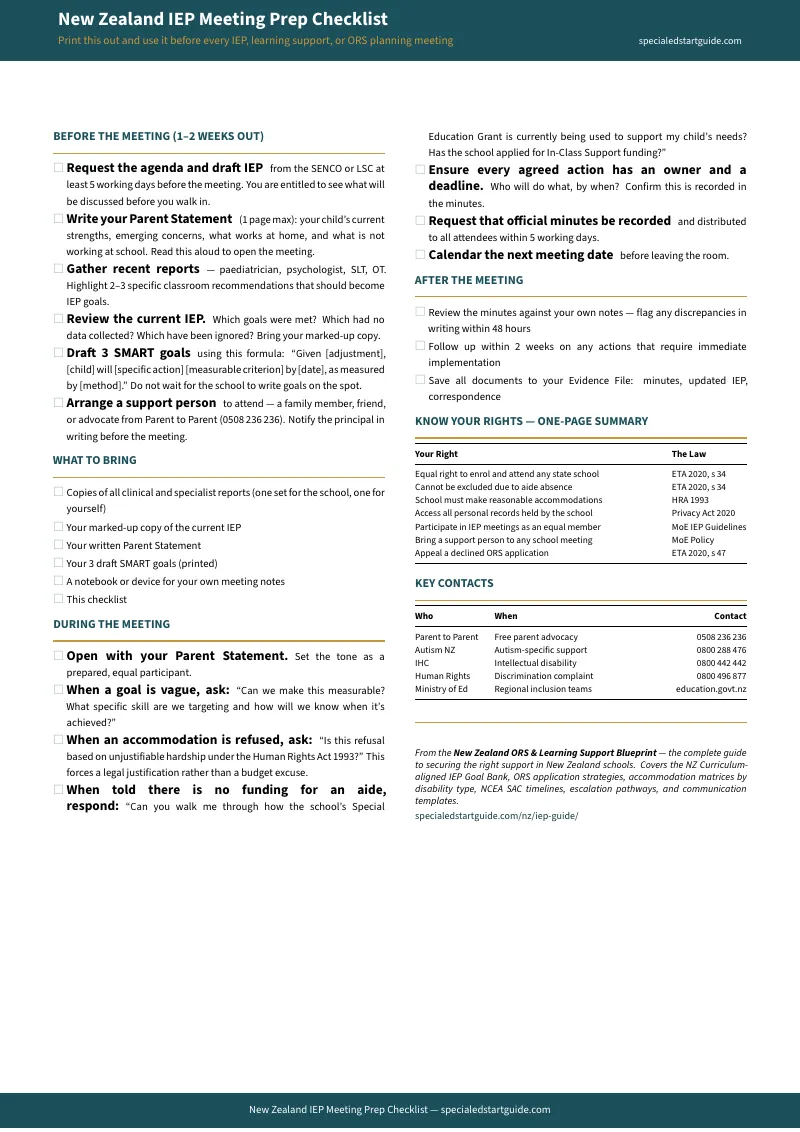
- IEP Meeting Prep Checklist (checklist.pdf) — the before/during/after checklist, your rights one-page summary, the vague-goal audit questions, key legal citations, and the escalation ladder
- NZ Curriculum-Aligned IEP Goal Bank (goal-bank.pdf) — SMART goals mapped to NZC Levels 1–4 organised by domain: Literacy, Numeracy, Social-Emotional, Communication, and Functional Independence
- Vague-Goal Audit Checklist (vague-goal-audit.pdf) — the five-question test to scan your child's current IEP, red flag phrases to challenge, and the exact replacement language to use at the meeting
- Communication Templates (communication-templates.pdf) — 4 cut-and-paste letters pre-loaded with NZ legal citations: IEP meeting request, Privacy Act disclosure, Board of Trustees escalation, and unimplemented accommodations follow-up
- Dispute Escalation Pathway (escalation-pathway.pdf) — 6-step ladder from Principal to the Ombudsman with evidence requirements, response times, and "escalate when" triggers for each step
- ORS Application Checklist (ors-checklist.pdf) — the full evidence portfolio guide, the 9 verification criteria, the Deficit Paradox, and the appeal process with critical deadlines
- Accommodations by Disability Type (accommodations-matrix.pdf) — specific IEP language for Autism, ADHD, Dyslexia, Dysgraphia, Intellectual Disability, and 2e learners, organised by Environment, Instruction, and Assessment
- NCEA Special Assessment Conditions (sac-guide.pdf) — the SAC application guide for Years 11–13 with available accommodations, evidence requirements, deadlines, and escalation steps when the school refuses
- Transition Planning Timeline (transition-timeline.pdf) — ECE to Primary, Primary to Secondary, and Post-School transition checklists with critical dates and action steps
Instant PDF download. Print the checklist tonight. Walk into tomorrow's meeting with the law, the data, and the specific goals already written.
Money-back guarantee, no time limit. If the Blueprint doesn't change how you approach IEP meetings, email us for a full refund. No questions asked.
Not ready for the full Blueprint? Download the free IEP Goal Examples for New Zealand Students — a printable checklist covering what to prepare before IEP meetings, questions that force accountability during the meeting, your rights under NZ law, and the escalation pathway. It's enough to walk into your next meeting prepared, and it's free.
Your child's education isn't a favour the school grants when the SEG budget allows. It's a legal right backed by the Education and Training Act 2020, the Human Rights Act 1993, and the Privacy Act 2020. After tonight, you'll know exactly how to enforce it.