
Your Child's Assessment Report Is 20 Pages Long. Nobody Told You What Any of It Means.
You paid $2,500 for a private educational psychologist. Or you waited five months for the Ministry's specialist to appear. Either way, you are now holding a clinical report full of terms like "Processing Speed Index," "Fluid Reasoning," and "Working Memory in the 5th percentile" — and you have no idea what any of it means for the classroom. The SENCO glanced at the report, said "we'll take this on board," and nothing changed. The teacher is still doing the same thing she was doing before the assessment. Your child is still falling behind.
Or you are at the other end of the pipeline — you cannot even get the assessment. The SENCO said your child would be referred to the RTLB cluster "this term." That was two terms ago. You called the Ministry's regional office and were told the wait is six months. You searched online and found dozens of guides — all written for American IEP law that does not apply in Aotearoa. You found the Ministry of Education website. It told you to start with a "casual conversation" with the teacher. You have already had the casual conversation. It did not work.
The New Zealand Special Education Assessment Decoder is a clinical translation and advocacy system that covers the full assessment landscape — from your first request letter to the Human Rights Commission. It translates WISC-V and WJ-V cognitive reports into plain English, maps every score to the specific classroom accommodations it justifies, gives you the ORS application strategy that verifiers actually respond to, walks you through the Section 47 appeal when ORS is declined, and provides the fill-in-the-blank letter templates that cite the Education and Training Act 2020 so administrators recognise you as someone who understands the system — not someone they can manage with a waitlist.
What's Inside the Assessment Decoder
The Legal Foundation You Cite in Every Letter
Section 34 of the Education and Training Act 2020 gives your child the right to receive education on the same basis as students without special needs. That is not a suggestion — it is a statutory obligation. The guide covers the three critical sections, the Human Rights Act 1993 anti-discrimination protections, the Privacy Act 2020 for requesting school records, and the IHC inclusive education settlement that strengthened enforcement. Every template in the guide is built on this legal foundation.
The Full Assessment Pipeline — Who Does What, in What Order
SENCOs, RTLBs, Learning Support Coordinators, Ministry regional teams, early intervention specialists. The referral pipeline has at least four handoff points where your child's case can stall for weeks or months. This chapter maps the entire chain — who refers to whom, what the expected timelines are, and the specific correspondence to send when a referral disappears into the system.
Every Assessment Type Available in New Zealand
Cognitive (WISC-V, WJ-V), educational achievement, speech-language, occupational therapy, behavioural (Conners, BRIEF-2), and autism-specific (ADOS-2). Each assessment type includes what it tests, who conducts it, the specific tools used in New Zealand, realistic costs, typical wait times, and when to request it. You will never again wonder which assessment your child actually needs.
The Report Decoder — The Chapter No Free Resource Provides
Standard scores, percentiles, confidence intervals, and the five cognitive indexes: Verbal Comprehension, Visual Spatial, Fluid Reasoning, Working Memory, and Processing Speed. Each index translated into plain English. What a low Processing Speed Index actually means for the classroom — your child is not slow, their brain processes output at a different rate, and the school must accommodate that. How to identify the specific scores that trigger SAC eligibility. How to spot when a report buries a significant finding in clinical language. This is the chapter that turns a $2,500 report from a piece of paper into leverage.
Translating Assessment Data Into IEP Goals and Accommodations
The missing step between receiving a report and seeing change in the classroom. How to convert "Working Memory Index in the 5th percentile" into a measurable IEP goal with specific classroom strategies. Template language the school cannot dismiss as vague. The SENCO can no longer claim the report "doesn't tell us what to do" — because you will show them exactly what it says.
The ORS Application Strategy
The nine criteria, what evidence verifiers actually evaluate (not what the brochure says), the most common reasons applications fail, the difference between High and Very High needs categories, and how to structure classroom observation narratives using frequency data that verifiers find compelling. ORS funds just 1.4% of the school population. This chapter ensures your child's application does not fail because the evidence was presented in the wrong format.
What to Do When ORS Is Declined
The review process, how to request formal reconsideration, the Section 47 appeal under the Education and Training Act 2020, and the independent arbitration process. Step by step, with the specific evidence categories that overturn rejections. If the school has given up after one declined application, this chapter shows you the pathway the school never mentioned.
Funding Beyond ORS
The Special Education Grant every school already receives, RTLB services, Interim Response Funding for crisis situations, the School High Health Needs Fund, and Learning Support Coordinators. Many parents fight for ORS without knowing the school has untapped funding it is already required to spend on students with additional needs.
Private Assessment — When to Go Private and the Critical Detail Most Parents Miss
How to ensure a private report is structured in a way the Ministry's ORS verification panel will accept. Registration verification on the NZ Psychologists Board register, current assessment tools (WISC-V not WISC-IV), school observation requirements, SAC-specific report formatting, and a cost comparison across provider types. If you are paying $1,800 to $3,500 for an assessment, this chapter ensures the money is not wasted on a report the system will not accept.
Special Assessment Conditions for NCEA
How to secure extra time, reader/writers, computer use, and other provisions through NZQA. The application timeline, the assessment evidence required, the difference between school-managed and NZQA-approved accommodations, and what to do when the school says your child "doesn't need" SAC despite the clinical data showing a Processing Speed Index below the 10th percentile.
Culturally Responsive Assessment
Te Whare Tapa Wha for Maori learners, Tapasa for Pasifika learners, and why standardised cognitive tools normed on overseas populations may underrepresent your child's actual capabilities. How to request culturally appropriate assessment and ensure reports reflect the full picture — not just a Western psychometric snapshot.
Six Fill-in-the-Blank Letter Templates
Formal assessment request, ORS evidence compilation cover letter, SAC application support letter, Section 47 appeal notice, Privacy Act information request, and Board of Trustees escalation. Each template cites the specific legislation and Ministry policy frameworks. Replace the bracketed details with your child's information. Send before your next school meeting.
The Evidence-Tracking System
The documentation architecture that builds an unassailable record across multiple agencies and years. What to save, how to organise it, and how to compile it when the time comes for an ORS application, SAC request, or formal dispute. Every email, every report, every meeting note — filed in a structure that makes your next application or appeal impossible to dismiss.
Who This Guide Is For
- Parents whose child was referred to the RTLB cluster two terms ago and nothing has happened — and who do not know whether to wait, escalate, or pay for a private assessment
- Parents who received a private educational psychology report and cannot translate "Verbal Comprehension Index 85, Processing Speed Index 72" into what the teacher should actually do differently on Monday morning
- Parents whose ORS application was declined — nobody at the school seems to know why, nobody has mentioned Section 47, and the school is saying "try again next year"
- Parents of secondary students approaching NCEA who need SAC accommodations but the school has not initiated an application and says the assessments are "not recent enough"
- Parents who called the Ministry's regional office and were told the wait for a specialist assessment is six months — while their child falls further behind every week
- Parents who found assessment guides online and everything references IDEA, Section 504, and FAPE — none of which applies in Aotearoa
- Maori and Pasifika parents whose child was assessed with tools normed on overseas populations — and who suspect the results do not reflect their child's actual capabilities
- Rural parents in the Waikato, Bay of Plenty, Southland, or the West Coast — where the nearest private educational psychologist is a two-hour drive and the public system cannot physically reach them
- Parents who have been told "your child's needs are not severe enough" but cannot get a straight answer about how the school's Special Education Grant is being spent
Why Not Just Use the Free Resources?
The Ministry of Education website explains how to seek help for children with learning support needs. IHC provides an advocacy toolkit. Parent to Parent offers IEP preparation guides. Autism NZ publishes navigation guides for the disability support system. None of them tell you what to do when the assessment report arrives and you cannot read it.
- The Ministry of Education advises you to "start with a casual conversation." That delays written documentation. This guide starts with putting everything in writing — because verbal promises disappear and written requests create legal obligations under the Education and Training Act.
- IHC's Advocacy Toolkit covers general disability rights across the lifespan. Educational assessment is one topic among dozens. It does not include a WISC-V report decoder, ORS verifier evidence requirements, or SAC application strategies. This guide covers nothing but assessment and what you do with the results.
- Parent to Parent provides IEP templates and meeting preparation. Excellent for the meeting itself — but they do not cover the step before the IEP: getting the assessment done, understanding the report, and translating the clinical data into goals the school cannot dismiss as vague.
- International guides dominate search results. They reference IDEA, 504 Plans, and state-specific IEP mandates. Citing American legislation in a New Zealand school meeting signals you are working from the wrong country's rules. This guide is built entirely on the Education and Training Act 2020, the ORS framework, and NZQA.
- A private educational psychologist charges $1,800 to $3,500 for the assessment. They do not attend IEP meetings on your behalf, do not apply for ORS, and do not file SAC applications. This guide is the companion to the assessment you already paid for — it turns the report from a piece of paper into funded support.
Free resources describe how the system should work. This guide tells you what to do when it does not — with the exact letter templates, report translations, and escalation strategies to make it move.
— Less Than 30 Minutes With a Private Educational Psychologist
A private educational psychologist in New Zealand charges $1,800 to $3,500 for a full assessment. An independent education advocate charges $46 to $69 per hour. Ninety percent of assessment disputes resolve when a parent demonstrates they understand the clinical data, the funding criteria, and the legal framework. This guide gives you that understanding — for less than the cost of a family takeaway dinner.
Your download includes 8 PDFs, instant download:
- The New Zealand Special Education Assessment Decoder (13 chapters) — the legal foundation (Education and Training Act 2020, Human Rights Act, Privacy Act), the full assessment pipeline from SENCO to Ministry, every assessment type available in New Zealand with costs and wait times, the WISC-V and WJ-V report decoder in plain English, translating assessment data into IEP goals, the ORS application strategy with Section 47 appeal process, funding beyond ORS, private assessment evaluation, Special Assessment Conditions for NCEA, culturally responsive assessment for Maori and Pasifika learners, and the dispute resolution pathway from the classroom to the Human Rights Commission
- Report Decoder Reference Card — a two-page printable reference with the standard score system, percentile ranks, all five cognitive indexes with classroom impacts, and common discrepancy patterns. Print it and hold it next to your child's assessment report.
- Assessment Advocacy Letter Templates — all six fill-in-the-blank letters as a standalone printable: assessment request, interim adjustments, Ministry escalation, private assessment consideration, Privacy Act records request, and formal complaint. Each cites the specific legislation.
- ORS Evidence Compilation Checklist — a one-page printable checklist of the ten evidence categories the ORS verification panel requires. Bring it to the SENCO and check off each item before submission.
- Assessment Pipeline Quick Reference — a one-page map of the three-level pipeline (SENCO → RTLB → Ministry) with timelines, key actions at each stage, and the parallel strategies that prevent lost months.
- Evidence Tracking Worksheet — a printable communication log, timeline tracker, and document filing checklist. The system that builds an unassailable advocacy record over time.
- Pre-Assessment Information Gathering Worksheet — complete before any assessment appointment (Ministry or private). Five categories of information the assessor needs, with space to write your answers.
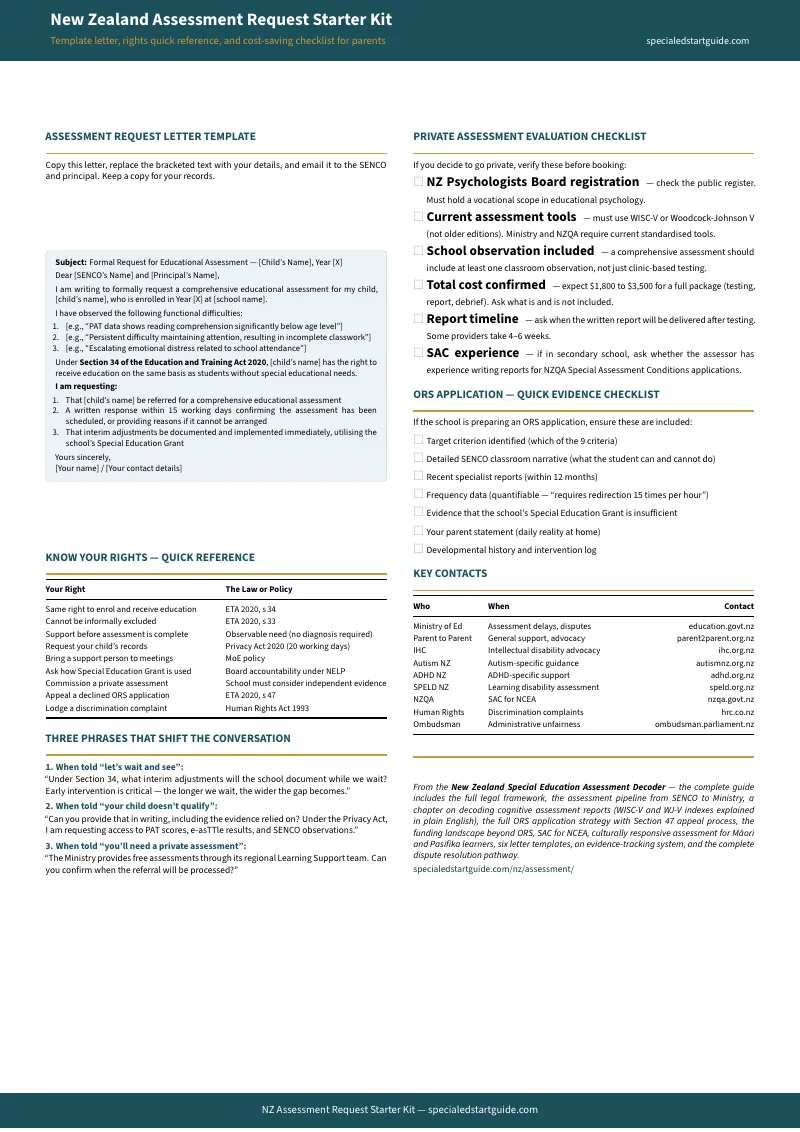
- Assessment Request Starter Kit (free) — a ready-to-send template letter for requesting assessment, a quick-reference rights table, three phrases that shift the conversation when the school pushes back, a private assessment evaluation checklist, and an ORS evidence quick checklist
Instant PDF download. Send the assessment request letter tonight. Decode the report you already have tomorrow.
Money-back guarantee, no time limit. If the Assessment Decoder does not change how you navigate your child's assessment journey, email us for a full refund. No questions asked.
Not ready for the full guide? Download the free Assessment Request Starter Kit — a template letter citing Section 34, a rights quick reference, three phrases for common pushback, and a private assessment evaluation checklist. Enough to take action this week. Free.
The report is not the end. It is the beginning — but only if you know how to read it, what it entitles your child to, and where to send the letter when the school does nothing with it.