Your child is out of school. The clock is running. You need a system.
A phone call from the principal. A letter with statutory language you have never seen before. Your child is at home, the board hearing is days away, and every free resource you find tells you what the rules say — but none of them gives you a structured way to respond.
The school has a process. The board has a procedure manual. The principal has a report. And right now, you have a stack of unanswered questions and a deadline you cannot afford to miss.
The First-Week Crisis Control System
The New Zealand Stand-Down, Suspension and Exclusion Guide for Parents is an immediate, printable organisational system that walks you through the entire school discipline process under the Education and Training Act 2020 — from the day your child is sent home through the board hearing, the outcome, and your review options.
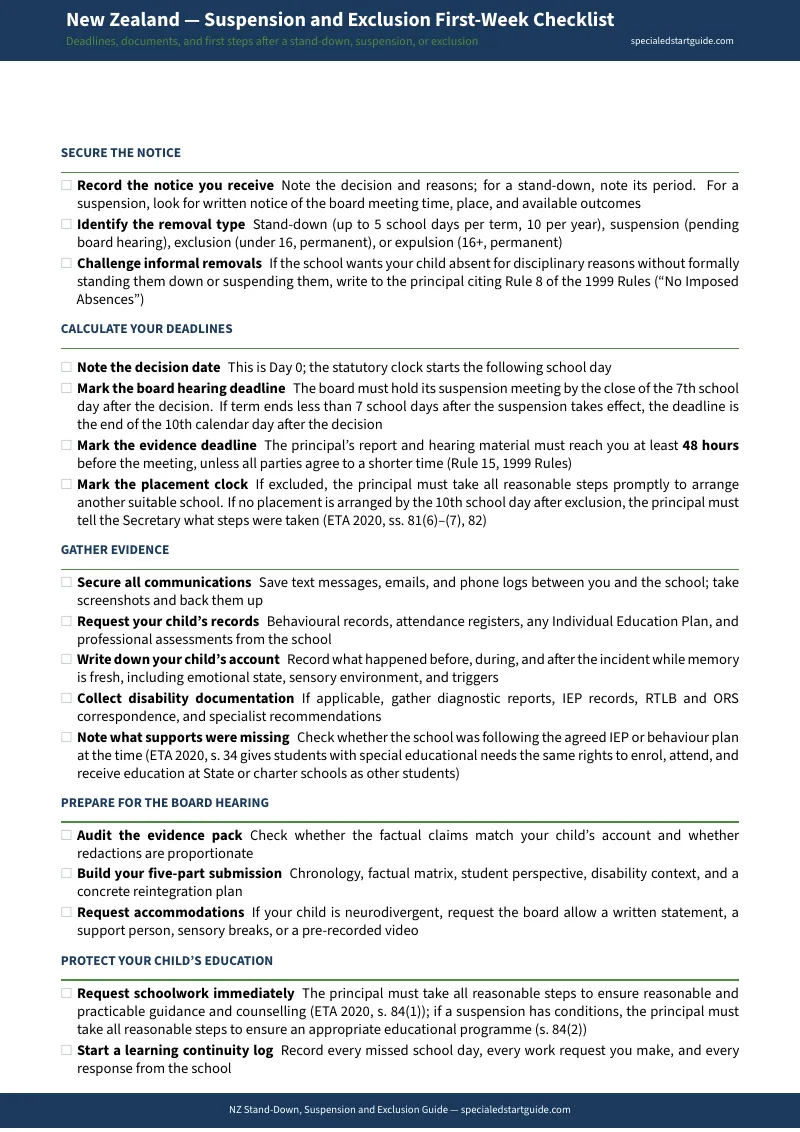
It is built around one principle: families facing the statutory hearing deadline — normally the seventh school day after the suspension decision, or the tenth calendar day after the decision if term ends less than seven school days after the suspension takes effect — need operational structure, not legal theory. The guide translates dense statutory rules into fillable worksheets, audit checklists and step-by-step preparation tools you can start using the same day you receive a suspension notice.
What's Inside
- Statutory deadline tracker — the 5-school-day-per-term stand-down cap (10 school days per year), the seventh-school-day hearing deadline or the tenth-calendar-day deadline if term ends less than seven school days after the suspension takes effect, and Rule 15's 48-hour disclosure timing unless all parties agree to shorter notice, mapped onto a calendar with your child's dates
- Incident account builder — a structured framework for reconstructing what happened from your child's perspective, including sensory and trigger logs for neurodivergent children, without leading questions or adversarial framing
- 48-hour evidence pack auditor — a worksheet that walks you through the principal's report and witness statements line by line, flagging inconsistencies, unverified claims, and missing context before you step into the board room
- Board hearing preparation kit — speaking notes structure, support person role guide, and a question template so you know what to say, when to say it, and what the board is required to let you do
- Disability and learning needs contextualiser — how to document the connection between unmet support (missing teacher aide hours, unexecuted IEP strategies, sensory overload) and the behaviour that led to the removal, without using disability as a defence or minimising safety concerns
- Learning continuity log — a tracking sheet for schoolwork, homework, and exam-access requests and the school's responses. If a suspension is subject to conditions, section 84(2) requires the principal to take all reasonable steps to ensure an appropriate educational programme
- Free legal-service preparation — use the incident account, evidence checklist, and communication log to organise your facts and documents before contacting YouthLaw or a Community Law Centre
- Review and appeal route map — when and how to request a review, complain to the Ombudsman, or escalate to the Ministry of Education if the board's decision was procedurally flawed
The guide covers all four removal types — stand-downs, suspensions, exclusions and expulsions — for domestic students at State, State-integrated and charter schools.
Who This Is For
- Parents and caregivers who have just received a stand-down or suspension notice and need to understand their child's rights, the deadlines, and what to do before the board hearing
- Families of children with ADHD, autism, learning disabilities or other additional needs who have been removed from school and want to document how unmet support contributed to the incident
- Whānau, grandparents and foster carers stepping in during a school crisis who need a structured system to follow
- Parents preparing for a board hearing who want to audit the evidence pack and build a clear, factual account of the incident
Why Not Free Resources?
Free resources from the Ministry of Education and YouthLaw are essential — the guide actively directs you to them and provides their contact numbers. But there is a gap between knowing the rules and being able to use them under pressure.
The Ministry's parent information sheets explain that you can attend the hearing, bring a support person, and present your child's side. They do not give you a printable incident diary to reconstruct a timeline with a dysregulated child. They do not give you a checklist to audit the principal's report for hearsay or missing context. They do not give you a learning-continuity log to track schoolwork requests and responses.
Free legal services and school-issue support — YouthLaw, the Students Rights Service, and Community Law Centres can offer advice and help. But their capacity is limited, intake can take days, and many families walk into a board meeting without representation. The guide's worksheets are designed to work alongside free legal help: you organise your facts before the intake appointment, then use the structured preparation tools whether or not an advocate is available on hearing day.
What This Is Not
This is not legal advice or representation. It is a plain-language process guide and organisational toolkit. It does not promise reinstatement — the board has discretionary power under the Act, and no guide or lawyer can guarantee the outcome. What it does is help you present your child's case accurately, make sure the school follows every procedural safeguard, and keep your child connected to learning while removed.
If your situation involves criminal allegations, physical restraint resulting in injury, or an urgent High Court application, the guide's escalation protocol directs you to qualified legal help immediately.
Satisfaction Guarantee
Full refund, no time limit. If the guide does not help your situation, email [email protected] and you will receive a complete refund — no questions asked.
Start Now — Your Child's Hearing Won't Wait
Download the free First-Week Checklist to get the deadlines and first steps immediately. When you are ready for the full system — the evidence auditor, the hearing preparation kit, the disability contextualiser and every worksheet — the complete guide is a one-time purchase with instant PDF delivery and a full, unconditional refund if it does not help.
Frequently Asked Questions
What if the rules change after I buy?
We update the guide when the rules change. Email us any time, even years later, and we'll send you the current edition free.