Children's services end at 18. The adult pathway has its own rules, its own deadlines, and no one walks you through it.
Your teenager is approaching the end of second-level education, and you have been told that HSE children's disability services stop at 18. What comes next — adult day services or rehabilitative training — runs on a separate system with its own referral timeline, a funding assessment visit you get one chance at, and a placement process where demand routinely outstrips supply.
The official information is scattered across HSE regional pages that still reference the old CHO structure, NDA policy documents written for professionals, and charity summaries that cover one disability group. You are left stitching the process together from fragments while the deadlines move closer.
The School Leaver Transition System — every step, every deadline, every lever you can pull
The Ireland HSE School Leaver Day Services and Rehabilitative Training Guide puts the entire adult day services pathway into one structured sequence: from early school-leaver referral planning through the funding profile home visit, service sampling, placement, and what to do when it stalls. It is built around the practical tools families actually need — a DOO visit preparation worksheet, a service-sampling scorecard, complaint-drafting checklists — that do not exist anywhere in the free information landscape.
What's Inside
- HSE Health Regions Map — the six integrated Health Regions that replaced the nine CHOs, which regional Day Opportunities Team covers your area, and the contact channels that actually work
- School Leaver Referral Timeline — when to refer after age 16 (usually 12–18 months before leaving school; referrals can be made at any time), and each administrative milestone through to September placement, with what to do if any step is missed or delayed
- Funding Profile Preparation Worksheet — how to organise support-needs evidence for the Day Opportunities Officer's 1.5-hour home visit, using the guide's worksheet areas so your notes are clear and complete
- RT vs Day Services Comparison — the eligibility criteria, duration limits, and what happens at the end of each track, laid out side by side so you can evaluate which pathway fits and how to request a change if the initial placement is wrong
- Legal Capacity at 18 — what the Assisted Decision-Making (Capacity) Act 2015 means for decisions about HSE services, the decision-making assistance agreement, co-decision-making agreement, and decision-making representation order, and where the Decision Support Service or Circuit Court fits in setting them up
- Disability Allowance Walkthrough — eligibility rules, the medical evidence the Department of Social Protection requires, and two worked financial examples: one about savings and one about part-time work while attending a day service
- Waiting List Strategy — how the HSE allocates places when demand exceeds supply, the information that strengthens your position, and the steps to take if September arrives without a confirmed offer
- Complaints, Reviews and Appeals — step-by-step drafting for the four stages of Your Service Your Say, escalation to the Ombudsman, and the Assessment of Need complaints route, with the deadlines and evidence each step requires
- Service-Sampling Scorecard — a structured evaluation form for site visits during the February–March sampling window, based on the New Directions outcome-focused criteria, so you can compare providers on what matters rather than on first impressions
- Communication Log — a template for tracking every call, email, and decision with the school, the DOO, the service provider, and the HSE regional team, because a paper trail is the strongest tool you have if something falls through
Who It's For
Parents and carers in Ireland whose disabled teenager is approaching the end of second-level education and needs to move into HSE adult day services or rehabilitative training. The guide is written for the family handling the process themselves — before or instead of engaging a solicitor or formal advocate.
Also for young adults navigating their own transition. The law presumes that a person has capacity in respect of each matter unless the contrary is shown under the Assisted Decision-Making (Capacity) Act 2015. A dedicated chapter explains your rights and choices under New Directions, written directly to you.
Why not free tools?
Down Syndrome Ireland publishes an excellent five-step pathway summary — but it covers one disability group and does not include worksheets for the DOO visit or provider evaluation. Citizens Information explains the eligibility rules accurately — but it is a directory, not a case-management system. The HSE's own regional pages still reference the old CHO structure, and the referral forms arrive without instructions on what evidence to attach.
The free landscape gives you the facts. What it does not give you is the organisational structure to act on them: a preparation worksheet for the assessment visit, a scorecard for comparing providers, a complaint-drafting checklist when deadlines are missed, or a single timeline that ties the scattered official sources into the sequence your family actually follows.
Satisfaction Guarantee
Full refund, no time limit. If the guide is not what you expected, email [email protected] and you will receive a refund — no questions, no deadline.
Start now
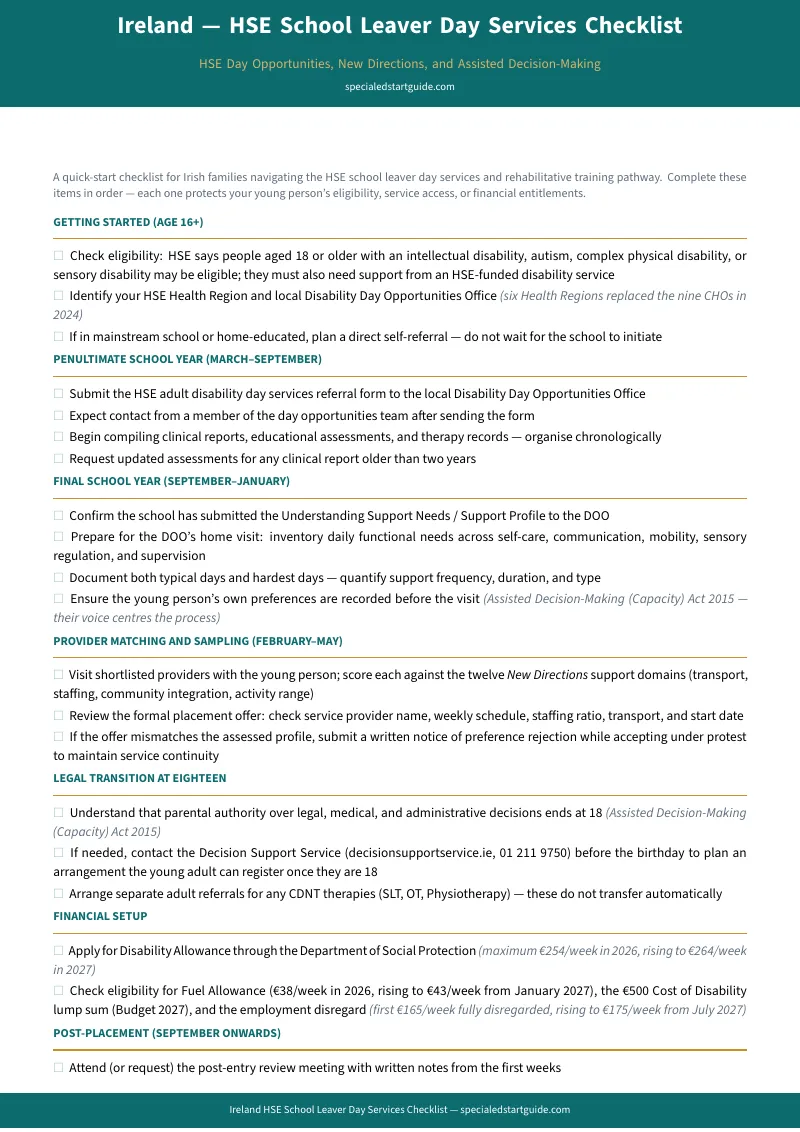
Download the free checklist for a two-page summary of the eligibility rules, evidence requirements, and application steps. When you are ready for the full guide — with the DOO preparation worksheet, the service-sampling scorecard, the complaints roadmap, and two worked Disability Allowance examples — get the complete Ireland HSE School Leaver Day Services and Rehabilitative Training Guide for .
Frequently Asked Questions
What if the rules change after I buy?
We update the guide when the rules change. Email us any time, even years later, and we'll send you the current edition free.