The School Made Its Decision. The Clock Is Running. You Have 42 or 63 Days to Get Your Child's Case in Order.
The letter says "expulsion" or "suspension" or "your application has been unsuccessful." Somewhere in the text it mentions Section 29, the Education Act 1998, and a right of appeal. It gives you a deadline — 42 calendar days from the Board's decision for an expulsion or for the suspension that brings the school-year total to 20 or more school days, 63 calendar days from the original refusal decision for an admission appeal — but it doesn't explain how to actually prepare. How to organise your evidence. How to audit whether the school followed the rules before it made its decision. How to present your child's experience at an oral hearing without sounding adversarial or falling apart.
You searched online. The government portal at www.section29appeals.gov.ie has a combined application form for expulsion and suspensions totaling 20 or more school days, plus separate application forms for oversubscribed and other admission refusals. Citizens Information gives a solid overview but no worksheets. Tusla assigns an Educational Welfare Officer who monitors your child's welfare — not a parent advocate who helps you build your case. The NEWB 2008 Guidelines have 93 numbered pages and were written for school boards, not for the parent reading them at 11 pm with a pit in their stomach. SchoolAppeal.ie generates a template letter for admission refusals — useful if you're appealing oversubscription, less so if you need to audit an expulsion procedure or prepare evidence for a disciplinary hearing.
What you need is a single document that puts the entire process in front of you in order: which appeal track applies to your situation, the exact deadlines, what the school was required to do before making its decision, how to organise every letter and meeting note into indexed evidence, and how to present your child's side calmly and clearly at the hearing — with worksheets you can fill in tonight.
The Ireland Section 29 Appeal Guide is that document. It is an independent administrative navigation guide — not legal advice — that covers suspension, expulsion, and refusal to enrol under Irish law. It includes the procedural audit tools, the evidence-organisation worksheets, and the hearing preparation framework that the government portal provides forms for but never teaches you how to use.
What's Inside
The Statutory Deadline Calculator
Three separate appeal routes, two appeal deadline lengths — 42 or 63 calendar days — and two different types of days, calendar days and school days, that parents routinely confuse. The guide maps each route precisely: the 42-calendar-day expulsion window; the 42-calendar-day suspension deadline, counted from the Board decision that brings cumulative suspensions to 20 or more school days in the school year; the 63-day admission-refusal deadline; and the 21-day Board of Management review for oversubscription. A fill-in worksheet lets you enter the date from your letter and calculate your exact filing deadline, so you stop wondering and start counting.
The Procedural Compliance Audit
Schools must follow fair procedures, including giving students a right to be heard, and follow their own Code of Behaviour. Before expelling a student, Section 24 of the Education (Welfare) Act 2000 requires written notice to Tusla's Educational Welfare Officer and a 20-school-day waiting period. The NEWB 2008 Guidelines direct Boards to consider prior interventions and whether expulsion is proportionate. The guide turns these procedures into a checklist you can hold against the school's actions. If the Board did not hold the required hearing, did not follow the Code of Behaviour, or did not consider prior interventions, those are relevant to the appeals committee. The audit helps you identify procedural gaps and document them in a format the committee can read.
The Neutral Chronology and Evidence Index
Section 29 appeals are decided on documented evidence, not emotional testimony. The guide includes a structured template for logging every suspension letter, meeting record, support plan, medical report, and school communication in date order with page references. When you walk into the hearing — or submit your paper-based admission appeal — your evidence is indexed, referenced, and organised the way the committee expects to receive it.
Oral Hearing Preparation
Disciplinary appeal hearings are conducted orally before a three-person committee. You present your case. The school presents its case. Both sides are heard. The guide explains what happens before, during, and after: who attends, how the room is typically arranged, what the committee is evaluating, how to present your child's account without adversarial language, and how to respond when the school makes claims you disagree with. The goal is not to "win" an argument — it is to present a structured, evidence-based account that the committee can weigh against the school's case.
Disability, SEN, and the Equality Route
If your child has autism, ADHD, a learning disability, or another additional need, the school's obligation to provide reasonable accommodation under the Equal Status Acts 2000–2015 is relevant — but it is not an automatic defence. The guide explains what the law actually requires, when unmet support needs strengthen your appeal, the realistic limits of an equality argument where the school documented safety concerns, and when a separate complaint to the Workplace Relations Commission may be appropriate. It also covers Form ES1, the normal two-month notification deadline (extendable to four months for reasonable cause; in exceptional circumstances, the Director General may dispense with notification if just and equitable), and how the WRC route runs parallel to — not instead of — the Section 29 process.
Informal Exclusions and Reduced School Days
If the school has been sending your child home early, placing them on a reduced timetable you never consented to, or suggesting "voluntary withdrawal," you may not have a formal letter to appeal against — yet. Under Circular 0047/2021, reduced school days require written parental consent, a time-limited return plan, and notification to Tusla. The guide explains how to request a formal decision in writing so the statutory protections apply, and includes a non-consent template you can send tonight.
Education While Your Child Is Out of School
During an extended exclusion or pending appeal, your child's education should not simply stop. The guide covers the Home Tuition Grant Scheme, eligibility conditions, how to log lost instructional hours, and planning for a return to school once the appeal is resolved.
Who This Guide Is For
- Parents whose child has been permanently excluded and who have 42 calendar days to lodge an appeal — and need to know exactly what to put in front of the committee
- Parents whose child's suspensions have crossed the 20-school-day threshold this year and who have just discovered the statutory right of appeal exists
- Parents whose child was refused a school place, who received a letter mentioning a Board of Management review, and who can't work out whether the 21-day review and the 63-day appeal run at the same time or sequentially
- Parents whose child is being sent home early or placed on a reduced timetable without written consent — and who need to convert the informal action into a formal decision before the statutory protections apply
- Parents whose child has autism, ADHD, or another additional need and who believe the school removed the child rather than providing the supports that were recommended
- Parents who want to handle the administrative appeal themselves — the hearing is designed for direct parental participation without a solicitor — and who need the preparation framework to do it effectively
Why Not Just Use the Government Forms?
You should. Every statutory form and procedural document is freely available on www.section29appeals.gov.ie, and you do not need to purchase anything to file an appeal. The question is whether you can organise your case with the forms alone:
- The Section 29 portal gives you blank forms — not preparation guidance. It tells you which form to fill in and where to send it. It does not tell you how to audit whether the school followed the NEWB 2008 procedural steps, how to organise your evidence into indexed pages, or how to present your child's account at the oral hearing. This guide fills the gap between "you have a right to appeal" and "here is how to build a credible case."
- Citizens Information explains the law clearly — without the worksheets. Their summary of Section 29 is accurate and plain-language. It does not include a deadline calculator, a chronology template, or a procedural audit checklist. This guide provides the practical tools that turn knowledge of your rights into an organised submission.
- Tusla's Educational Welfare Officers are neutral state officials — not parent advocates. An EWO monitors attendance and educational welfare. They do not draft your appeal, review your evidence, or prepare you for the hearing. This guide gives you the self-preparation framework so you arrive at the hearing ready, whether or not the EWO has been able to help.
- SchoolAppeal.ie covers admission refusals — not disciplinary exclusions. Their automated letter generator covers admission refusals, including Board of Management reviews and Section 29 appeals. If your child was expelled and you need to audit the procedural steps, organise evidence for a full hearing, or address disability-related issues, that falls outside their scope. This guide covers all three appeal tracks.
— A Fraction of One Hour With an Education Solicitor
Private solicitors who handle Section 29 appeals charge professional hourly fees. If you eventually need legal representation, the evidence file and chronology you build with this guide saves hours of billable preparation — because you're handing your solicitor an organised case, not a carrier bag of letters and meeting notes. If you handle the appeal yourself, the guide gives you the same organisational framework those solicitors use.
Your download includes 8 PDFs:
- Complete Guide (guide.pdf) — 14 chapters covering the three appeal tracks and their deadlines, procedural compliance under the NEWB 2008 Guidelines, evidence organisation, oral hearing preparation, disability and additional needs, informal exclusions and Circular 0047/2021, education while out of school, worksheets, and key contacts
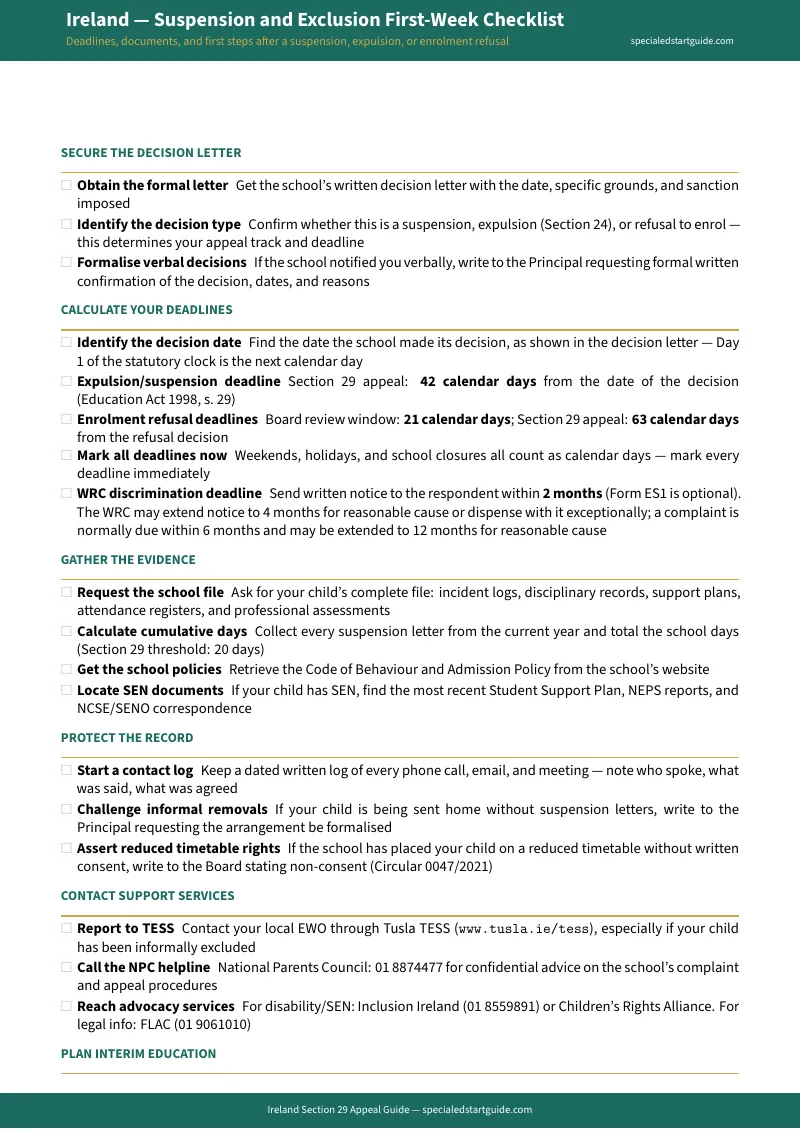
- First-Week Checklist (checklist.pdf) — 25-item printable checklist covering the first actions after a suspension, expulsion, or refusal to enrol: documents to request, deadlines to calculate, free agencies to contact, and a non-consent template for unapproved reduced timetables
- Deadline Calculator (deadline-calculator.pdf) — fill-in worksheet to identify your appeal track and calculate every statutory deadline: 21-day Board review, 42/63-day Section 29 filing, and WRC notification timelines
- Suspension Tracking Log (suspension-tracking-log.pdf) — running record of each suspension with cumulative school-day totals toward the 20-day threshold
- Procedural Compliance Audit (procedural-compliance-audit.pdf) — step-by-step checklist to audit the school's actions against the NEWB 2008 Guidelines, Section 24 requirements, disability accommodation duties, and Circular 0047/2021
- Neutral Chronology Template (neutral-chronology-template.pdf) — structured date-ordered timeline and evidence index for your appeals committee submission
- Education Continuity Log (education-continuity-log.pdf) — daily record of missed school hours, academic milestones, and interim education arrangements for the committee and Home Tuition applications
- Agency Communication Log (agency-communication-log.pdf) — contact tracker for every call, meeting, and letter with TESS, NCSE, NEPS, NPC, FLAC, and other agencies, with a quick-reference directory
Instant PDF download. Calculate your deadline, organise your evidence, and prepare your child's case — tonight.
Full refund, no time limit. If the guide doesn't help you navigate the process, email [email protected] for a full refund. No questions, no deadline.
Not ready for the full guide? Download the free Ireland — Suspension and Exclusion First-Week Checklist — a printable checklist of the deadlines, first documents to request, and free agencies to contact. It's enough to protect your deadline and get started, and it's free.
Your child's right to appeal is statutory. The deadline is absolute. The only question is whether you spend that time searching — or preparing.
Frequently Asked Questions
What if the rules change after I buy?
We update the guide when the rules change. Email us any time, even years later, and we'll send you the current edition free.