
You Got the Report. The School Filed It. Nothing Changed.
You suspected something was wrong months ago. The teacher confirmed it. You did everything right — you called the HSE about an Assessment of Need, you asked the school about NEPS, you researched online. And then the system stopped moving.
The HSE told you the statutory six-month timeline is fiction. The realistic wait for an Assessment of Need exceeds two years. NEPS can see a handful of students per school per year, and the waiting list is already full. You looked into going private and discovered psycho-educational assessments cost between EUR 650 and EUR 1,800 — autism assessments between EUR 2,400 and EUR 2,700. You are not sure what the assessment even measures, whether the school will act on it, or if you are about to spend thousands of euro on a report that gets filed and forgotten.
Maybe you already went private. You have a 20-page clinical report full of standard scores, percentile ranks, and diagnostic classifications. You brought it to the school. The principal said they would "take it into account." The Student Support Plan was not updated. The SNA hours were not reviewed. Nobody explained what any of the numbers mean or how to make them count.
Over 22,000 Assessment of Need applications are backlogged at the HSE. Private assessments cost hundreds to thousands of euro. And the legislation that was supposed to guarantee your child a statutory right to an Individual Education Plan — the EPSEN Act 2004 — has had its critical provisions sitting uncommenced for over two decades. A diagnosis is just a piece of paper until someone forces the system to act on it.
The Ireland Educational Assessment Decoder is the Assessment-to-Action System — the guide that bridges the gap between receiving a diagnosis and getting real classroom support. It maps the three assessment pathways (NEPS, HSE Assessment of Need, and private), translates clinical reports into plain English, and provides the exact letter templates and legal citations required to convert professional recommendations into documented obligations the school must address in writing.
What's Inside the Decoder
The Three Assessment Pathways Mapped Step by Step
No free resource in Ireland provides a strategic comparison of all three routes. This guide does. NEPS: what the school-based psychologist actually covers, how the SCPA (Scheme for Commissioning Psychological Assessments) works, and what to do when the school says the annual quota is exhausted. HSE Assessment of Need: how to apply, the statutory timelines under the Disability Act 2005, and the exact escalation sequence when the HSE breaches the six-month deadline by two years. Private assessment: realistic costs broken down by assessment type, what to ask before booking, how to verify PSI registration, and how to claim 20% tax relief on the fees through the Med 1 form — the financial recovery most parents never learn about.
The Health vs. Education Divide Explained
The single most common mistake Irish parents make is assuming a medical diagnosis automatically triggers classroom support. It does not. The HSE identifies a disability under the Disability Act 2005. The NCSE controls educational resources under Department of Education circulars. A child can receive an AON Service Statement listing therapies their CDNT cannot provide — while the school says nothing about additional SET hours. This chapter explains exactly how to bridge the gap: which numbers in the clinical report map to NCSE allocation criteria, and how to format assessment evidence so the school cannot dismiss it as irrelevant to educational provision.
What Assessment Reports Actually Mean
A full chapter dedicated to decoding clinical reports in plain language. Standard scores, percentile ranks, confidence intervals, scaled scores — explained with the specific thresholds that matter. Which score ranges indicate learning difficulty versus intellectual disability under Irish criteria. Which numbers trigger resource allocation at the NCSE. Which scores the school cannot reasonably dismiss. How to read the "Recommendations" section strategically — because a psychologist who writes "would benefit from additional support" gives the school an excuse to do nothing, while specific, quantified recommendations create documented obligations.
The Continuum of Support — Your Leverage Before a Diagnosis
Under Circular 0013/2017, a formal diagnosis is not required before the school deploys Special Education Teacher hours. The Continuum of Support operates on a needs-based model: observed functional difficulty, not a clinical label, is what triggers the first tier of intervention. This chapter explains how to activate the school's own framework immediately — so your child receives support today while you navigate the assessment process. It also explains how to build the evidence trail during the wait, because the documentation you create now determines whether the assessment process moves quickly or stalls when contact finally comes.
Strategic Escalation for Every Bottleneck
The school says NEPS is fully booked. The HSE has breached the AON statutory timeline. The school filed your private report and changed nothing. The NCSE refused additional SNA allocation. Each of these scenarios has a specific escalation pathway with specific legal leverage — and the guide provides the exact letter template for each one, pre-loaded with the Irish legal citations that trigger documented obligations. Not generic complaint letters. Letters that reference Section 14 of the Disability Act 2005, Circular 0013/2017, and the school's own Student Support File obligations.
SNA and SET Allocation — How the System Actually Decides
The NCSE's whole-school review process determines SNA allocation based on the school's overall profile, not strictly on individual diagnostic reports. The 2024/2025 guidelines introduced restrictive six-week application windows, mandatory "inclusive reflection" documents, and a redeployment-first policy that principals and parents widely view as rationing by design. This chapter details the exact criteria SENOs use to grant or deny access, the specific grounds for a mid-year SNA review, how to format an appeal using assessment evidence, and the process for escalating a refusal through the NCSE's formal appeals mechanism.
The Post-Assessment Action Plan
What to do the day the report arrives. Within two weeks: schedule the school meeting, open or update the Student Support File, begin the DCA application if eligible. Within one month: Assistive Technology Grant application with the specific assessment wording required. Within the academic year: RACE exam accommodations (with the November deadline nobody warns you about), DARE university access preparation (with the three absolute deadlines in February and March), and how to ensure assessment evidence transfers when your child moves from primary to post-primary. Every step, every deadline, every agency — sequenced so nothing falls through the cracks.
Seven Fill-in-the-Blank Letter Templates
The feature that no free resource provides. Pre-written letters for requesting school assessment, NEPS referral follow-up, AON application and escalation, private report implementation demand, GDPR Subject Access Request for the Student Support File, SNA review request, and complaint escalation. Each template includes the specific Irish legal citation that triggers an obligation — not a generic plea for help, but a documented request that creates a paper trail the school must respond to in writing.
The EPSEN Act Reality Check
A dedicated explanation of why Sections 3 through 12 of the EPSEN Act were never commenced, what this means for your child's rights in 2026, and the alternative legal levers that carry actual enforcement: the Disability Act 2005, the Education Act 1998, the Equal Status Acts 2000-2018, and the June 2025 EPSEN Review recommendations. When a school tells you they cannot provide an IEP, they are technically correct. When they tell you they have no obligation to support your child, they are wrong. This chapter explains the difference.
The Dispute Resolution Ladder
When internal school advocacy reaches a dead end, the guide maps every external escalation pathway: Board of Management complaint, NCSE formal appeal, Ombudsman for Children investigation, WRC discrimination referral under the Equal Status Acts, Section 29 appeal for admission refusal, and the Disability Appeals Officer for breached AON timelines. Each pathway is explained with when it applies, what evidence is required, and which route gives you maximum leverage for your specific situation.
Who This Decoder Is For
- Parents whose child's teacher raised concerns but the school says NEPS is fully booked and there is nothing more they can do until September
- Parents who applied for an HSE Assessment of Need over a year ago and the CDNT still has not made contact — while their child falls further behind every week
- Parents weighing whether to spend EUR 1,000 to EUR 2,500 on a private assessment when nobody can confirm the school will implement the recommendations
- Parents who already paid for a private psycho-educational report and the school responded by filing it and changing nothing — no additional SET hours, no SNA review, no updated Support Plan
- Parents whose child received an autism or ADHD diagnosis through the HSE, but the Service Statement lists therapies the CDNT cannot provide and says nothing about educational support
- Parents trying to understand a clinical report full of standard scores and percentile ranks when nobody at the school or HSE has explained what any of it means for classroom support
- Parents who have been reading UK guides about EHCPs and SENCOs, or US guides about IEPs and IDEA, and have just realised none of it applies in the Republic of Ireland
- Parents whose child is approaching the transition from primary to post-primary and who need assessment evidence documented properly before supports vanish at the new school
Why Not Just Use the Free Resources?
Ireland has excellent advocacy organisations. The NCSE publishes guidelines. AsIAm provides comprehensive autism journey guides. Citizens Information lists entitlements. Inclusion Ireland lobbies for systemic change. Here is what none of them provide:
- State resources explain the system as it should work. The NCSE describes what SNAs and SETs are. The HSE outlines the AON statutory timeline. Citizens Information lists your entitlements. None of them tell you what to do when NEPS is fully booked, when the HSE breaches the six-month timeline by two years, or when the school files your private report and changes nothing. Free resources describe the rules. This guide tells you what to do when the system breaks those rules.
- No free resource provides template letters. AsIAm explicitly states they do not provide pre-written advocacy templates. Inclusion Ireland outlines what to put in a SENO letter but does not provide one. The NCSE publishes administrative forms. The single highest-value tool a parent needs — a copy-and-paste letter pre-loaded with the correct legal citation — does not exist in the free ecosystem. This guide provides seven of them.
- Nobody bridges the health-education divide. The HSE explains health assessments. The NCSE explains educational allocations. No free resource explains how to translate an HSE diagnosis into NCSE resource criteria. That translation is the difference between a report that gets filed and a report that triggers allocated support.
- UK and US guides cite the wrong law. Etsy and Amazon are filled with special education templates built for US IDEA legislation and UK EHCP frameworks. Irish parents who download these guides and present EHCP demands to their principal face immediate confusion and wasted effort. There are zero paid guides addressing the Irish AON process, zero addressing SENO allocation appeals, and zero addressing the interaction between private assessments and NCSE resource criteria.
— Less Than a Single Private Consultation Call
A 60-minute pre-assessment discovery call with a private psychologist in Ireland costs EUR 89. A psycho-educational assessment costs EUR 1,000 to EUR 1,800. A combined autism and ADHD assessment costs EUR 2,400 to EUR 2,700. For a fraction of a single consultation fee, you get the complete navigation system for the entire Irish assessment landscape — and the exact tools to ensure the assessment report does not get filed and forgotten.
Your download includes the comprehensive 11-chapter Assessment Decoder plus 5 standalone printable tools — ready to use tonight.
- Complete Assessment Decoder (guide.pdf) — 11 chapters covering the legal landscape, the three assessment pathways (NEPS, HSE AON, private), the Continuum of Support framework, strategic escalation for every bottleneck, clinical report interpretation, SET and SNA allocation criteria, the post-assessment action plan (DCA, Assistive Technology, RACE, DARE), Irish-language school and homeschool considerations, dispute resolution pathways, and 7 fill-in-the-blank letter templates with Irish legal citations
- Letter Templates (letter-templates.pdf) — all 7 fill-in-the-blank advocacy letters extracted as a standalone document: school assessment request, NEPS referral, HSE Assessment of Need application, breached AON timeline complaint, private report submission, GDPR Subject Access Request, and SNA review request — each with the specific Irish legal citation that triggers a documented obligation
- Report Decoder Reference Card (report-decoder.pdf) — the score interpretation guide you bring to the school meeting: standard score thresholds, what each range means for NCSE resource allocation, common assessment tools explained, and the three strategic moves that turn a clinical report into classroom support
- Escalation Pathway (escalation-pathway.pdf) — the visual escalation ladder from school-level complaint through the Board of Management, Ombudsman for Children, Section 29 appeals, and the Disability Appeals Officer, with critical deadlines for each pathway
- Key Contacts and Deadlines (assessment-contacts.pdf) — every state body, advocacy organisation, and professional directory on one reference card, plus a fill-in section for your personal contacts (SENO, principal, CDNT) and all time-sensitive deadlines
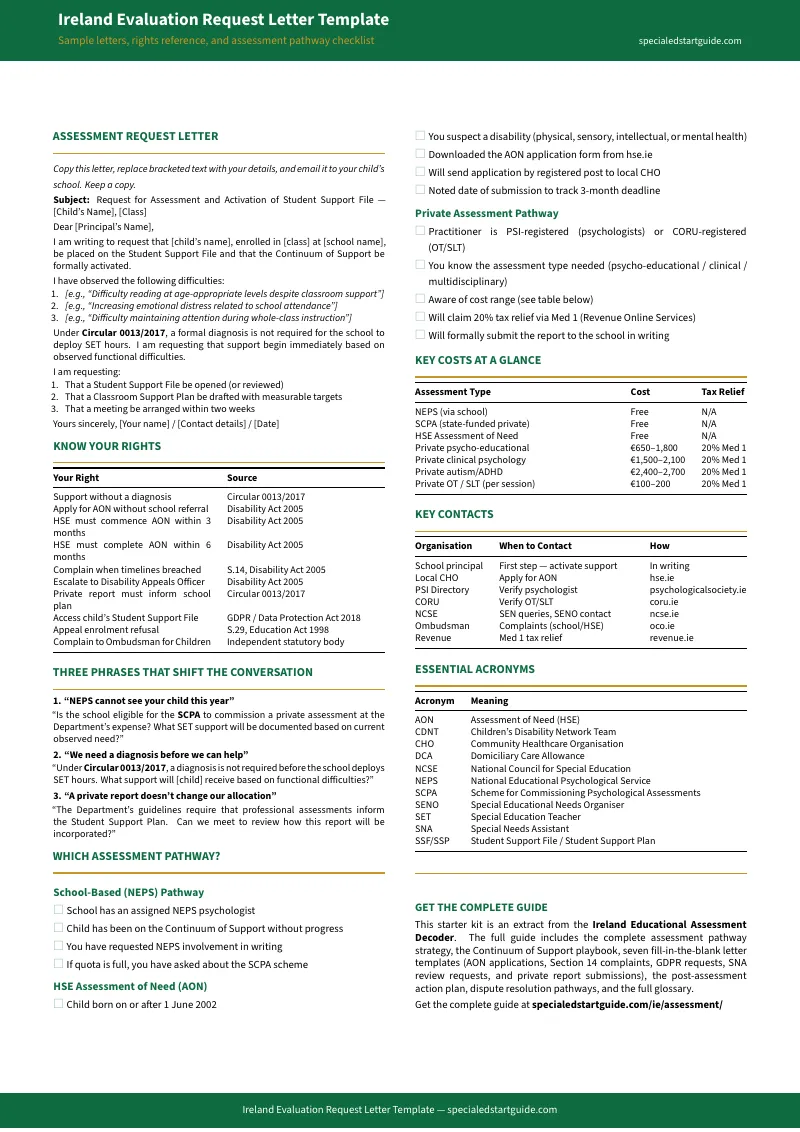
- Evaluation Request Letter Template Kit (checklist.pdf) — the free quick-start: ready-to-send letters for requesting school assessment, NEPS referral, and HSE Assessment of Need, a rights quick-reference table covering every relevant Irish statute, and an assessment pathway decision checklist
Instant PDF download. Six files, ready to print. Find the chapter that matches your situation and act on it tonight.
Money-back guarantee, no time limit. If the Decoder does not change how you navigate assessment and advocacy for your child, email us for a full refund. No questions asked.
Not ready for the full Decoder? Download the free Ireland Evaluation Request Letter Template — ready-to-use letter templates for requesting school assessment, NEPS referral, and HSE Assessment of Need, plus a rights quick-reference table and assessment pathway decision checklist. It is enough to initiate the assessment process tonight — and it is free.
Every week the school files an assessment report without updating the Support Plan is a week your child misses support they are entitled to. Every month on an HSE waiting list without a formal complaint is a month the statutory clock runs unchallenged. The Decoder ensures the system acts on what the assessment found.