A suspension letter just landed. The school's clock is already running.
Your child has been suspended — or the principal is talking about expulsion — and you are holding a letter full of Department policy references, deadline language, and phrases you have never seen before. You need to know what the school is allowed to do, what it must do, what it skipped, and what you can do about it. You need to know tonight.
The NSW Department of Education publishes policy documents written for principals and Directors. Free factsheets exist, but they describe the system in institutional language — they do not tell you how to check the notice for errors, structure your evidence, raise missing disability adjustments, or prepare your child's own account for a meeting that may happen next week.
Private education lawyers charge hundreds of dollars an hour. For a 5-day suspension, that is not a realistic option. For a potential expulsion, the procedures allow 7 school days for a response before the final decision.
The Procedural Navigation System: 14 chapters of practical guidance
This guide bridges the gap between free government factsheets and paid legal representation. It takes the Department's own Student Behaviour Policy and Suspension and Expulsion Procedures (v3.2.0, October 2026) and reorganises them into a step-by-step system you can follow from the kitchen table — with practical guidance for each stage.
It is built for families handling the process themselves, before or instead of engaging a lawyer or advocate. The guide includes free legal and advocacy contacts with realistic limitations, so you know exactly when to escalate.
What's inside the guide
- Notice Validity Checklist — check key details in the written notice and note anything that appears to be missing.
- School-Day Counter and Deadline Tracker — track suspension dates, extensions, and appeal windows in school days (not calendar days), with worked examples across term breaks.
- Incident Chronology Worksheet — separate what happened, what the school alleges, and what your child says, in date-and-time order. This becomes the backbone of any submission.
- Student Account Worksheet — capture your child's perspective at home, with guidance for younger children and neurodivergent communication styles (ADHD, autism, anxiety).
- Reasonable Adjustment Audit — review the adjustments that were supposed to be in place and whether they were operating on the day of the incident.
- Appeal Submission Planner — assemble documents, identify your strongest arguments, and structure a clear submission before you start writing.
- Agency Communication Log — keep a record of calls, emails, and meetings with the school, DEL, advocates, and external bodies.
- Return-to-School Planning Template — prepare specific requests for the reintegration meeting: updated strategies, environmental changes, communication plans, and named contacts.
What the guide covers
- The legal framework — Education Act 1990, Student Behaviour Policy, Suspension and Expulsion Procedures, and the Disability Standards for Education 2005.
- Duration caps and extensions — K–2 (5 days, extendable to 10), Years 3–12 (10 days, extendable to 15), and what triggers DEL involvement.
- Evidence access — how to request incident records, witness statements, school investigation notes, and when to use a formal GIPA application.
- Disability and additional needs — when behaviour is linked to unimplemented adjustments, what the DSE 2005 requires, and how to present this in an appeal without adversarial framing.
- Formal cautions — the 50-school-day expiry, what a caution means for escalation, and that cautions cannot be appealed.
- Expulsion procedures — the notice of potential expulsion, the 7-school-day response window, and the principal-DEL determination process.
- Appeal routes — suspension appeals to the DEL and expulsion appeals to the EDPS, with resolution within 15 or 20 school days of receipt respectively, and what changes when the DEL was involved in the original decision.
- External oversight — NSW Ombudsman, Anti-Discrimination NSW, the Australian Human Rights Commission, and what each one can and cannot do.
- Informal exclusions — how to identify when a school removal bypasses formal process, and what to put in writing.
- Education continuity — what the school must provide while your child is out, and how to plan a structured return.
Who this guide is for
- Parents and carers of children in NSW public schools who have received a suspension, formal caution, or expulsion notice.
- Families whose child has a disability, ADHD, autism, or other additional needs — and where the suspension may be connected to unmet support.
- Kinship carers, foster carers, and caseworkers navigating the discipline process for a child in out-of-home care.
- Regional and rural families who cannot easily access face-to-face legal advice or specialist disability advocates.
Who it's not for
If your child attends a Catholic systemic or independent school, this guide does not cover your school's procedures. If you are facing criminal charges, Children's Court proceedings, or complex out-of-home care disputes, seek direct legal help. LawAccess NSW (1300 888 529), part of Legal Aid NSW, provides free legal information and referrals — the guide lists free services and their limitations, but those situations need a lawyer, not a toolkit.
Why not free tools?
The Department's official factsheets and appeal form are free, and you should read them. What they do not include is a system for checking whether the school followed each procedural step, a framework for organising evidence into something a DEL reviewer can follow, or practical guidance for capturing a neurodivergent child's account in an accessible way.
Legal blogs published by private firms often reference pre-2022 terminology — "short suspension" and "long suspension" labels that no longer exist under the current procedures. Relying on outdated language in a formal submission damages your credibility.
Free advocacy services (Family Advocacy, Disability Advocacy NSW) provide excellent systemic support, but face waitlists and cannot act as your on-demand representative for a standard suspension that runs on a 5-day or 10-day clock.
This guide sits between the free factsheets and the $350-per-hour lawyer: immediate, structured, and built for the parent doing it themselves.
Satisfaction guarantee
Full refund, no time limit. If the guide does not help, email [email protected] and you get your money back — no questionnaire, no waiting period.
What you get
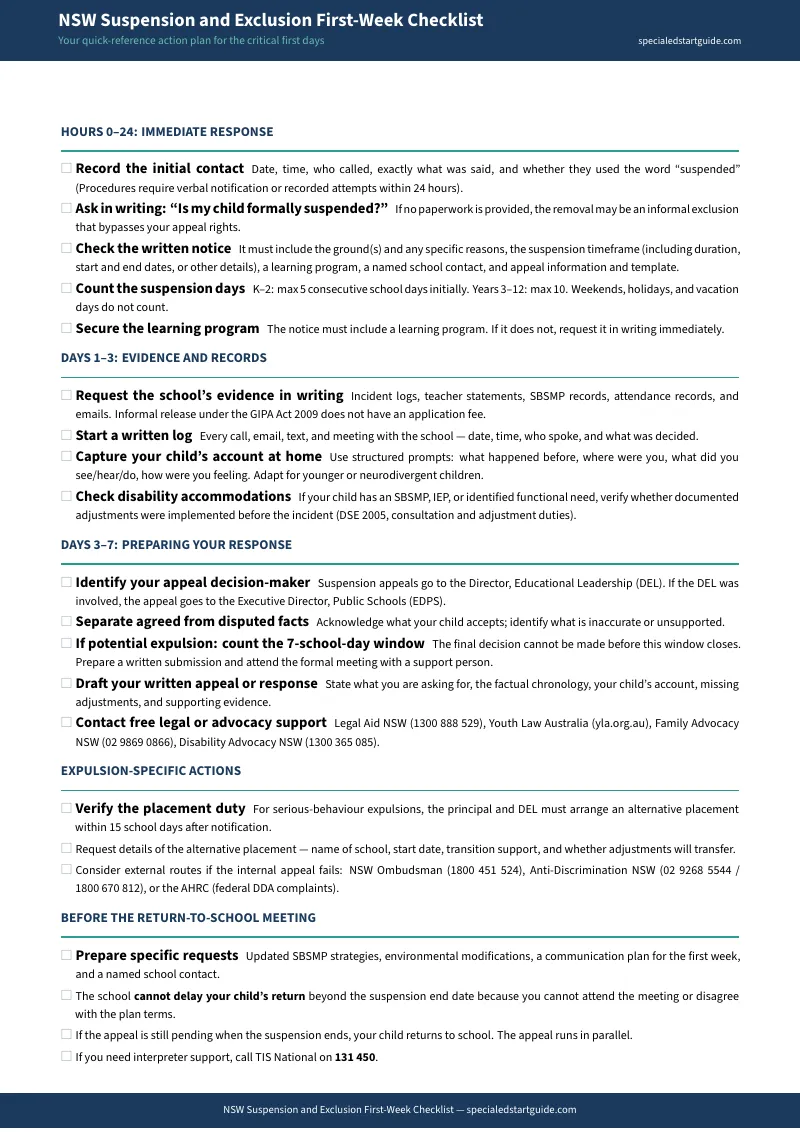
Your download includes 10 PDFs: the full 47-page, 14-chapter guide; the 2-page First-Week Checklist (21 action items); and eight fillable worksheets you print and write on — Notice Validity Checklist, School-Day Counter and Deadline Tracker, Incident Chronology Worksheet, Student Account Worksheet, Reasonable Adjustment Audit, Appeal Submission Planner, Agency Communication Log, and Return-to-School Planning Template. They are designed for use at the kitchen table, not on a screen.
A single purchase grants an unlimited household licence — reuse these steps and examples for siblings or future school years without additional purchase.
Get the NSW Suspension and Expulsion Appeal Guide →
Or download the free First-Week Checklist — the 5 immediate actions, a school-day date tracker, a document-request list, and free legal and advocacy contacts. No purchase required.
Not legal advice
This guide is independently published. It is not affiliated with, endorsed by, or connected to the NSW Department of Education, any state government body, legal aid commission, or statutory oversight tribunal. It does not provide legal advice or legal representation. No guide can guarantee an appeal outcome — reinstatement decisions belong to the DEL or EDPS.
Free legal help is available: LawAccess NSW (1300 888 529), Youth Law Australia (yla.org.au), Legal Aid NSW Children's Civil Law Service. These contacts appear throughout the guide — helpline numbers are never paywalled.
Frequently Asked Questions
What if the rules change after I buy?
We update the guide when the rules change. Email us any time, even years later, and we'll send you the current edition free.