
The School Has Federal Funding for Your Child. You Just Don't Know How to Make Them Use It.
You sat in the Student Support Group meeting and listened to the school explain why they "don't have the resources" to provide a teacher's aide. You asked about your child's rights and the principal mentioned something about "reasonable adjustments" before redirecting to what the NDIS should be funding instead. You went home and opened the Department of Education website. You found 14 pages of policy language that explained what schools should do without telling you a single thing about what happens when they don't.
Then you found the Australian Human Rights Commission site. You read about the Disability Standards for Education 2005. You found the NCCD portal and discovered that schools claim billions in federal disability funding based on your child's data. You tried to work out whether the school or the NDIS is supposed to pay for the speech pathologist. You opened the Raising Children Network. You read CYDA's factsheets. Forty browser tabs later, you still couldn't answer the question you started with: what can I actually do when the school says no?
The Australia Disability Education Parent Rights Compass is a federal-first advocacy system that maps the legal framework sitting above every state education department, every principal's office, and every school policy document. It connects the Disability Discrimination Act 1992 and the DSE 2005 to the state-level machinery that delivers or withholds your child's support — across all eight states and territories — so you walk into meetings knowing exactly what the law requires, what the school is funded to provide, and what to do when they claim otherwise.
What's Inside the Guide
The Federal Legal Foundation That Overrides State Policy
Under Section 109 of the Australian Constitution, federal law prevails over any inconsistent state law. The DDA 1992 and DSE 2005 create five binding obligations — covering enrolment, participation, curriculum, support services, and elimination of harassment — that apply to every government, Catholic, and independent school without exception. This chapter gives you the specific statutory provisions, the landmark case law (Finney v Hills Grammar School), and the exact threshold for "unjustifiable hardship" so you know how high the legal bar actually is when a school claims it can't afford to help your child.
The NCCD Decoded — How Schools Claim Funding Using Your Child's Data
The Nationally Consistent Collection of Data drives billions in federal disability loading. In 2024, over 1,062,000 students were counted — 25.7% of national enrolments. Schools submit your child's disability category and adjustment level to the August census to secure funding. This chapter explains the four levels (QDTP through Extensive), reveals the projected per-student loadings ($6,076 at Supplementary, $21,122 at Substantial, $45,137 at Extensive), and shows you how to request your child's NCCD categorisation in writing under the Privacy Act 1988. When the school needs your child documented to get paid, you become the person ensuring the documentation translates into actual classroom support.
The Eight-State Translation Matrix
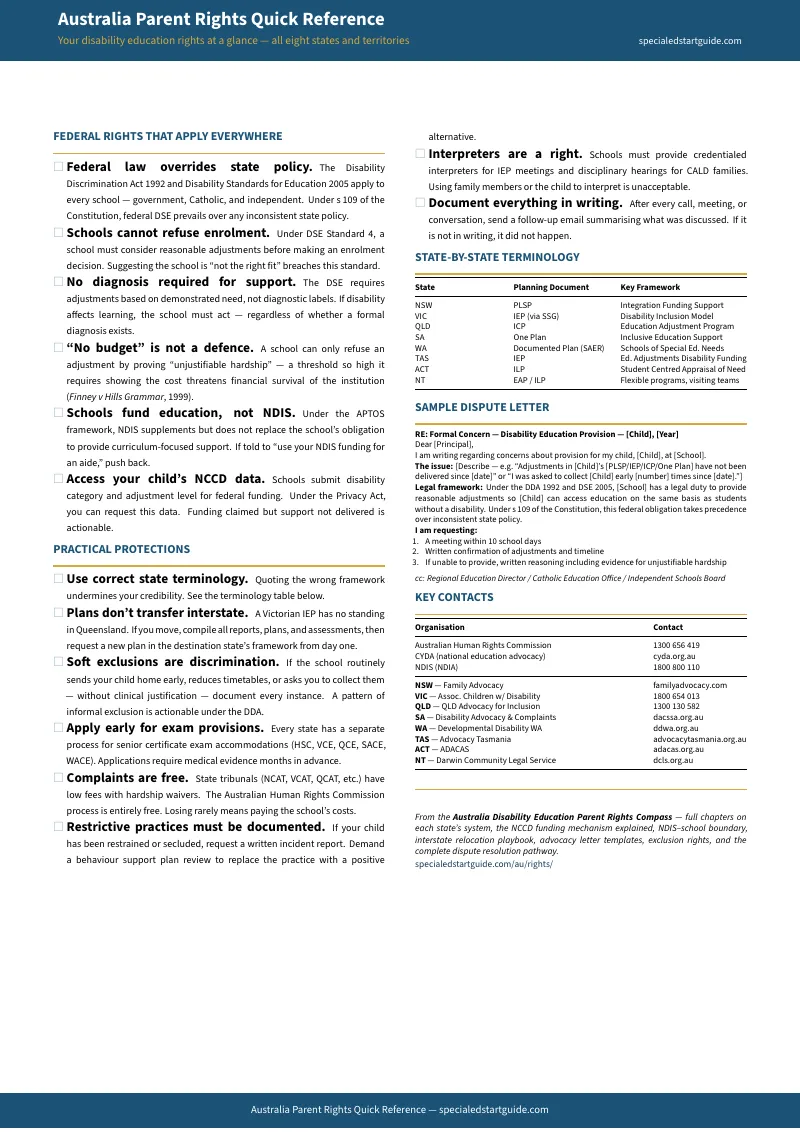
What Victoria calls a Student Support Group, Queensland calls an Education Adjustment Program. Your child's plan is an "IEP" in Victoria and Tasmania, a "Personalised Learning and Support Plan" in NSW, an "Individual Curriculum Plan" in Queensland, a "One Plan" in South Australia, and something different again in every other jurisdiction. This chapter maps all eight systems — terminology, planning documents, funding mechanisms, and escalation pathways — into a single reference so you never cite the wrong framework in a meeting.
The NDIS-Education Boundary — Definitively Drawn
Schools routinely tell parents "use your NDIS funding for an aide." The NDIA rejects those requests, stating "that's the school's educational responsibility." Parents are caught between two bureaucracies, each pointing at the other. This chapter maps the exact boundary using the Applied Principles and Tables of Support (APTOS): what the school must fund (learning assistants, modified curriculum, classroom adjustments, building modifications) versus what the NDIS covers (personal care, mobility equipment, non-educational therapy). Includes the response framework for when the school tries to shift its legal obligations onto your NDIS plan.
Reasonable Adjustments — What Schools Must Provide
A request for "extra time" is vague. A request for "25% additional time on timed assessments, consistent with the psychoeducational assessment recommendation dated [date], documented as a reasonable adjustment under DSE 2005" is enforceable. This chapter provides the adjustment framework organised by disability area — cognitive, sensory, social-emotional, physical, and communication — with the specific legal language that transforms aspirational requests into documented, actionable provisions.
School Exclusions and Restrictive Practices
Disability-related behaviours that lead to suspension, informal exclusion ("come collect your child early"), seclusion rooms, and physical restraint are addressed head-on. This chapter explains what constitutes lawful versus unlawful discipline under both the DDA and each state's published guidelines. If your child is being routinely sent home, that pattern of informal exclusion is documentable and actionable.
Dispute Resolution — From the Classroom to the Federal Court
When internal pathways fail, external enforcement exists. State anti-discrimination bodies (NCAT, VCAT, QCAT, SACAT, SAT), the Australian Human Rights Commission (free to lodge), the Commonwealth Ombudsman, and ultimately the Federal Court and Federal Circuit Court. This chapter maps every external complaint pathway with filing requirements, expected timeframes, and what evidence you need at each stage. Most disputes resolve before reaching a tribunal — but only when the school knows you understand the full escalation ladder.
Interstate Relocation — Protecting Your Child's Support
Moving from Melbourne to Brisbane means your child's Victorian IEP has no legal standing in Queensland. The terminology changes, the funding model changes, the planning documents change. This chapter provides the interstate transfer protocol — the documentation package to compile before you move, the first-week actions in the new state, and the comparison framework that ensures your child does not lose hard-won accommodations because two states use different names for the same thing.
The Advocacy Toolkit — Letters That Work
Twelve fill-in-the-blank templates citing the specific legislation that applies to each situation. Templates cover: formal reasonable adjustment requests, NCCD information requests, learning plan review demands, responses to "unjustifiable hardship" claims, escalation to the regional director, formal complaints to the principal, AHRC discrimination complaints, restrictive practice incident responses, requests for interim adjustments, and interstate transition letters. Replace the bracketed details. Send tonight.
Building Your Paper Trail
Every escalation is only as strong as the documentation behind it. This chapter gives you the evidence system: the contemporaneous log, the meeting preparation checklist, the communication tracker, and the method for organising reports, correspondence, and adjustment records into a structured case file. When you lodge a complaint, your documentation tells the story without requiring you to reconstruct it from memory.
Special Topics — First Nations, CALD, Twice-Exceptional, Rural
First Nations children, culturally and linguistically diverse families, twice-exceptional (2e) students, children in out-of-home care, and families in rural and remote Australia each face compounding barriers. This chapter addresses the specific legal protections, cultural considerations, and practical adaptations for each group.
Who This Guide Is For
- Parents whose school claims it "doesn't have the resources" to support their child — and who need to know what federal law says about that claim
- Parents navigating the NDIS-school boundary when both sides say the other is responsible
- Families moving interstate who need to translate their child's support plan from one state system to another without losing accommodations
- Parents entering their first Student Support Group, IEP, or planning meeting and wanting to know their rights before the school sets the agenda
- Parents who've discovered the school is claiming NCCD disability funding for their child but cannot see the corresponding classroom support
- Parents whose child has been suspended, sent home early, or placed on a reduced timetable for disability-related behaviours
- Parents in rural and regional Australia — Dubbo, Cairns, Geraldton, Launceston, Alice Springs — where advocacy services are scarce and the school is the only option
- Parents enrolled in government, Catholic, or independent schools — the DDA and DSE 2005 apply to all sectors equally
Why Not Just Use the Free Resources?
The Australian Human Rights Commission publishes the full legal text of the DSE 2005. The NCCD portal explains how schools collect data. CYDA provides excellent advocacy factsheets. The Raising Children Network gives a gentle overview. None of them tell you what to write in the email you need to send tonight when the school has been ignoring your requests for six months.
- Government websites explain the system's rules. This guide gives you the tools for when the system ignores them — the letter templates, the NCCD accountability framework, and the escalation procedures that Department websites were not designed to volunteer.
- CYDA and People with Disability Australia provide excellent advocacy principles. But their resources are scattered across dozens of separate PDFs and written with the diplomatic restraint required of federally funded organisations. They cannot teach you how to win an argument in a hostile SSG meeting.
- The Raising Children Network gives a gentle overview. But it doesn't explain the differences between eight state systems, doesn't map the NDIS-school boundary in detail, and doesn't provide the tactical escalation pathway for when polite requests are ignored.
- Etsy sells special education guides for American families. They reference IDEA, Section 504, and due process hearings — none of which exist in Australia. Quoting American law in an Australian school meeting instantly destroys your credibility.
- Private disability education advocates charge $130 to $180+ per hour. This guide gives you the legal framework, state-by-state translation, and correspondence templates those professionals use — for less than 15 minutes of a consultant's billable time.
Free resources are written by institutions to explain how the system works. This guide is written by parents, for parents, to show you what to do when the system stops working.
— Less Than 15 Minutes With a Disability Education Consultant
A private disability education advocate charges $130 to $180+ per hour. A single meeting attendance costs $300+. This guide gives you the federal legal framework, the state-by-state translation matrix, the NCCD accountability tools, the NDIS-school boundary map, and twelve advocacy letter templates — all reusable at every school meeting, every plan review, every state you move to.
Your download includes 6 PDFs, instant download:
- The Australia Disability Education Parent Rights Compass (14 chapters, 70 pages) — federal legal foundation (DDA 1992, DSE 2005, Section 109), the NCCD decoded with per-student funding figures, all eight state systems mapped (NSW, VIC, QLD, SA, WA, TAS, ACT, NT), the NDIS-education boundary definitively drawn, reasonable adjustments framework by disability area, school exclusion and restrictive practice rights, dispute resolution from classroom to Federal Court, interstate relocation protocol, twelve advocacy letter templates, evidence system, and special topics covering First Nations, CALD, 2e, and rural families
- Advocacy Letter Templates — all 12 fill-in-the-blank templates extracted as a standalone printable, citing specific legislation for each situation
- State-by-State Comparison Matrix — all eight jurisdictions at a glance: planning documents, funding models, tribunal pathways, and senior certificate exam accommodations
- Dispute Resolution Pathway — the complete escalation ladder from internal complaints through state tribunals to the Australian Human Rights Commission and Federal Court
- Key Contacts Directory — national organisations, state advocacy contacts, and exam accommodations authorities for every jurisdiction
- Australia Parent Rights Quick Reference (free) — 15-item rights checklist, state-by-state terminology table, sample dispute letter template citing the DDA 1992 and DSE 2005, and key contacts directory for all eight states and territories
Instant PDF download. Print an advocacy letter tonight. Send it before your next school meeting.
Money-back guarantee, no time limit. If this guide doesn't change how you navigate school meetings, email us for a full refund. No questions asked.
Not ready for the full guide? Download the free Australia Parent Rights Quick Reference — a 15-item rights checklist covering federal law supremacy, NCCD accountability, the NDIS boundary, and state-by-state terminology, plus a ready-to-send dispute letter template and key contacts for all eight states and territories. It's enough to walk into your next meeting knowing your rights, and it's free.
The next time a school says "we don't have the resources," you'll know exactly what the federal law says — and where to send the letter when they don't listen.