
The School Said "We'll Get to It." That Was Eight Months Ago.
You know something is wrong. Your child melts down every night over homework that should take 20 minutes. The teacher mentioned "maybe getting assessed" at last term's meeting — then nothing happened. You called a private psychologist and heard "$2,800 and a four-month wait." You looked up what the school is supposed to do and drowned in acronyms you'd never seen before: NCCD, DSE, DIP, EAP, ILP, QDTP. You found the Department of Education website and read three pages of policy language that somehow managed to explain your child's rights without telling you a single concrete thing to do about it.
Meanwhile, your child is falling further behind every week. One in four Australian students receives educational adjustments for a disability — over a million children. Nearly 60% of students with disability report significant difficulty at school. And 40% of those currently receiving support say it is not enough. The system processes children by the thousand. Yours is one of them, and no one is treating it as urgent.
The Australia Disability Assessment Decoder is a national assessment navigation system that translates federal legislation, all eight state and territory bureaucratic frameworks, clinical assessment options, and cost-mitigation pathways into a single, actionable document. It tells you exactly what assessment to request, how to get it without spending thousands, what the school is legally required to do while you wait, and what to do when the answer is no — grounded in the Disability Discrimination Act 1992, the Disability Standards for Education 2005, and each jurisdiction's own published policy.
What's Inside the Guide
Your Legal Foundation
The DDA 1992 and DSE 2005 create obligations that bind every school in Australia — government, Catholic, and independent. Schools must provide reasonable adjustments based on functional need, not diagnostic labels. A formal diagnosis is not required before the school must act. This chapter gives you the specific statutory provisions, the landmark case law (Finney v. Hills Grammar, Phu v. Minister for Education), and the exact compliance language that transforms your emails from requests into documented legal correspondence.
The NCCD Decoded — How Federal Funding Really Works
The Nationally Consistent Collection of Data drives billions in federal disability funding, but most parents have never heard of it. Schools must document 10 weeks of educational adjustments before the August census to secure funding for each student. This chapter explains the four adjustment levels (QDTP through Extensive), how to request your child's NCCD categorisation in writing, and how to use the school's own funding mechanism as leverage for securing consistent support. When the school needs your child's adjustments documented to get paid, you become the person ensuring the documentation actually happens.
Every Assessment Type — What They Test, What They Cost, How Long They Take
When the school says "get an assessment," they could mean five fundamentally different evaluations conducted by different professionals at vastly different price points. Psychoeducational assessments ($1,500–$3,000 private), autism diagnostic evaluations ($2,600–$5,500), OT and speech assessments ($300–$800 each), behavioural functional assessments — this chapter maps the full landscape so you know what you actually need before you spend anything. Includes the specific tools used (WISC-V, WIAT-III, Vineland-3, ADOS-2), what each tool measures, and which assessment answers which question.
The Cost Mitigation Playbook
Private psychoeducational assessments cost thousands. University psychology clinics — Monash Krongold, UQ Psychology Clinic, Macquarie University, Western Sydney — offer comprehensive evaluations conducted by provisional psychologists under expert supervision for $300–$600, with some offering concession rates under $100 per session. This chapter maps every low-cost pathway: university clinics across Australia, Medicare Better Access rebates for neurodevelopmental assessments, NDIS-funded assessment options, state-funded specialist services, and how to navigate GP referrals to maximise rebates. The assessment your child needs does not require $3,000 — it requires knowing where to look.
The 8-State Translation Matrix
Australia runs eight entirely separate special education systems. Your child's individualised plan is called the "One Plan" in South Australia, the "Disability Inclusion Profile" in Victoria, the "Education Adjustment Program" in Queensland, the "Individual Pathway Plan" in Western Australia, and something different again in every other jurisdiction. Funding mechanisms, assessment referral processes, and escalation pathways vary by state. This chapter translates all eight systems into a single reference — so whether you live in Sydney, Perth, Hobart, or Darwin, you know exactly what your child's support framework is called, who administers it, and how to access it.
The NDIS-Education Boundary
Schools that cannot manage a student's needs routinely tell parents "that's an NDIS matter." The NDIS tells parents it does not fund educational supports. Your child falls into the gap between two systems, each pointing at the other. This chapter maps the exact boundary: what the school must provide (learning assistants, modified curriculum, classroom adjustments, building modifications) versus what the NDIS funds (personal care, mobility equipment, non-educational therapy). Includes the response framework for when the school tries to shift its legal obligations onto your NDIS plan.
Requesting an Assessment When the School Says No
The school says your child "doesn't meet the criteria" or "the waitlist is closed." This chapter gives you the escalation pathway — from the initial written request (citing DSE 2005 obligations) to the principal, to the learning support coordinator, to the regional office, to the state complaints body. Each step includes what to say, who to send it to, what response to expect, and the specific trigger for escalating further. Schools respond to documented, legally framed requests because they are trained to manage compliance risk — not because they want to.
Dispute Resolution — From the Classroom to the Federal Court
When every internal pathway fails, external enforcement exists. State anti-discrimination bodies (VEOHRC, Anti-Discrimination NSW, QHRC), the Australian Human Rights Commission, the Commonwealth Ombudsman, and ultimately the Federal Court and Federal Circuit Court. This chapter maps every external complaint pathway with filing requirements, expected timeframes, and what evidence you need at each stage. Most disputes resolve before they reach a tribunal — but only when the school knows you understand the full escalation ladder.
Fill-in-the-Blank Letter Templates
Every template cites the specific legislation and policy framework that applies to the situation. Replace the bracketed details with your child's information and send. Templates cover: initial assessment requests, follow-up when the school doesn't respond, requests for your child's NCCD categorisation, challenges to inadequate individualised plans, responses when the school says "get a private assessment," formal complaints to the principal, escalation to the regional director, AHRC discrimination complaints, and requests for interim adjustments while awaiting assessment. Each template is written to position you as a documented, legally informed advocate.
The Evidence System
Every escalation you make is only as strong as the documentation behind it. This chapter gives you the 10-week evidence tracker aligned to NCCD requirements, the meeting preparation checklist, the communication log template, and the system for organising clinical reports, school correspondence, and adjustment records into a structured case file. When you eventually meet with a regional director or lodge a complaint, your documentation tells the story without requiring you to reconstruct it from memory.
Accommodation Planning
Once you have assessment results, you need to translate them into specific, documented classroom adjustments. This chapter provides the accommodation request framework organised by disability area — cognitive, sensory, social-emotional, physical, and communication — with the specific DSE 2005 language that makes each request actionable rather than aspirational. A request for "extra time" is vague. A request for "25% additional time on timed assessments, consistent with the psychoeducational assessment recommendation dated [date], documented as a reasonable adjustment under DSE 2005" is enforceable.
National Resources and Advocacy Contacts
Every state and territory disability advocacy organisation, education department complaints pathway, anti-discrimination body, university psychology clinic, and relevant federal agency — compiled into a single directory. Includes the parent advocacy organisations that offer free support (ACD Victoria, AEIOU Foundation, Amaze, CYDA, SPELD affiliates, Learning Links) and the circumstances where each organisation can help.
Who This Guide Is For
- Parents whose child is struggling at school and who suspect a learning difficulty, developmental delay, or disability — whether or not they have a diagnosis
- Parents whose school has suggested "getting an assessment" but offered no clear pathway, timeline, or support while waiting
- Parents on a 12-month school psychologist waitlist who need to know what alternatives exist and what the school must do in the meantime
- Parents who've been told to "get a private assessment" without being told about university psychology clinics that charge a fraction of private rates
- Parents who need to understand the NCCD and how to use the school's own funding mechanism to secure documented support
- Parents navigating the NDIS-education boundary — especially when the school says "that's an NDIS matter" for adjustments it's legally required to provide
- Parents who've relocated interstate and need to translate their child's support plan into the new state's framework
- Parents in rural and regional Australia — Dubbo, Cairns, Geraldton, Launceston, Alice Springs — where private assessment options are limited and advocacy services are scarce
- Parents enrolled in government, Catholic, or independent schools — the DDA and DSE 2005 apply to all sectors equally
Why Not Just Use the Free Resources?
The Department of Education's website tells you the school must make reasonable adjustments. The NCCD portal explains how data is collected. The Australian Human Rights Commission outlines your legal rights. None of them give you the assessment request letter to send tonight when the school has been "working on it" for eight months.
- Government websites explain the system's rules. This guide gives you the tools for when the system ignores them — the letter templates, cost-saving pathways, and escalation procedures that Department websites are not designed to volunteer.
- AUSPELD's guide is scientifically excellent for dyslexia. But it doesn't cover ADHD, autism, intellectual disability, or the broader spectrum of conditions — and it doesn't touch the NCCD, NDIS boundary, or state-by-state funding frameworks.
- Advocacy organisations like ACD and CYDA offer free support. But when you need to send a formal assessment request before tomorrow's meeting and the helpline opens at 9 AM, this guide is the advocate in your inbox tonight.
- Etsy and Amazon sell special education guides for American families. They reference IDEA, Section 504, and due process hearings — none of which exist in Australia. Using American terminology in an Australian school meeting signals you don't understand the system you're navigating.
- Private educational advocates charge $200+ per hour. Private psychoeducational assessments cost $2,000–$3,000. This guide gives you the assessment navigation roadmap, cost-mitigation strategies, and legal correspondence templates those professionals use — at a fraction of a single billable hour.
Government resources are written to protect the Department's budget and liability. This guide is written to get your child assessed.
— Less Than 10 Minutes With a Private Educational Psychologist
A private psychoeducational assessment costs $1,500 to $3,000. A private educational advocate charges $200+ per hour. A single meeting attendance costs $400+. This guide gives you the assessment pathways, cost-mitigation strategies, letter templates, and legal escalation framework that those professionals use — and you can reuse them at every school meeting, every assessment referral, every state you move to.
Your download includes 7 PDFs, instant download:
- The Australia Disability Assessment Decoder (12 chapters) — federal legal framework (DDA 1992, DSE 2005), the NCCD decoded with the 10-week evidence strategy, every assessment type with costs and tools, the cost mitigation playbook with university clinic directory, the 8-state translation matrix, NDIS-education boundary mapping, assessment request escalation pathways, dispute resolution from classroom to Federal Court, fill-in-the-blank letter templates, evidence system framework, accommodation planning by disability area, and national advocacy contacts directory
- Letter Templates (7 ready-to-send templates) — assessment request, interim adjustment demand, regional escalation, NCCD information request, external assessment consideration, formal complaint, and records request — each citing the specific legislation that applies
- State Translation Matrix — all 8 state and territory education systems on one page: learning plan names, funding frameworks, and assessment mechanisms, plus the interstate transfer checklist
- NDIS-Education Boundary Card — the colour-coded responsibility matrix showing exactly what the school must pay for versus what the NDIS covers, with the rebuttal script for when the school says "that's an NDIS matter"
- Accommodation Reference Card — evidence-based classroom accommodations organised by NCCD disability category (cognitive, physical, sensory, social-emotional) with checkbox format for school meetings
- 10-Week Adjustment Tracker — the fillable worksheet aligned to NCCD census requirements, plus the weekly evidence log and follow-up email formula
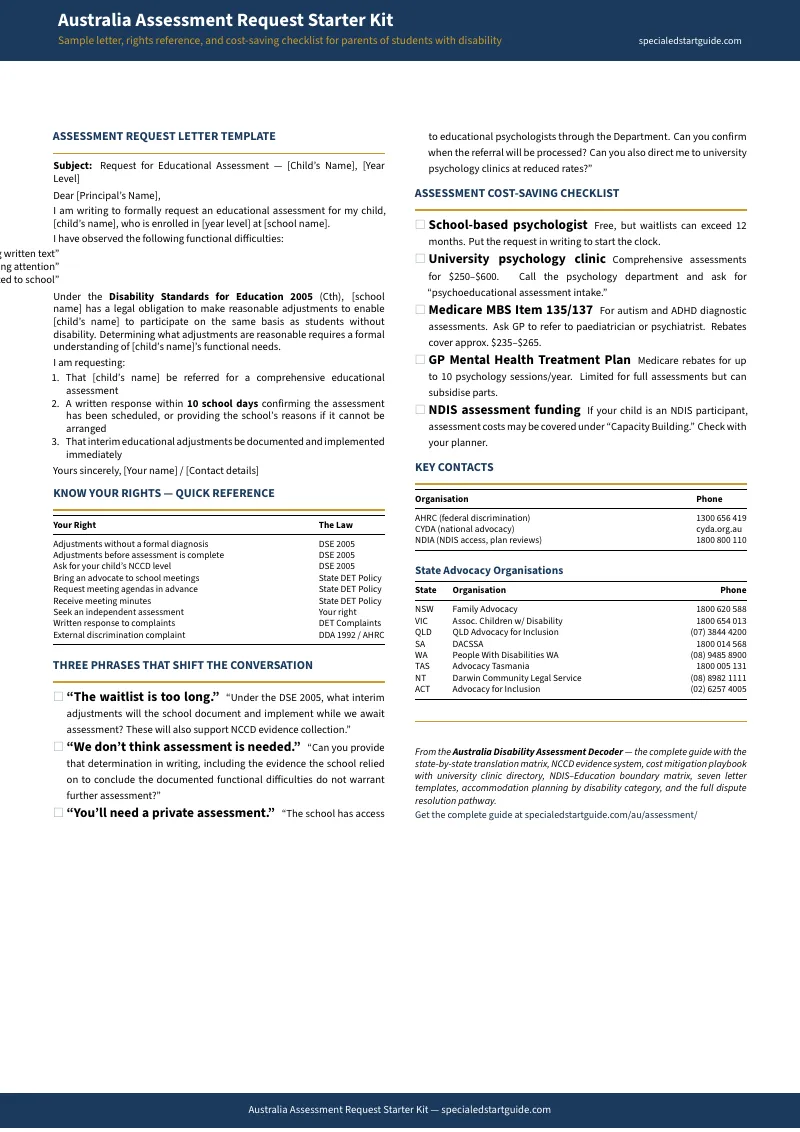
- Australia Assessment Request Starter Kit (free) — ready-to-send assessment request letter template citing the DSE 2005, parent rights quick-reference table, three power phrases for common school pushback scenarios, and assessment cost-saving checklist with low-cost pathways most parents never hear about
Instant PDF download. Print the assessment request letter tonight. Send it before your next school meeting.
Money-back guarantee, no time limit. If this guide doesn't change how you navigate the assessment process, email us for a full refund. No questions asked.
Not ready for the full guide? Download the free Australia Assessment Request Starter Kit — a ready-to-send assessment request letter, parent rights one-pager, three power phrases for school pushback, and the cost-saving checklist that reveals pathways most parents never hear about. It's enough to send a legally grounded assessment request tonight, and it's free.
The next time the school says "we'll get to it," you'll know exactly what to write — and where to send it when they don't.