The Virginia DD waiver waitlist is needs-based, not first-come first-served — and most families find that out too late
You contacted the Community Services Board. They confirmed your child is on the waiting list. And then — silence. An annual letter. A priority level you're not sure how to change. A system that seems to reward documentation you were never told to keep.
Virginia's DD waiver system runs on a set of assessments, scoring tools, and committee reviews that determine who gets a slot next: the VIDES, the Priority Needs Checklist, the Critical Needs Summary, the Slot Assignment Review Form, the WSAC. These are public processes governed by 12VAC30-122 — but the state's own materials explain the rules without explaining how to navigate them. What you document, how you document it, and when you report a change in your family's circumstances directly shapes where you land in the scoring.
The Virginia DD Waiver Navigation System is a 42-page guide and five planning worksheets built around one principle: the families who document their needs thoroughly and report changes promptly are the ones whose priority profiles actually reflect their situation when slots are scored.
What's inside
- VIDES assessment walkthrough — the eight functional domains the CSB evaluates, what "without informal supports" means in practice, and how to prepare documentation that reflects your child's unassisted baseline rather than what they can do with family help stepping in
- Priority Needs Checklist breakdown — the specific criteria that separate Priority One from Priority Two and Three under 12VAC30-122-90, including the life-event triggers (caregiver health crisis, ageing out of school services, loss of housing) that warrant an immediate update to your Support Coordinator
- Critical Needs Summary and WSAC scoring — how the Critical Needs Summary selects Priority One candidates for review, how the committee scores coded Slot Assignment Review Forms and recommends by need, and why DBHDS makes the final slot decision rather than using chronological waiting time
- All three waivers compared — Building Independence, Family and Individual Supports, and Community Living side by side: who each is designed for, what each funds, annual cost baselines, and service caps so you understand what a slot actually means before you're asked to accept or decline one
- Post-offer action timeline — the step-by-step sequence when a slot is offered, including the Medicaid financial application, service facilitation setup, and the 15-calendar-day confirmation window, with a checklist so nothing slips through
- Age-18 transition map — how IEP transition planning, SSI, adult Medicaid, DARS vocational rehabilitation, and the DD waiver waiting list intersect at the hand-off to adult services, with the specific Priority One criterion under 12VAC30-122-90 that applies only between school exit and age 27
- Denial and appeal guide — what to do when a VIDES screening comes back ineligible, how the administrative appeal timeline works (with the good-cause extension), and how to file a formal complaint with DBHDS if the CSB refuses a re-assessment
- Five fillable planning worksheets — a CSB Intake Checklist, a Factual Needs Log aligned to the eight VIDES domains, a Notice and Deadline Organiser for PNC and CNS reviews, a Support Coordination Communication Log, and a Waiver Offer Decision Matrix
Who this is for
- Parents of a child with a developmental disability who have just been told about the DD waiver waiting list and want to understand the full application and assessment process before the first CSB meeting
- Families already on the waiting list in Priority Two or Three whose circumstances have changed and need to know exactly what to report, to whom, and how to ensure the change is reflected in their priority profile
- Parents of teenagers approaching the transition out of school-based services who need to coordinate the waiver waiting list with IEP transition planning, SSI, and adult Medicaid
- Young adults with developmental disabilities navigating the system on their own terms, including supported decision-making alternatives to guardianship
Why not just use the free state information?
You should use it — and the guide tells you exactly where to find it. The CSB screening, DBHDS policy documents, The Arc of Virginia's advocacy guides, and PEATC's transition toolkits are all free and all valuable. What none of them do is put the full workflow into a single document with fillable tracking tools.
CSB Support Coordinators manage high caseloads and assess what you bring to the table — they rarely coach families on how to organise their documentation before a meeting. The state regulations explain what Priority One criteria are, but not how to recognise that your family's situation has met one. The guide fills the gap between understanding the rules and being ready when the rules apply to you.
What this guide will not do
It will not get your child off the waiting list faster. Slot assignments depend strictly on the WSAC's scoring of documented need — no guide, consultant, or advocate can bypass state priority criteria. It will not give you legal, financial, or medical advice. It will not replace your Support Coordinator, the CSB, or the free help available from The Arc of Virginia and the disAbility Law Center of Virginia. It is an independent navigational resource, not an official state publication.
Satisfaction guarantee
Every purchase comes with a full refund, no time limit. If the guide isn't what your family needs, email [email protected] and we'll refund you in full.
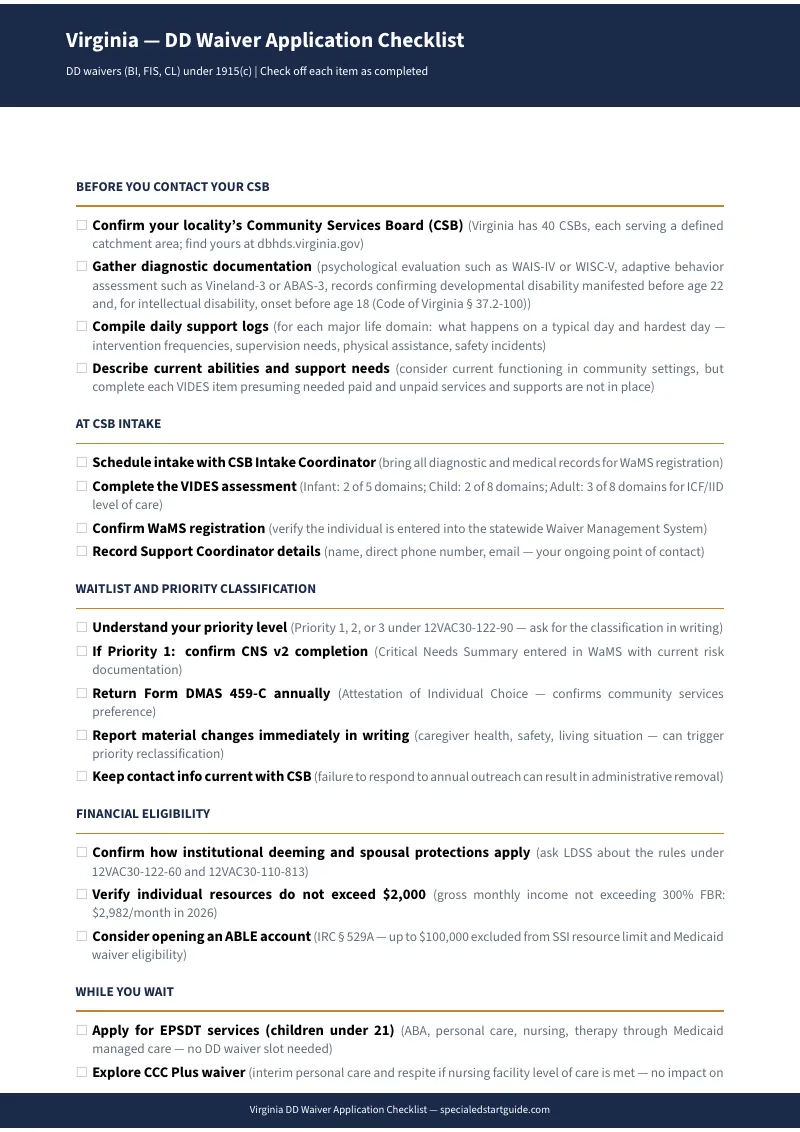
The free checklist gives you the overview. The full guide gives you the system.
Get the Virginia DD Waivers Guide →
Frequently Asked Questions
What if the rules change after I buy?
We update the guide when the rules change. Email us any time, even years later, and we'll send you the current edition free.