
The School Sent a 30-Page Evaluation Report Full of Standard Scores, T-Scores, Percentile Ranks, and Index Composites. Your Child's Eligibility Meeting Is Thursday. You Cannot Understand a Single Page. This Guide Translates Every Number Into Plain English and Tells You Exactly What to Say.
Your child's evaluation report arrived. You opened it expecting clarity. Instead, you found 30 pages of clinical data: a Full Scale IQ of 94, a Processing Speed Index of 78, a Verbal Comprehension Index of 118, T-Scores ranging from 42 to 71, percentile ranks that seem to contradict the standard scores, and phrases like "statistically significant discrepancy with a base rate of 3.8%." You read it three times. You still cannot tell whether your child qualifies for services.
The eligibility meeting is in four days. Credentialed professionals will sit across from you and use this data to determine your child's educational future. They will interpret the numbers quickly, using clinical shorthand that assumes you already understand the difference between a Scaled Score of 7 and a Standard Score of 85. They will spend approximately 15 minutes on a report that took the school psychologist eight hours to write. If you wait until the meeting to hear the explanation, you will be reacting instead of advocating.
So you started searching. You found Understood.org — empathetic and accessible, but it explains what an evaluation is, not what a 40-point gap between Verbal Comprehension and Processing Speed means for your child's accommodations. You found Wrightslaw — the definitive legal reference, but structured like an academic textbook that requires hours of reading you do not have. You found Reddit threads where other parents post their child's WISC-V scores begging for help, and the replies say "talk to the school psychologist" — the same person whose report you cannot understand. You found Teachers Pay Teachers brochures that define what an IEP is. They do not explain what a BASC-3 T-Score of 65 in the Externalizing Problems composite means for eligibility under Emotional Disturbance.
You are not lacking information. You are lacking a translation tool. The clinical data exists. The plain-English explanation of that data — connected to the specific accommodations, eligibility categories, and advocacy strategies it implies — does not exist in any single resource. Until now.
The United States Special Ed Assessment Decoder is the Evaluation Report Translation System — the 12-chapter reference guide that takes every major psychometric instrument school districts use, explains what each score means in language parents can immediately understand, shows you exactly how those scores connect to the 13 IDEA disability categories, and gives you the specific language to use at the eligibility meeting when the numbers support services the school is reluctant to provide.
What's Inside the Decoder
The Scoring System Translated — Every Metric on One Page
School evaluations use four different scoring systems simultaneously — Standard Scores (mean 100), Scaled Scores (mean 10), T-Scores (mean 50), and percentile ranks — and the report never explains how they relate to each other. A Standard Score of 85 puts your child at the 16th percentile. A T-Score of 65 on a behavior scale means clinically significant problems. A Scaled Score of 4 on a WISC-V subtest indicates a severe deficit. The guide provides the complete conversion system so you can instantly translate any number on any page of any evaluation report into a plain-English severity classification: average, below average, or clinically significant.
25+ Assessment Tools Decoded — The Exact Instruments Schools Administer
The WISC-V measures cognitive ability across five domains. The Woodcock-Johnson IV measures academic achievement in reading, math, and written expression. The BASC-3 captures behavioral and emotional functioning through rating scales. The Conners-4 identifies ADHD-related attention and executive functioning deficits. The ADOS-2 and CARS-2 assess autism. The CELF-5 evaluates language processing. The Vineland-3 measures adaptive behavior. The Beery VMI assesses visual-motor integration. Each tool is explained in parent-friendly language: what it tests, what the scores mean, what a low score implies for your child's daily functioning, and which IDEA disability category it maps to.
The Subtest Scatter Playbook — What Uneven Scores Actually Mean
Your child scored in the 95th percentile for Verbal Comprehension but the 12th percentile for Processing Speed. The school says the Full Scale IQ is "average" and wants to close the case. But that 40-point gap is not average — it reveals a child who understands complex concepts but physically cannot produce written output at a pace the classroom demands. The guide explains exactly what scatter patterns mean, which ones are statistically significant, and the specific accommodations each pattern demands: extended time, oral exams, reduced writing load, assistive technology, or modified assignments. You will know what to ask for and exactly which data point supports it.
The 13 IDEA Disability Categories — Which Tests Map to Which Eligibility
The school says your child "does not meet criteria." Criteria for what? Under which category? IDEA defines 13 disability classifications, each requiring specific types of assessment evidence. Specific Learning Disability requires documented achievement deficits in reading, math, or writing. Other Health Impairment (the category that captures ADHD) requires evidence that a chronic condition adversely affects educational performance. Autism requires documentation of social communication deficits and restricted behaviors. The guide maps every assessment tool to every eligibility category — so when the team says "does not qualify," you can identify exactly which category they evaluated, which ones they missed, and whether they tested in all areas of suspected disability as IDEA requires.
The IEE Strategy — How to Make the District Pay for a Second Opinion
A private psychoeducational evaluation costs $2,000 to $4,000. A neuropsychological evaluation can exceed $8,000. Before you spend that money, learn how to use the school's own data against them. Under 34 CFR §300.502, you have the right to an Independent Educational Evaluation at public expense if you disagree with any part of the district's evaluation. The guide walks you through identifying the clinical flaws — untested areas, outdated instruments, missing behavior scales, narrow assessment scope — that legally justify an IEE request. It includes a ready-to-send IEE demand letter with the federal citations that trigger the district's legal obligation to either fund your evaluation or file for due process to defend their own.
Medical Diagnosis vs. Educational Classification — Why They Disagree
Your pediatrician diagnosed ADHD. Your neuropsychologist confirmed autism. The school says your child "does not qualify for an IEP." This is the single most common source of rage and confusion in special education. The guide explains exactly why medical and educational systems reach different conclusions — they use different criteria, different thresholds, and different definitions of "impact" — and shows you how to bridge the gap by documenting adverse educational performance beyond grades: homework duration, compensatory effort, social-emotional functioning, and classroom behavior data that the school may be ignoring.
The Three SLD Identification Models — How Your State Determines Learning Disabilities
There is no single method for identifying a Specific Learning Disability. Some states use the Ability-Achievement Discrepancy model (comparing IQ to achievement). Others use Response to Intervention (tracking response to classroom interventions). A growing number use the Pattern of Strengths and Weaknesses model (looking for cognitive processing deficits). Your state may use one, two, or all three. The guide explains each model, its strengths, its weaknesses, and what it means for your child's evaluation — because the model the school uses determines which test scores matter most for eligibility.
Ready-to-Use Letter Templates
Two fully drafted letter templates: one for requesting an initial evaluation under IDEA (34 CFR §300.301), and one for demanding an Independent Educational Evaluation at public expense (34 CFR §300.502). Each letter includes the federal regulation citations that trigger the district's legal timeline, specific language requesting assessment in "all areas of suspected disability," and instructions for documenting delivery. Send them as-is or adapt them to your situation.
The Evaluation Report Audit Checklist
A systematic 11-point checklist for reviewing any psychoeducational evaluation report: Were all areas of suspected disability assessed? Were parent input forms included? Were behavior rating scales administered to both parents and teachers? Were assessments conducted in the child's native language? Were technically sound, current-edition instruments used? If you can check every box, the evaluation is likely comprehensive. If you cannot, you have documented grounds for requesting additional testing or an IEE.
Who This Decoder Is For
- American parents who just received a psychoeducational evaluation report and need to understand it before the eligibility or IEP meeting — this week
- Parents whose child has a private medical diagnosis (ADHD, autism, dyslexia) but the school says they "do not qualify" for an IEP — and who need to understand why the results diverge and how to bridge the gap
- Parents who suspect the school's evaluation was too narrow — testing only academics when cognitive processing, behavior, and social-emotional functioning should have been assessed too
- Parents considering a private evaluation at $2,000 to $8,000 and who want to understand the school's free evaluation first — or identify its flaws to get the district to pay for a second opinion through an IEE
- Parents of twice-exceptional (2e) children whose high IQ masks significant processing deficits — and who need to understand why "gifted but struggling" still qualifies for services
- Parents navigating a re-evaluation (triennial review) who want to compare current results against previous testing and identify regression or emerging needs
- Parents who feel intimidated by credentialed professionals in IEP meetings and want to walk in with the same understanding of the data that the school psychologist has
Why Not Free Resources?
Free resources for understanding evaluations are not bad. Several are excellent. They are structurally unable to do what this guide does. Here is exactly where each one stops:
- Understood.org explains what an evaluation is — in empathetic, accessible language that never reaches the actual test data. It will tell you that evaluations assess "how your child thinks and learns." It will not tell you what a WISC-V Processing Speed Index of 78 means, which accommodation that score demands, or how a 40-point scatter between Verbal Comprehension and Processing Speed affects eligibility. This Decoder translates the specific numbers on your child's specific report.
- Wrightslaw publishes the definitive legal references — structured like academic textbooks designed for attorneys and seasoned advocates. Their All About Tests and Assessments book is comprehensive but dense, legalistic, and requires physical shipping. If you need to understand WISC-V results by Thursday, a 300-page textbook arriving next week cannot help. This Decoder is an instant download, searchable, and organised by assessment tool so you can find answers in minutes.
- Teachers Pay Teachers sells IEP brochures for $6 to $7 — written for teachers to hand to parents, not for parents to advocate with. They define the IEP process. They do not decode BASC-3 T-Scores, explain subtest scatter, or map assessment results to IDEA eligibility categories. This Decoder is built for the parent who needs to walk into the eligibility meeting as an equal member of the team.
- Clinical psychology blogs provide deep breakdowns of specific tests — scattered across dozens of private practice websites with no consolidation. One blog in New York explains the WISC-V. A different blog in Texas explains the BASC-3. A third covers the Woodcock-Johnson. Assembling these fragments into a coherent understanding of your child's complete evaluation takes 15+ hours of anxious searching. This Decoder puts 25+ assessment tools in one document.
- Reddit threads feature parents posting their child's scores and begging for interpretation — from strangers who cannot see the full report. The advice is well-intentioned and dangerously incomplete. A single score without context — without the scatter pattern, without the behavior scales, without the achievement data — cannot be meaningfully interpreted. This Decoder teaches you how to read the full picture yourself.
— Less Than 1% of a Private Evaluation
A private psychoeducational evaluation costs $2,000 to $4,000. A comprehensive neuropsychological evaluation runs $3,000 to $8,000, with waitlists of 3 to 6 months. Special education advocates charge $150 to $300 per hour. An educational attorney charges $300 to $500 per hour.
This Decoder does not replace a private evaluation for complex diagnostic questions. It does something no private evaluation can do: it teaches you how to read any evaluation report yourself. It gives you the vocabulary to identify clinical flaws, the legal framework to demand comprehensive testing, and the advocacy language to connect your child's scores to the services they need. One guide. Every evaluation. Every meeting. For the rest of your child's school career.
Your download includes 9 PDFs:
- United States Special Ed Assessment Decoder (guide.pdf) — The complete 12-chapter guide covering your IDEA evaluation rights, the three SLD identification models, 25+ assessment tools decoded in plain English, the scoring system translation, subtest scatter interpretation, the 13 IDEA disability categories crosswalk, IEE rights and strategy, evaluation dispute resolution, letter templates, and the evaluation report audit checklist
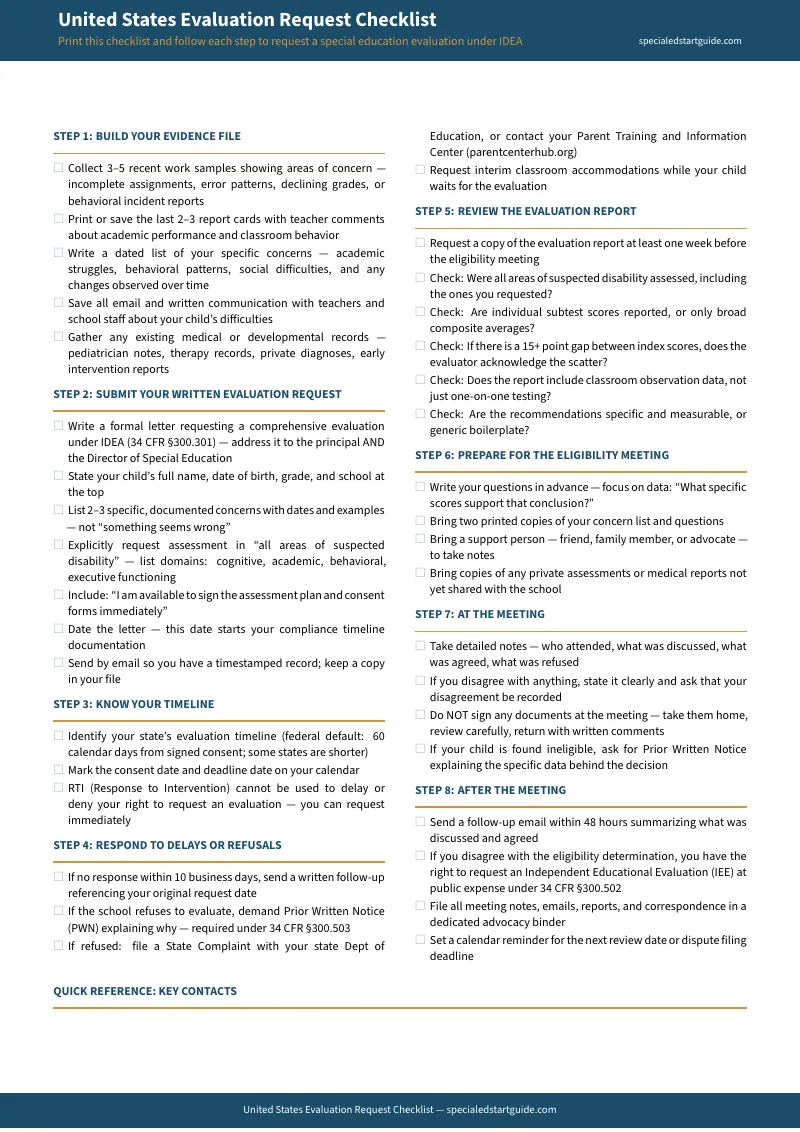
- Quick-Start Evaluation Checklist (checklist.pdf) — 8-step checklist covering evidence building, the written evaluation request, state timelines, responding to delays, preparing for the eligibility meeting, and next steps
- Score Translation Reference Card (score-reference-card.pdf) — One-page printable card with Standard Score, T-Score, Scaled Score, and percentile rank conversion tables
- Assessment Tools Quick Reference (assessment-tools-reference.pdf) — All 25+ assessment tools on a compact reference sheet: what each test measures, age range, and which IDEA category it maps to
- 13 IDEA Categories Crosswalk (idea-categories-crosswalk.pdf) — Tabular map of all 13 disability categories with assessment batteries and common disputes
- Evaluation Report Audit Checklist (evaluation-audit-checklist.pdf) — Printable 11-point checklist for reviewing any psychoeducational evaluation report
- Evaluation Request Letter Template (evaluation-request-letter.pdf) — Ready-to-send letter requesting a special education evaluation under IDEA (34 CFR §300.301)
- IEE Request Letter Template (iee-request-letter.pdf) — Ready-to-send letter demanding an Independent Educational Evaluation at public expense (34 CFR §300.502)
- Eligibility Meeting Preparation Checklist (meeting-prep-checklist.pdf) — Printable before/during/after checklist for your child's eligibility meeting
You can also download the Quick-Start Evaluation Checklist for free — a standalone 8-step checklist with the evaluation request letter framework, state timeline reference, and evidence-building steps, so you can take action immediately before committing to the full Decoder.