Your child's school team mentioned the LIDDA. Nobody explained what happens next.
The school district had an IEP, a transition meeting, maybe a referral letter. Then graduation happened, and overnight the structured support ended. Now there is a Local Intellectual and Developmental Disability Authority — a LIDDA — that serves your county, and it is the single point of access to certain publicly funded adult IDD services and supports in Texas. Getting through that door means assembling the right evidence, understanding the eligibility rules that your LIDDA actually applies, and knowing what services and funding sit on the other side — not just the waiver interest lists everyone warns you about, but the General Revenue services that may be available now.
The problem is not a lack of information. The rules are on the HHSC website, in 26 TAC Chapter 304, in provider manuals written for clinicians. The problem is that the information is scattered across dozens of pages, written for state employees, and organised around agency processes — not around what a family actually needs to do, and in what order, to get from "we were told to contact the LIDDA" to "we have services in place."
The Texas LIDDA Adult IDD Services Guide is a structured intake-to-decision roadmap: one document that walks you through contacting your regional LIDDA, preparing the evidence for a Determination of Intellectual Disability, understanding the services and funding that can follow, and exercising your rights when the answer is no.
What's Inside
- Source-linked evidence organiser — a structured record-assembly checklist keyed to the three DID evidence pillars (standardized intellectual assessment, adaptive behavior evaluation, developmental-period onset), with space to log every document gathered and every deadline tracked. Prepares the records an Authorized Provider reviews under 26 TAC §304.401 so your family walks into the intake meeting with everything organised, not scattered across old school folders and medical files
- Eligibility rules decoded in plain language — the statutory criteria under 26 TAC Chapter 304, the priority population definition, the distinction between a clinical diagnosis and state service eligibility, and the IQ, Adaptive Behavior Level, and age-of-onset thresholds that evaluators actually apply — explained without clinical jargon
- The DID process from start to finish — what an Authorized Provider reviews, what a certified Authorized Provider can do that an AP cannot, how school Full and Individual Evaluations transfer into the adult system, what endorsement means and what happens when it does not come through
- Intake-to-decision workflow map — step-by-step tracking from the first phone call to your regional LIDDA through the DID evaluation and Form 8578, plus the scheduled February 1, 2027 transition of Form 8578-CFC for CFC Non-Waiver from CARE to LTCOP
- General Revenue services and what they actually include — service coordination, respite, community support, day habilitation, and supported employment funded through state General Revenue. These exist outside of the long-term Medicaid waiver interest lists — available where your LIDDA has capacity, subject to eligibility and possible local interest lists
- Interest list clarity — the difference between a local General Revenue interest list and a statewide Medicaid waiver interest list (HCS, TxHmL), how list position is determined, how to maintain your place, and what to do while waiting
- Notice and review action checklist — how to read a formal LIDDA decision notice, how to request an administrative hearing within 30 days after the LIDDA gives you a DID report under the HHSC LIDDA Rights Handbook, how to request an independent DID evaluation, the HHSC fair hearing process, and the Ombudsman route
- Person-centered meeting preparation — worksheets that ensure the young adult's own preferences, choices, and voice lead the planning meeting instead of being written in by someone else. Covers Supported Decision-Making Agreements as an alternative to guardianship, so the young adult keeps their rights and chooses the help they get
- County routing and relocation — which of Texas's 39 LIDDAs covers your county, what to bring to the first call, and how the §304.404 transfer process works when a family moves between local service areas
- Intake phone log — a structured log for recording every call, contact name, and commitment from your LIDDA, so nothing said on the phone disappears
Who This Guide Is For
This is for families and young adults in Texas navigating the transition from school-based special education into the adult IDD service system — or responding to a LIDDA decision they need to understand and possibly challenge.
- Parents whose child is in their last years of school and who have been told to contact the LIDDA before graduation — but were not given a roadmap for what that means
- Young adults turning 18 who want to lead their own intake meetings and make their own service decisions
- Siblings or relatives who have just taken over caregiving and need to establish local eligibility quickly — possibly after a move across county lines
- Families who received a denial letter from the LIDDA and need to understand the review and hearing options before deadlines run
- Anyone on a Medicaid waiver interest list who does not know what General Revenue services may be available right now
Why Not Just Read the HHSC Website?
You can. Every administrative code, form, and provider manual cited in this guide is publicly available online. The guide does not sell secret laws or hidden information.
What it does is take 26 TAC Chapter 304, the DID Best Practice Guidelines, Form 8578, the LIDDA handbook, and the LTCOP transition bulletins and organise them into a step-by-step workflow with checklists, tracking tools, and plain-language explanations that you can carry into a LIDDA meeting. The guide links directly to every official source document so you can verify any claim yourself.
Free state agencies, parent groups, and advocacy organisations provide genuinely valuable help. Texas Parent to Parent offers peer support and transition conferences. Navigate Life Texas publishes plain-language overviews. The Arc of Texas tracks legislation. Disability Rights Texas represents a small number of qualified legal cases. Each operates within a defined scope: none of them publishes a step-by-step intake preparation manual that organises the evidence your LIDDA evaluator will review, tracks the deadlines that run after a decision notice, and puts the young adult's own voice at the centre of the planning meeting.
Private waiver consultants and disability attorneys are thorough — and charge accordingly, often hundreds of dollars per hour. This guide fills the administrative preparation gap at a fraction of a single billable hour.
What This Guide Is Not
This is an independent educational guide. It is not published by, endorsed by, or affiliated with the Texas Health and Human Services Commission, any LIDDA, or any government agency. Purchasing the guide does not submit an application, establish eligibility, or guarantee any service. It does not provide legal, medical, or financial advice. This guide does not change a place on a standard Medicaid waiver interest list or guarantee faster access. HHSC has a separate HCS crisis-diversion process for people at imminent risk of institutional admission who meet its criteria.
Satisfaction Guarantee
Full refund, no time limit. If the guide does not change how you prepare for your LIDDA meeting, email [email protected] and you get every penny back.
Get Started
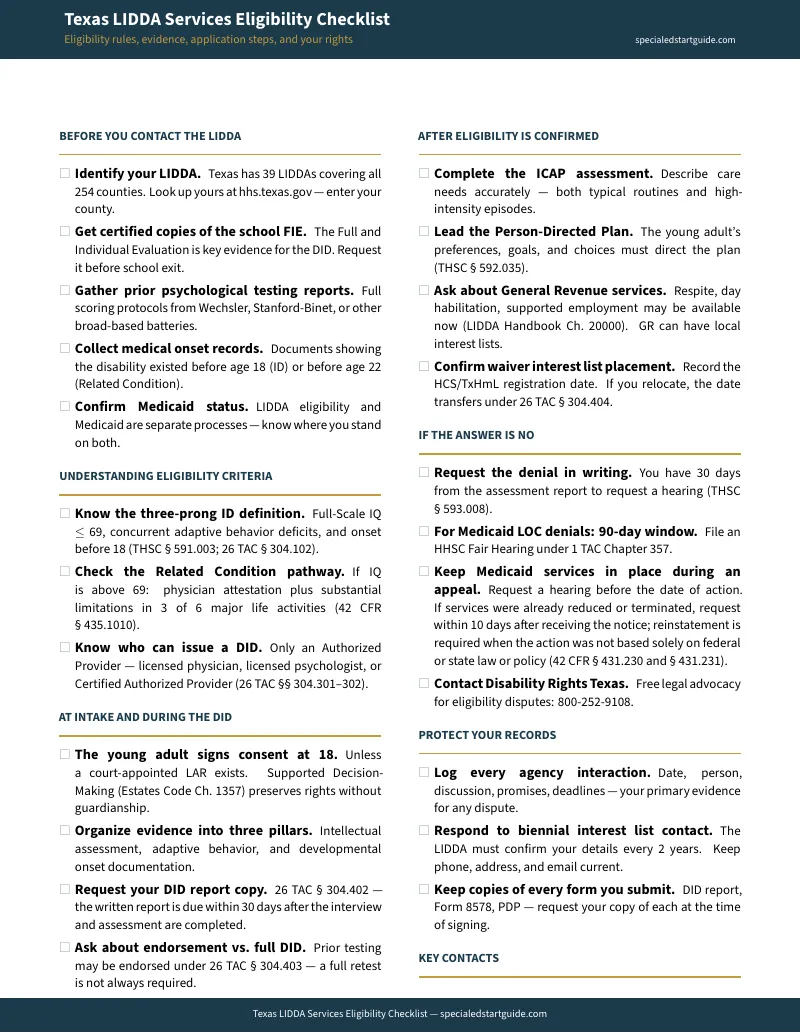
Download the free Texas LIDDA Services Eligibility Checklist — a two-page summary of the eligibility rules, the core documents to gather, the first three steps to contact your regional LIDDA, and free helplines. If you need the full roadmap, get the complete Texas LIDDA Adult IDD Services Guide — 9 PDFs including the 47-page guide, 7 printable worksheets you can fill in and bring to meetings, and the free eligibility checklist.
Get the Texas LIDDA Services Guide
Frequently Asked Questions
What if the rules change after I buy?
We update the guide when the rules change. Email us any time, even years later, and we'll send you the current edition free.