Your child turns 18 in Ohio. Five agencies start five separate clocks — each running on its own calendar — and nobody hands you the order of operations.
The SSA sends a redetermination letter that re-evaluates your child using adult disability standards. Your county JFS expects you to know that SSI approval triggers automatic Medicaid in a Section 1634 state — and that SSI loss silently terminates it unless you proactively file for protections that most caseworkers never mention by name. Your county board of developmental disabilities puts your child through a Waiting List Assessment that ranks unmet need, not time spent waiting. OOD offers employment supports, but only if you know to refer before age 22. And your child's legal decision-making rights transfer on their 18th birthday whether you have filed for guardianship, power of attorney, or a supported decision-making agreement or not.
The free resources are real. Disability Rights Ohio publishes a thorough Supported Decision-Making Toolkit. DODD explains each waiver on its website. DB101 Ohio calculates benefit scenarios. But each resource covers its own program in isolation. None of them gives you the full sequence — what to file first, which applications depend on which approvals, what to submit proactively before a coverage gap opens, and what forms you need at each step across five separate agencies operating on five separate calendars.
That sequencing gap is where families get hurt. Not from bad advice — from incomplete advice delivered one agency at a time.
The Transition Sequencing System — Every Agency, Every Form, Every Deadline in Order
The Ohio SSI at 18 & Adult Disability Benefits Guide is a 12-chapter process manual that organizes five agency systems into a single chronological workflow. It does not replace the individual agency resources — it connects them into the sequence that prevents gaps.
Where free resources explain what each program does, this guide maps which steps to take when, which applications depend on which outcomes, and what to file before a deadline you didn't know existed closes.
What's Inside
- The SSI age-18 redetermination walkthrough — the adult standard that replaces childhood criteria, what Forms SSA-3368-BK and SSA-827 require, how the cessation of parent-to-child income deeming opens new eligibility for families who were previously excluded, and the full four-level appeal process including the critical 10-day continued-payment rule and the 60-day reconsideration deadline that most families learn about after it passes
- DAC benefits on a parent's work record — eligibility when a parent retires, becomes disabled, or passes away, the before-age-22 onset requirement, how DAC interacts with SSI (and when it replaces SSI entirely), and why the Social Security Fairness Act's 2025 repeal of WEP and GPO means previously reduced benefits for children of Ohio's public employees under OPERS, STRS, and SERS are now fully restored
- Ohio's Section 1634 Medicaid pathway decoded — how SSI approval automatically triggers Medicaid enrollment with no separate JFS application, why Ohio permanently eliminated the ABD spend-down on August 1, 2016, and the three manual Medicaid protections (Pickle Amendment, DAC Medicaid Protection, Section 1619(b)) you must file with your county JFS if SSI is lost. Any Ohio guide still mentioning the ABD spend-down is working from pre-2016 rules.
- Qualified Income Trusts (Miller Trusts) — when your young adult's monthly income exceeds the $2,982 Special Income Level for HCBS waivers, the step-by-step process for establishing a QIT naming Ohio as the remainder beneficiary, the monthly deposit protocol, and the consequences of missing even one monthly transfer
- Level One, SELF, and Individual Options waiver applications — county board intake through one of Ohio's 88 local boards of DD, how the Waiting List Assessment categorizes need as immediate, current, or future, what documentation moves your case to a higher priority, the 2026 funding parameters for each waiver, and the 15-day intake scheduling rule that starts the moment you make the request
- Ohio STABLE accounts — opening an account through the Ohio State Treasurer's program, the $100,000 SSI resource disregard, the $20,000 annual contribution limit plus the $15,650 ABLE-to-Work provision, Ohio's $0 resident fee, and the state's Medicaid Estate Recovery Exemption that shields remaining STABLE funds at death. The qualifying age of disability onset expanded to 46 as of January 2026.
- OOD employment supports and work incentives — Pre-ETS referral at age 14 through Opportunities for Ohioans with Disabilities, the Individual Plan for Employment, how the Student Earned Income Exclusion shelters up to $2,410 per month from the SSI income test, and how Section 1619(b) preserves Medicaid for workers who earn above the SSI cash limit
- Decision-making authority options — supported decision-making (including the status of Senate Bill 35), durable power of attorney, healthcare proxies, and guardianship through county probate court, with a breakdown of how filing requirements, fees, and investigator procedures differ across Ohio's 88 counties
- Room-and-board agreements — a step most families skip that prevents the SSA from reducing your child's SSI payment by one-third ($331.33 in 2026) when they live with you after turning 18
- The Residential State Supplement (RSS) — how the program works for adults in licensed Class Two Residential Facilities, the 2026 rent cap and personal needs allowance calculation, and who qualifies
- The multi-year timeline from age 14 to 22+ — every application, referral, and deadline mapped across all five agencies in chronological order, coordinating the school's academic-year IEP calendar, the county board's rolling 12-month ISP spans, the county JFS annual Medicaid redetermination, and the SSA's variable federal timelines
- Official forms and agency contacts — every form number, every online portal, and every agency phone number in one reference section
Who This Guide Is For
Ohio parents and guardians of young adults with intellectual or developmental disabilities who are approaching, currently navigating, or recently past the age-18 transition — and who need the full sequence of steps across SSA, county JFS, county board of DD, OOD, and Ohio STABLE in one place.
- You received the SSA's age-18 redetermination letter and are not sure what "adult disability standards" means for your child's current SSI eligibility
- Your child's IEP transition plan mentions "adult services" but nobody has explained that the school does not actually enroll your child in any of them — the county board, OOD, and county JFS each require their own separate applications
- You contacted your county board of DD about waivers and were told the system is "needs-based" but nobody explained how the Waiting List Assessment works, what documentation establishes immediate-need status, or what counts as "natural supports" in the assessment
- Your young adult's income from DAC benefits pushed them over the $994 Medicaid threshold and you are scrambling to figure out whether you need a Miller Trust, the Medicaid Buy-In for Workers with Disabilities, or both
- You want to save money for your child's future but are afraid that any savings above $2,000 will disqualify them from SSI and Medicaid
- Your young adult wants to work and you need to understand exactly how earned income affects cash benefits and healthcare coverage
- You are trying to decide between supported decision-making, power of attorney, and guardianship — and your county's probate court uses different forms, fees, and procedures than the ones you find in online guides written for Franklin or Cuyahoga County
- A parent in the household is approaching retirement from a position under STRS, OPERS, or SERS and you want to know whether your adult disabled child qualifies for DAC benefits now that WEP and GPO have been repealed
Why Free Resources Alone Leave Gaps
The free resources from Disability Rights Ohio, DODD, OCALI, and DB101 Ohio are genuinely valuable — this guide references many of them. The problem is structural, not qualitative.
Each agency publishes information about its own programs. DRO's materials focus on civil rights advocacy and systemic litigation. DODD organizes information by waiver type rather than by family timeline. OCALI's transition tools are written primarily for educators and school-based transition coordinators. DB101 Ohio's calculators model benefit scenarios but cannot tell you which applications to file in which order.
None of them can tell you: "File the SSI application before you open the STABLE account because the SSI approval is what triggers automatic Medicaid, and you need Medicaid in place before the county board submits the waiver application because HCBS waivers require Medicaid financial eligibility as a prerequisite."
That sequencing — which steps gate which other steps, which deadlines are absolute, and which applications can run in parallel — is what this guide provides. One document, one timeline, one reference point instead of five agency websites and three phone calls per county office.
Satisfaction Guarantee
If the guide does not change how you prepare for your child's transition — if the timelines, form references, and agency sequences do not save you confusion, missed deadlines, or hours of scattered research — email [email protected] at any time for a full refund.
Get Started
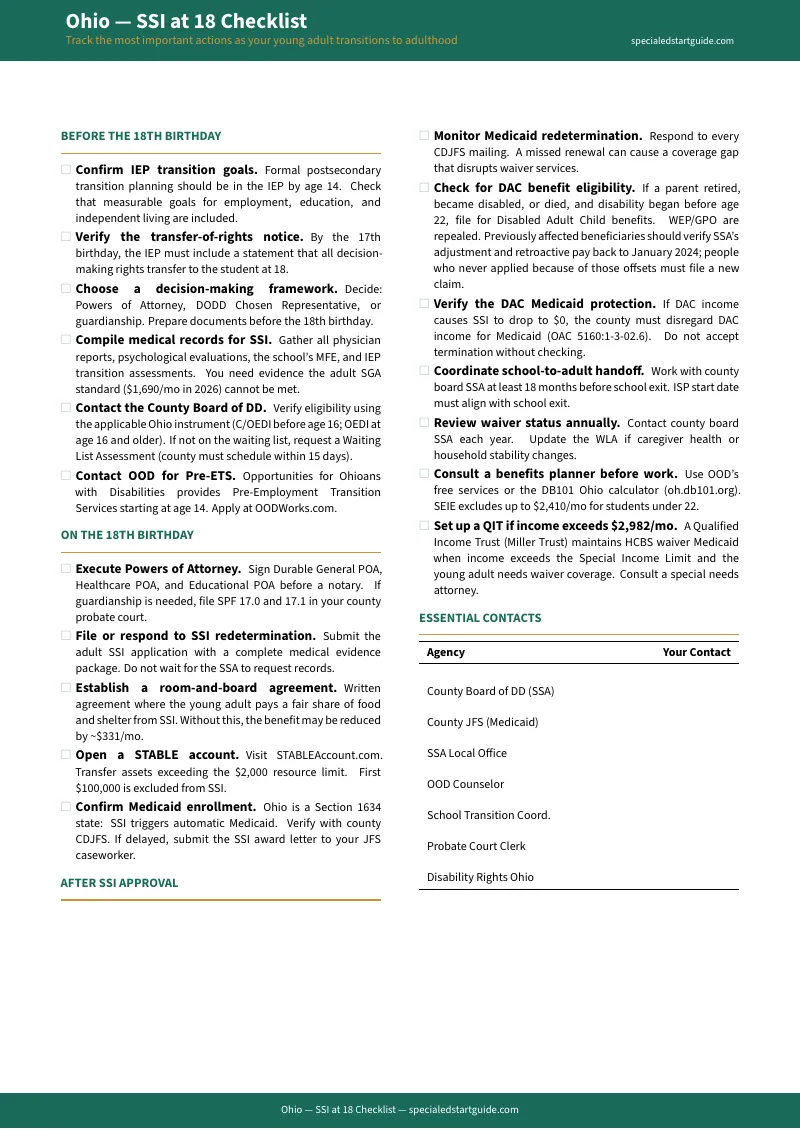
The free Ohio SSI at 18 Checklist gives you the one-page overview — every critical action from the 17th birthday through age 19 on a single printable page. Download it now, or get the full Ohio SSI at 18 & Adult Disability Benefits Guide for the complete 12-chapter walkthrough plus 8 fillable standalone worksheets — transition timeline, Medicaid pathway map, waiver comparison, SSI redetermination prep tracker, decision-making comparison, STABLE account setup, forms directory, and income calculation worksheets — with every form, every portal, and every deadline across all five agencies.
The transition timeline does not pause while you research. The SSI redetermination appeal window closes in 60 days. The 10-day continued-payment rule waits for no one. The county board's 15-day intake scheduling deadline starts when you make the request, not when you are ready. And Ohio's needs-based waiver system rewards families who document their unmet needs early.