You heard MRS can help — but the process feels impossible to start
Your child is approaching adulthood, or already there, and someone mentioned Michigan Rehabilitation Services. Maybe a teacher brought it up at a transition meeting. Maybe an audiologist said MRS could fund hearing aids. Maybe you found a state website that lists six steps and tells you to call a number.
So you called. And now you have more questions than when you started. What documents do they actually need? What happens if the 60-day eligibility window passes and nobody calls you back? What is an "Order of Selection" and what would a waiting list mean for your family? If your child is still in high school, can they get Pre-Employment Transition Services without a formal application?
The state's own materials answer each question — but across different PDFs, different administrative rules, and different web pages that assume you already know the system. For a family that is new to vocational rehabilitation, it feels like being handed a jigsaw puzzle with no picture on the box.
The MRS Process Navigation System
This guide takes every step of the Michigan Rehabilitation Services process and lays it out in the order you will actually encounter it — from your first contact through your Individualized Plan for Employment and beyond. Each chapter matches a stage of the process, and each stage comes with the specific questions, documents and deadlines that apply.
It is not legal advice, medical advice or benefits planning. It is not affiliated with MRS, the Department of Labor and Economic Opportunity, or any government agency. It is a plain-language process workbook that helps you prepare for each meeting, track what you have submitted, and understand the rights you have at every decision point.
What's inside the guide
- Application walkthrough with the 60-day eligibility clock — exactly what to bring to intake, how the eligibility determination works under Michigan Administrative Code R 395.60, and what to do if the deadline is approaching without a decision
- Order of Selection explained in plain language — how MRS assigns priority categories based on functional limitations, what the waiting list means, who is protected from waiting under grandfathering rules, and how to make sure your documentation reflects your actual daily barriers
- Pre-Employment Transition Services for students aged 14 to 26 — the five core Pre-ETS categories, how to access them while still enrolled in school, and why you do not need a formal MRS application to start
- Individualized Plan for Employment (IPE) preparation — how informed choice works, what to request before you sign, how to set goals that match the young person's career interests rather than a default placement, and why the IPE is not a legal contract
- College and MCTI funding rules — how MRS coordinates with Pell Grants for postsecondary education, the financial need test under R 395.75, and the exemption that applies to students attending the Michigan Career and Technical Institute
- Section 511 protections — the federal rules that limit subminimum-wage employment and what they mean for a young person choosing between competitive integrated employment and a sheltered workshop
- Disputes: the Client Assistance Program, mediation and hearings — how to request an informal review, when to contact Disability Rights Michigan's CAP office, what to bring to mediation, and how the formal hearing process works
Who this guide is for
- Parents of a Michigan student or young adult with a disability who want to understand the MRS process before the first appointment
- Young adults applying to MRS on their own who want to know their rights and prepare their own records
- Families who received an Order of Selection notice and need to understand what their priority category means and what to do next
- High school transition teams and families exploring Pre-ETS options while the student is still enrolled
Why not just use the free resources?
You should use the free resources. Michigan Rehabilitation Services has a customer service helpline (800-605-6722). Michigan Alliance for Families offers free parent mentoring. Disability Rights Michigan runs the Client Assistance Program at no cost. This guide does not replace any of them.
What the free resources do not give you is a personal tracking system. The state explains what the steps are. It does not give you a checklist to track your submissions, a framework to prepare your IPE goals, or a single document that walks you through each stage in order with the deadlines and rights that apply. The guide fills that gap — not by hiding public information, but by organising it into a sequence you can actually follow, with worksheets and question sheets you can bring to each meeting.
What you get
- The full guide — 47 pages covering every stage of the MRS process, from first contact through IPE development and dispute resolution
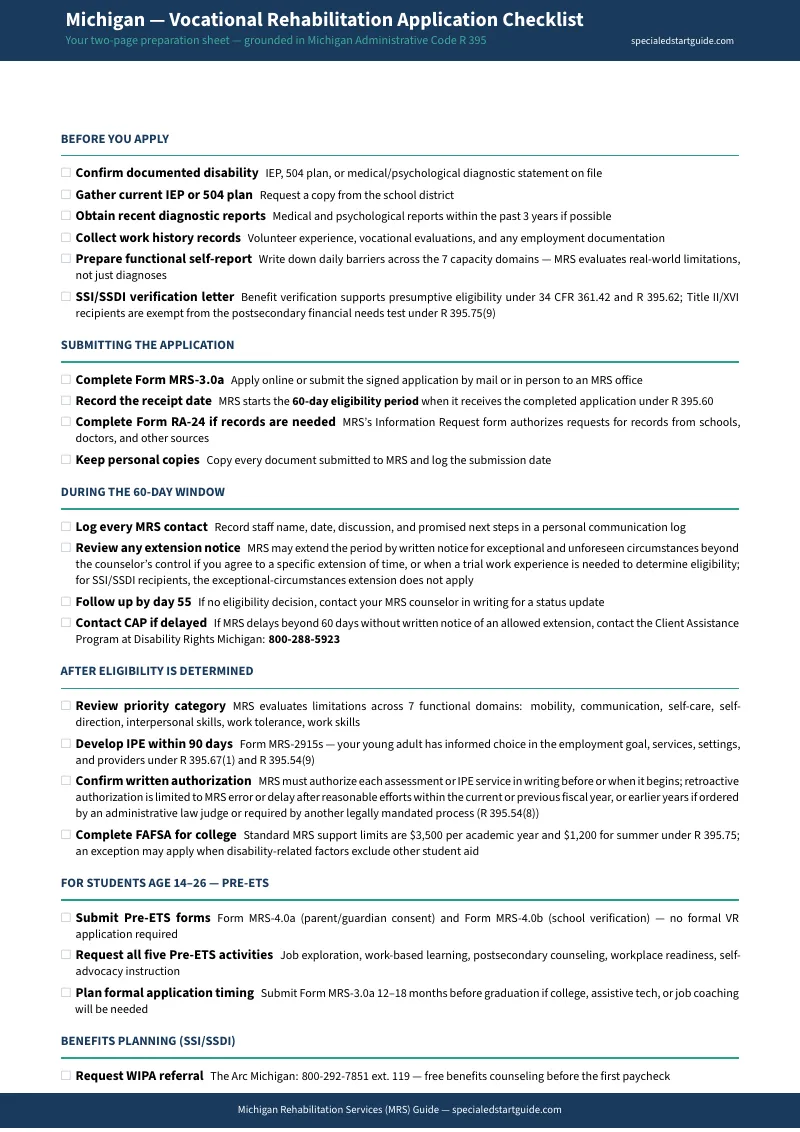
- Application preparation checklist — a standalone 2-page checklist of the documents, timelines and questions for your intake appointment
- Functional Limitation Self-Audit — a 4-page worksheet walking through all seven MRS priority category domains with prompts for describing real-world barriers on typical and hardest days
- IPE Preparation Worksheet — a 4-page planning tool for articulating career goals, work environment preferences, accommodation needs and training pathways before the IPE meeting
- 60-Day Eligibility Timeline Tracker — tracks the R 395.60 deadline from MRS receipt of the completed application through eligibility determination, with extension tracking and document submission log
- Agency Communication Log — a landscape-format log to record every call, email and meeting with MRS staff, including outcomes and follow-up deadlines
- IPE Service Authorization Tracker — records every service, vendor and authorized dollar amount on the IPE with start dates and authorization references
- Dispute Resolution Log — tracks agency notices, CAP contacts, filing deadlines and hearing dates in one place
Full refund, no time limit. If the guide does not help, email [email protected] and we will process it.
Frequently Asked Questions
What if the rules change after I buy?
We update the guide when the rules change. Email us any time, even years later, and we'll send you the current edition free.