Four agencies. Seven years of deadlines. Zero coordination between them.
Your child's IEP team will write transition goals and make agency linkage referrals. That is the extent of what the school is built to do. They will not submit your DDA waiver application. They will not file your child's SSI claim at 18. They will not draft a supported decision-making agreement that complies with Maryland's statutory requirements. And when your child exits school — the transition coordinator's involvement ends, permanently.
What remains is your responsibility: a multi-year, multi-agency coordination problem where DORS, DDA, SSA, and the school IEP each run on their own calendars and none of them show you how their deadlines interact. Miss the DORS VR referral in junior year and your child enters the Order of Selection waiting list months late. Miss the June 30 GTYI waiver deadline and they lose the dedicated funding pathway for transitioning youth — landing on the standard DDA waiting list where some families wait years.
Free state resources explain each agency's programs in isolation. DORS publishes a Pre-ETS brochure. DDA publishes an eligibility application guide. SSA publishes benefit rules. None of them show you which applications must happen simultaneously and which depend on each other. That cross-agency coordination gap is where families lose time, funding, and options.
The Transition Coordination System
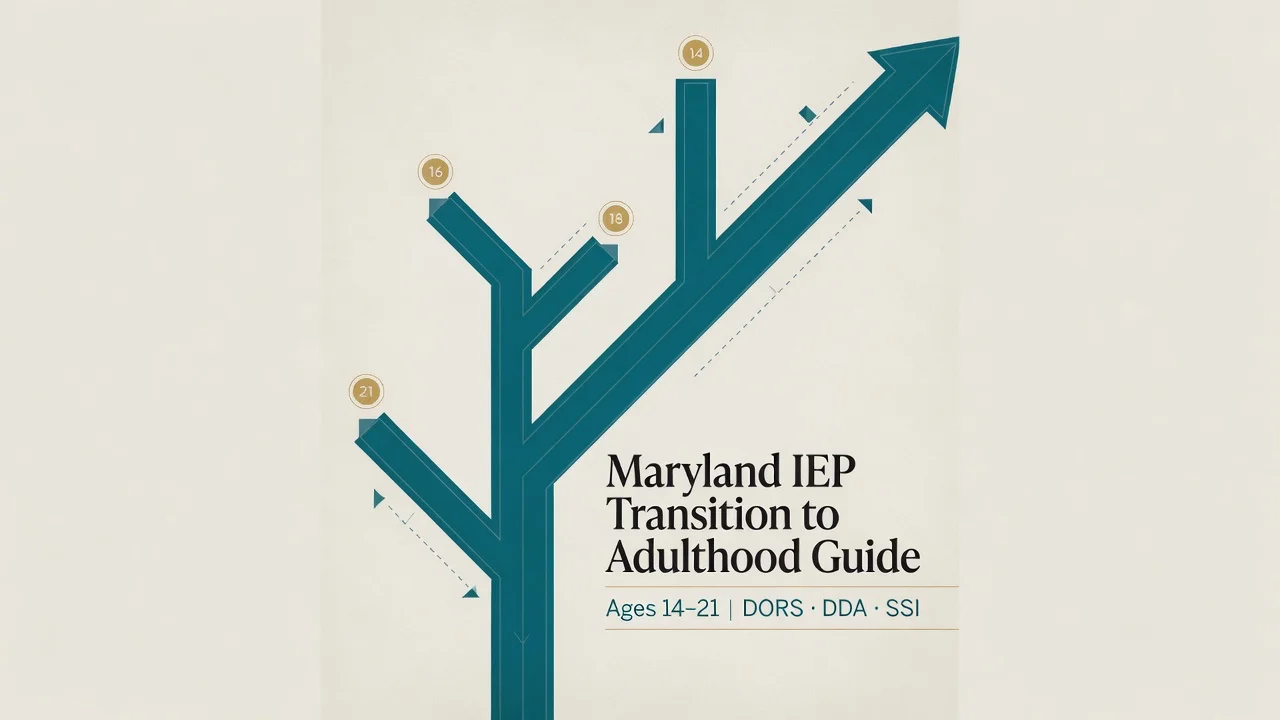
The Maryland IEP Transition to Adulthood Guide is a single-document planning system that maps every DORS, DDA, SSI, and IEP deadline by age — from the school year your child turns 14 through the final handoff to adult services after exit. Instead of toggling between five government websites trying to reconstruct a timeline, you open one guide and see exactly which applications, referrals, and legal preparations need to happen this year and which are coming next.
This is not a pamphlet restating what state agencies already publish. It is an organizing tool that bridges the gap between those siloed programs — the same cross-agency coordination framework that professional transition consultants build for their clients, structured so you can execute it yourself.
What's Inside
- Integrated Multi-Agency Timeline — every DORS, DDA, SSI, and IEP milestone mapped chronologically from age 14 through 21, showing which applications must overlap and which are sequential, so you never discover a deadline after it has passed
- Diploma vs. Certificate Decision Framework — a side-by-side comparison of the standard Maryland High School Diploma (22 credits, 75 service hours) and the Certificate of Program Completion, with the downstream impact on FAPE continuation, DORS eligibility, and adult employment funding
- DORS Pre-ETS and VR Walkthrough — how to access no-waitlist Pre-Employment Transition Services starting at 14, the strategic timing for the formal VR referral in junior year, and what to do when the Order of Selection places your child on a waiting list
- DDA Eligibility Through GTYI Funding — the precise difference between the DDA eligibility letter (which guarantees nothing) and active waiver funding through the Governor's Transitioning Youth Initiative, the June 30 deadline, and the one-year provider selection window that starts the clock after school exit
- Community Pathways Waiver Breakdown — how the October 2025 consolidation of the Family Supports and Community Supports waivers into a single Community Pathways Waiver changes what services are available to transitioning youth
- Transfer of Rights and Decision-Making — what changes at 18, how to evaluate Supported Decision-Making under Maryland's 2022 SDM Act versus guardianship, and the seven requirements for a valid SDM agreement under Estates & Trusts § 18-107
- SSI, ABLE, and Benefits Navigation — how parental income deeming ends at 18, the adult SSI application process, the $2,000 resource limit, Maryland ABLE account setup with its $100,000 SSI exemption, and how to protect Medicaid through Section 1634(c) when DAC benefits replace SSI
- Provider Comparison Worksheet — a side-by-side evaluation grid for researching, visiting, and comparing DDA-licensed adult service providers so you submit an informed choice letter instead of selecting a provider under deadline pressure
- Six Printable Planning Worksheets — transition timeline tracker, agency communication log, decision-making evaluation worksheet, provider comparison grid, benefits eligibility tracker, and IEP transition goal planner — designed to be printed and used across the entire planning process
- Postsecondary Accommodations — why IEPs do not transfer to college, how the ADA replaces IDEA, and the documentation your child needs to self-disclose and request accommodations independently
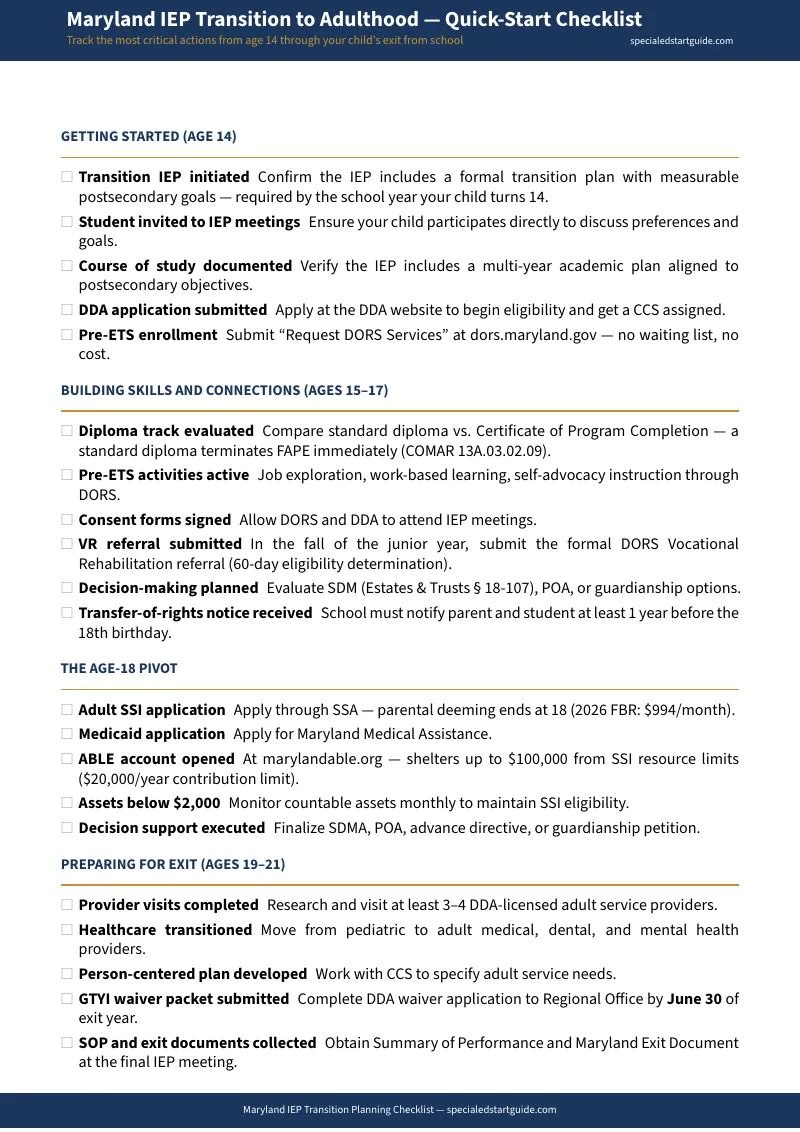
- Free Tier: Transition Planning Checklist — a printable milestone checklist covering the critical deadlines across all four systems, designed to be posted on your fridge or brought to IEP meetings
Who This Guide Is For
This guide is for Maryland parents whose child with an IEP is approaching or in the middle of transition — whether the school just mentioned the word for the first time at age 14 or your teenager is 17 and you are realizing how many systems need to be coordinated before their 18th birthday.
- Your child has DDA eligibility and you assumed adult services would be waiting — but nobody explained the GTYI waiver deadline or the gap between eligibility and funded services
- Your child turns 18 soon and you have not started the legal groundwork for decision-making support
- You have visited the DORS, DDA, and SSA websites individually but cannot figure out which applications run in parallel and which depend on each other
- The school transition coordinator handles classroom goals — but you know they will not manage SSI applications, waiver packets, or healthcare transitions
- You have priced special education advocates at $125 to $200 per hour and need to coordinate the transition yourself
Why Free State Guides Are Not Enough
State agencies and parent centers like Parents' Place of Maryland publish valuable program-specific resources. But each publication explains only the issuing agency's own programs. The DORS brochure does not tell you when to file with DDA. The DDA eligibility guide does not mention SSI timing. The SSA benefits handbook does not discuss the GTYI deadline. These are not flaws — each agency is responsible for its own services and has no mandate to coordinate the others.
The problem is that your family's transition does not happen inside one agency. It happens across all of them simultaneously. The guide that coordinates those timelines into a single actionable sequence — showing you that the DORS VR referral in junior year needs to precede the age-18 SSI application, which needs to precede the GTYI waiver submission by June 30 of exit year — is the guide that prevents the most consequential mistakes.
Professional transition consultants and special education advocates charge $125 to $200 per hour to build exactly this kind of cross-agency plan. This guide gives you the same coordination structure for a fraction of one consulting session.
Satisfaction Guarantee
Money-back guarantee, no time limit. If the guide does not give you a clear, actionable understanding of your child's transition timeline, you get a full refund — no questions.
Start Coordinating the Systems the School Cannot Coordinate for You
The free checklist gives you the milestone overview. The full Maryland IEP Transition to Adulthood Guide gives you the cross-agency coordination system — every deadline, every application, every decision framework from age 14 through exit. Open it tonight and identify which windows your family is approaching. For , you get the same planning structure that advocates build at premium hourly rates — organized so you can execute it yourself.