Your child turns 18 in Iowa. The SSA re-evaluates their disability under adult standards, and because Iowa is a Section 1634 state, that single decision controls whether Medicaid stays or goes. Nobody hands you the sequence.
The age-18 redetermination letter arrives from the SSA, and everything changes. Your child is no longer evaluated as a child with a "marked and severe functional limitation." The SSA now asks whether they can engage in Substantial Gainful Activity — a stricter standard that denies roughly one in three applicants who qualified as children. In most states, losing SSI still leaves a separate Medicaid application as a fallback. In Iowa, there is no fallback. Because Iowa is a Section 1634 state, SSI approval is the direct mechanism for automatic Medicaid enrollment. An SSI denial terminates Medicaid access. The coverage that pays for therapies, medications, Supported Community Living providers, and Day Habilitation services shuts off.
Meanwhile, Iowa's HCBS system is in the middle of its largest overhaul in a generation. The HOME Waiver Redesign is merging legacy diagnosis-based waivers into two age-based waivers. CareStar has replaced county-level assessors, and the interRAI Intellectual Disability tool replaced the Supports Intensity Scale that most online resources still describe. The Intellectual Disability Waiver waitlist carries more than 7,000 names. And the 15 former Mental Health and Disability Services regions were dissolved in July 2025 and replaced by seven district-level Disability Access Points that most families have never heard of.
The free resources are real. The ASK Resource Center runs transition workshops. Iowa HHS publishes assessment guides and waiver manuals. The IAble website explains ABLE account mechanics. But each source covers its own program in isolation. None of them gives you the full sequence — what to file first, which applications depend on which approvals, what to submit proactively before a coverage gap opens, and what forms you need for each step.
That sequencing gap is where families get hurt. Not from bad advice — from incomplete advice delivered one agency at a time.
The Transition Sequencing System — Every Agency, Every Form, Every Deadline in Order
The Iowa SSI at 18 & Adult Disability Benefits Guide is a 13-chapter process manual that organizes federal and state agency systems into a single chronological workflow. It does not replace the individual agency resources — it connects them into the sequence that prevents gaps.
Where free resources explain what each program does, this guide maps which steps to take when, which applications depend on which outcomes, and what to file before a deadline you didn't know existed closes.
What's Inside
- The SSI age-18 redetermination walkthrough — the adult disability standard that replaces childhood criteria, what functional evidence to compile from IEP records, psychological evaluations, and medical files, the 60-day reconsideration deadline, and the critical 10-day Statutory Benefit Continuation window that preserves both SSI cash and Section 1634 Medicaid while your appeal is reviewed
- Section 1634 automatic Medicaid — why the stakes are higher in Iowa — how SSI approval automatically triggers Medicaid enrollment without a separate application, why an SSI denial immediately terminates Medicaid access, and why the redetermination preparation covered in this guide matters more in a 1634 state than in states where Medicaid can be maintained independently
- Representative Payee designation — why power of attorney is legally insufficient for managing SSA funds, how to file Form SSA-11, the dedicated bank account requirements, record-keeping rules, and the audit exemptions available to live-in parents
- The SSI resource limit and asset restructuring — the $2,000 individual limit, how to audit child-owned UTMA accounts, savings, and cash gifts before the 18th birthday, qualified spend-down strategies, and the interaction between countable resources and Iowa Medicaid
- IAble accounts — Iowa's ABLE program — the $20,000 annual contribution limit, the ABLE-to-Work additional contribution of up to $15,650, the $6,100 Iowa state income tax deduction per contributor, the $100,000 SSI resource disregard, and the $505,000 lifetime balance cap
- Special needs trusts — third-party trusts (no Medicaid payback) versus first-party trusts (mandatory Medicaid payback), how trusts complement IAble for amounts exceeding contribution limits, Iowa's estate recovery rules, and when professional trust planning is worth the cost
- DAC benefits on a parent's work record — Disabled Adult Child eligibility when a parent retires, becomes disabled, or passes away, the before-age-22 onset requirement, how DAC interacts with SSI, and why the Social Security Fairness Act's repeal of WEP and GPO means Iowa public employees and their dependents now receive full, unreduced benefits
- Section 1634(c) Medicaid protection — the federal provision that requires Iowa to disregard DAC income increases and maintain Medicaid and waiver eligibility when your child transitions from SSI to DAC
- The HCBS waiver system and HOME Redesign — how legacy diagnosis-based waivers are merging into the Children and Youth Waiver (ages 0–20) and Adults with Disabilities Waiver (ages 21+), what the transition means for waitlisted families, and how automatic enrollment works at age 21
- The CareStar interRAI assessment — step by step — how the independent assessment entity replaced county-level evaluations, how the interRAI Intellectual Disability tool works, the worst-day reporting principle, and how tiered rate assignments (Tiers 1–5) determine funding levels for Supported Community Living, Day Habilitation, and Adult Day Care
- Waiver waitlist strategy — the Waiver Priority Needs Assessment (WPNA) form, how to document institutional risk and caregiving limitations to maximize prioritization, how to request a priority reassessment when needs change, and what to do during the multi-year wait
- Disability Access Points and interim supports — the seven newly established district DAPs (Western Iowa Service Collaborative, Polk County BHDS, Collaborative Individual and Community Support, Eastern Iowa Disability Alliance), Short-Term Supports and Services for non-Medicaid-funded respite and crisis care, and how to locate your assigned district
- SSI work incentives and MEPD — the Student Earned Income Exclusion, the standard earned income formula, Section 1619(b) Medicaid continuation, and Iowa's Medicaid for Employed People with Disabilities Buy-In for workers earning above standard limits
- The multi-year timeline from age 14 to 22+ — every IEP transition milestone, application, referral, and deadline mapped across all agencies in chronological order
Who This Guide Is For
Iowa parents and guardians of young adults with intellectual or developmental disabilities who are approaching, currently navigating, or recently past the age-18 transition — and who need the full sequence of steps across SSA, Iowa HHS, Iowa Vocational Rehabilitation Services, and the district Disability Access Points in one place.
- You received the SSA's age-18 redetermination letter and are not sure what "adult disability standards" means for your child's current SSI eligibility — and someone mentioned Iowa is a "1634 state" but nobody explained why that makes the redetermination higher-stakes
- Your child has an intellectual or developmental disability and you were told to "apply for the ID waiver," but nobody mentioned the 7,000-person waitlist, the CareStar assessment that replaced everything you researched, or the interRAI tool that scores differently from the old SIS-A
- The IEP transition plan mentioned "adult services" but nobody explained that SSA, Iowa HHS, IVRS, and your district Disability Access Point each require separate applications the school does not file for you
- You want to save money for your child's future but worry that any savings above $2,000 will disqualify them from SSI and Medicaid
- Your child is on the ID waiver waitlist and you did not know about the WPNA, the district Disability Access Points, or the Short-Term Supports and Services available while you wait
- A parent in the household is a retired Iowa teacher or public employee and you want to understand DAC benefits and how the WEP/GPO repeal affects those calculations
- Your young adult wants to work and you are afraid that earned income will cost them their cash benefits and healthcare
Why Not Just Use Free Resources?
The ASK Resource Center, Iowa HHS waiver manuals, and the IAble website are strong sources for individual program information. We link to them throughout the guide — they are the right place for the latest forms and eligibility details. But they are organized by topic, not by timeline. When you are coordinating SSI redetermination, asset restructuring, Representative Payee designation, IAble account opening, CareStar assessment preparation, WPNA submission, and Disability Access Point enrollment simultaneously, the challenge is not finding information about each program. It is knowing which steps depend on which outcomes, what to file proactively before a coverage window closes, and what sequence prevents the gaps that take months to repair.
A special needs planning attorney can provide all of this — for a flat fee that typically starts around $2,000 and can reach $4,000 or more for trust and guardianship planning. This guide costs and covers the preparation and sequencing work that reduces the hours you spend with an attorney if you hire one, or replaces the attorney entirely for families whose needs are administrative rather than legal.
Satisfaction Guarantee
Money-back guarantee, no time limit. If the guide does not change how you prepare for your child's transition, you get a full refund — no questions, no forms, no justification required.
Get Started Now
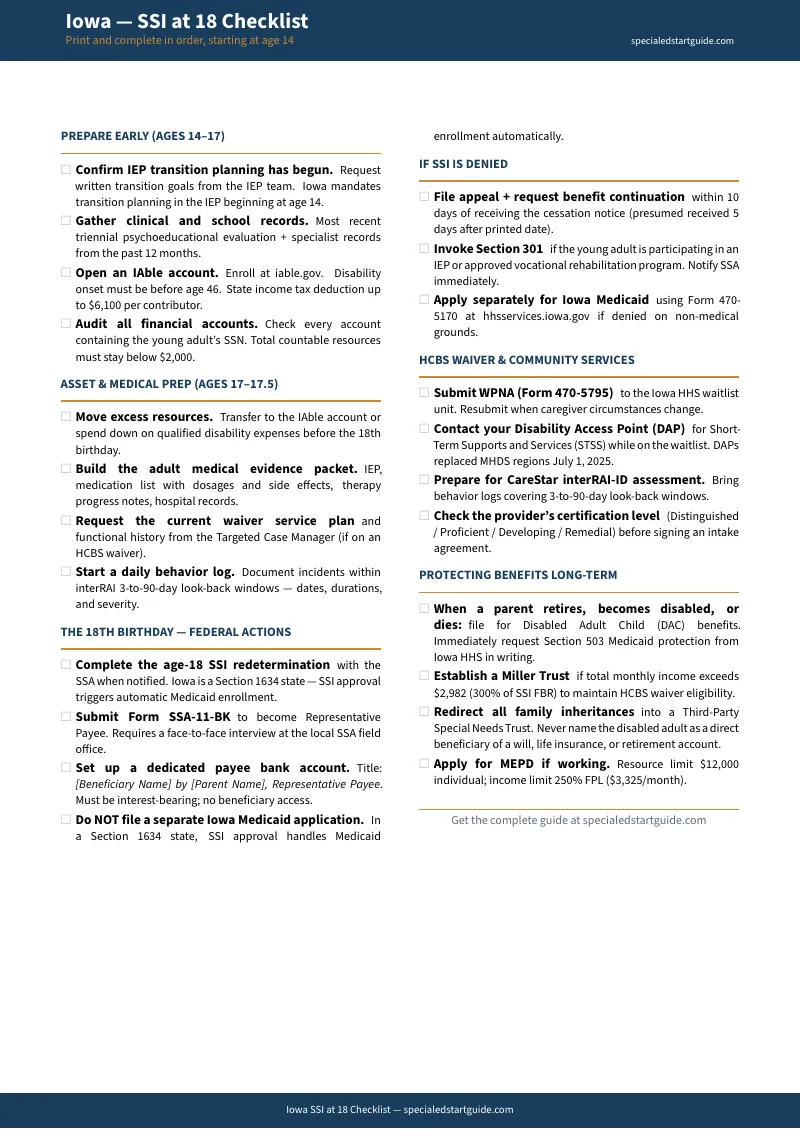
Download the free Iowa SSI at 18 Checklist — a one-page printable covering every critical action from the 17th birthday through age 19. If the checklist changes how you think about the transition, the full guide covers how to execute every step.
Get the Full Iowa SSI at 18 & Adult Disability Benefits Guide →