Your child turns 18 and the system resets. The DSO Administrative Navigation System gives you every step, deadline, and worksheet to get through intake, assessment, and Passport funding — before the transition cliff hits.
You have been told that children's services end at 18. You have been told to "contact DSO." You have visited the DSO website and found intake forms, regional office phone numbers, and a FAQ page that answers questions you have not asked yet while ignoring the ones keeping you up at night.
How do you know whether your existing psychological assessment meets DSO's documentation requirements — or what options to ask about before paying $2,000–$4,000 for a new one? What happens in DSO's two roughly three-hour application-package meetings, and how does the information recorded in the SIS-A feed into Passport funding alongside other assessed needs? How do you keep your file active on a waiting list that stretches eight to fifteen years — when administrative errors can close it without warning and reset you to the back of the queue?
Free agencies define the rules. This guide helps you execute them.
The DSO Administrative Navigation System
This is not a summary of the provincial website. It is a step-by-step administrative navigation system — with pre-built tracking worksheets, assessment preparation frameworks, and expense audit tools — that turns fragmented provincial rules into a single operational file you control from first phone call through funded support.
The government tells you what the system requires. This guide gives you the tools to actually do it — systematically, without missing a deadline, without under-reporting a need, and without losing your file in a system where, in September 2026, the Ministry reported 53,000 people registered for supportive living and noted that not all were ready to move at that time.
What's Inside
The Legal Framework, Translated
The Services and Supports to Promote the Social Inclusion of Persons with Developmental Disabilities Act, 2008 is the law that governs every DSO decision. The guide translates its eligibility criteria, rights protections, and complaint mechanisms into plain language your family can use at every stage — from first intake call to administrative review.
DSO Intake — From First Call to Eligibility Confirmation
Applying at 16 is possible, but services cannot start until 18 — and the gap between applying and receiving is measured in years, not months. The guide walks through the nine DSO regional offices, the documentation you need before the first contact, what happens at each intake stage, and the specific evidence DSO needs to confirm eligibility.
SIS-A Assessment Preparation Framework
The SIS-A is one component of DSO's application package, which is completed across two meetings of about three hours each with at least two people who know the applicant. After the DSO assessment, a Ministry system automatically calculates Passport funding using behavioural, medical, and personal support needs, as well as caregiver circumstances. Accurate information about support needs feeds into that calculation. The guide includes a preparation framework that helps co-observers describe support needs across the assessment domains.
Passport Funding — Allocation, Claims, and Expense Tracking
Passport funding starts at $5,665 per year and can reach $45,604 at the assessed maximum. But knowing the allocation is only the beginning: families can submit reimbursement claims electronically through Passport eCLAIM or MyDirectPlan, with manual claims submitted by email, fax, or mail using the Purchase of Service Invoice Form from their local Passport agency. Ineligible expenses — adaptive clothing, restaurant meals for the recipient, general groceries — lead to rejected claims and out-of-pocket losses. The guide includes an expense tracking worksheet that maps eligible categories against your allocation so you do not burn through funding on items that will be clawed back.
Waitlist Survival System
Residential support waitlists in Ontario stretch eight to fifteen years. During that time, annual status update letters arrive — and failing to respond can silently close your file, resetting the wait to zero. The guide provides a waitlist tracking log, a protocol for responding to status letters, and an explanation of how DSO prioritises service requests: a tool scores risk using the applicant's living situation, behavioural, personal-support and medical needs, and caregiver circumstances, then compares that risk with others waiting.
Reviews, Complaints, and Appeals
When DSO denies eligibility, you have 25 business days to request a Stage 1 written review from the local office. The application entity may extend that period if you or your representative cannot submit the request within the timeframe. The guide walks through each stage of the review process — Stage 1, Stage 2, Stage 3 — with the deadlines, the evidence to include, and ARCH's free summary legal advice and referral service; additional legal services are subject to Legal Aid Ontario's legal and financial eligibility criteria. It also covers filing a complaint with the Ombudsman when systemic delays or administrative failures are the problem.
The Transition Cliff
School supports end. Paediatric therapies stop. ODSP income support — currently up to $1,436 per month for a single person, depending on circumstances — does not cover the full cost of independent living. The guide explains how to coordinate the end of school-based services with the start of adult DSO supports, what ODSP provides alongside Passport, and how the federal Canada Disability Benefit interacts with provincial income (Ontario exempts the Canada Disability Benefit as income for social assistance, so it does not reduce ODSP payments).
Legal Capacity and Supported Decision-Making
Turning 18 does not mean parents automatically retain decision-making authority. The guide covers powers of attorney, supported decision-making arrangements, and guardianship — in that order, because the least restrictive option that preserves the young person's rights should be explored first. Court-ordered guardianship is explained as the option of last resort, not the default.
Worksheets and Contacts — 8 Standalone Printable PDFs
Document audit checklist, SIS-A co-observer preparation sheet, Passport expense and mileage tracker, waitlist contact log, Stage 1–3 eligibility review decision finder, DSO communication log, transition cliff planner, and a directory of all nine DSO regional offices, legal clinics, and advocacy organisations — each a standalone PDF you can print and use independently.
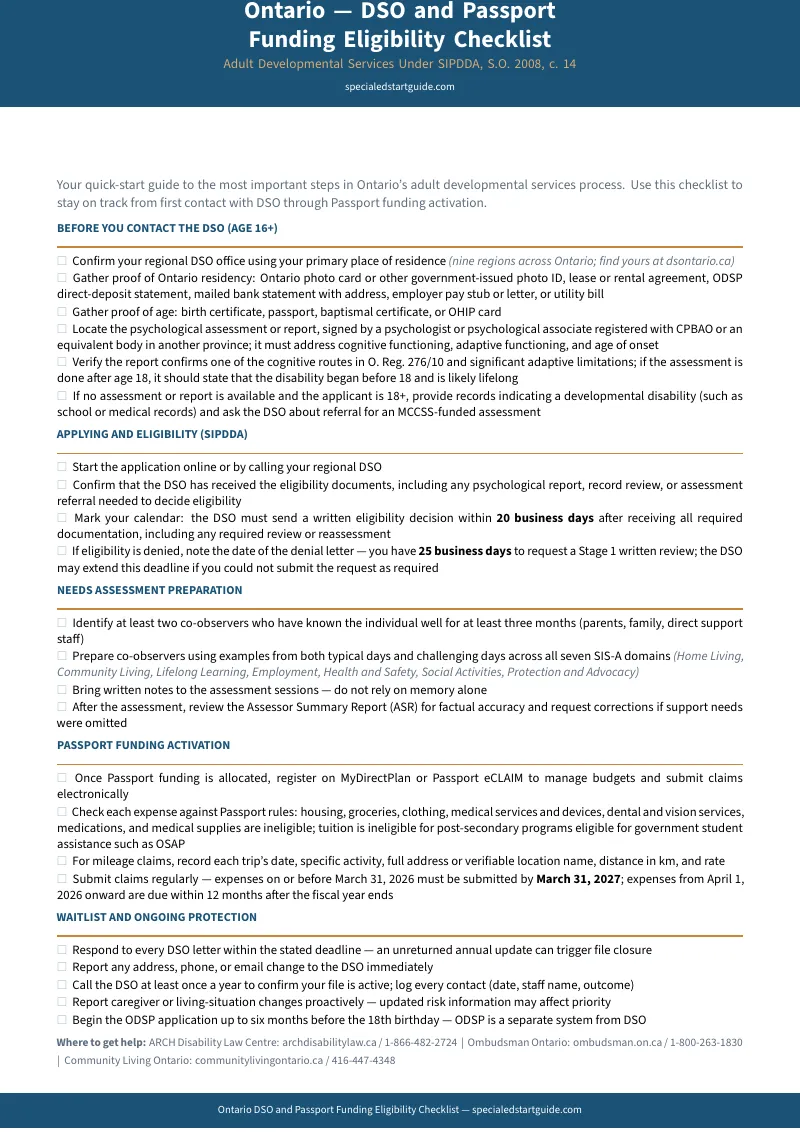
Free Tier: Ontario DSO & Passport Eligibility Checklist
A one-page checklist covering the eligibility criteria, evidence requirements, and application steps — yours to download free, no purchase required.
Who This Guide Is For
This guide is for families in Ontario who are navigating — or about to navigate — the adult developmental services system.
- Your child is 15 or 16 and you need to start the DSO application before 18, but you do not know what documents to gather or what the intake process involves
- Your family member had the SIS-A assessment and the Passport allocation seems low — you suspect the assessor captured a good day, not a typical day
- You are managing Passport claims through PassportONE and have had reimbursements rejected without understanding which expense categories are ineligible
- You were told your family member is "not eligible" and you have a few weeks to request a written review — but you do not know the deadline or what to include
- A parent or primary carer has become unwell and a sibling has stepped in with no knowledge of the system, inheriting an open DSO file they have never seen
- Your family member is on a years-long waiting list and you are not sure whether the file is still active or whether a missed status letter closed it
Why Not the Free Resources?
The free resources are valuable — and you should use them. DSO's regional offices confirm eligibility. ARCH Disability Law Centre offers free summary legal advice and referrals on certain disability-related matters; additional legal services are subject to Legal Aid Ontario's legal and financial eligibility criteria. Community Living Ontario publishes the Ending the Wait reports that document system-wide failures.
What they do not provide is a personal administrative file that tracks your family member's application, assessment preparation, expense claims, waiting list position, and review deadlines in one place. This guide does not replace DSO, ARCH, or Community Living. It sits alongside them — turning their scattered rules, deadlines, and procedures into a single operational toolkit you manage yourself.
Satisfaction Guarantee
Full refund, no time limit. If this guide does not change how you navigate DSO and Passport, email [email protected] and you will get every penny back.
Start Before the Transition Cliff
Starting early gives you time to complete the eligibility and application-package steps before adult services become available at 18. The support needs recorded through DSO's assessment feed into the Passport funding calculation alongside other factors. Every missed annual update letter is a file that gets closed.
Download the free eligibility checklist, or get the complete guide with every worksheet, timeline, and tracking tool you need.
Get the Ontario DSO & Passport Guide
Instant download. Start navigating the system tonight.
Frequently Asked Questions
What if the rules change after I buy?
We update the guide when the rules change. Email us any time, even years later, and we'll send you the current edition free.