
The School's Transition Plan Says "Explore Career Interests." Meanwhile, the Housing Waitlist Is 10 Years Long and the RDSP Clock Is Ticking. This Is the Roadmap That Actually Gets Your Child From School to Adulthood.
Your child's IEP has a transition section. You read it after the last meeting. It says something like "student will explore post-secondary options" and "student will develop independent living skills." It does not mention that adult residential supports in Ontario have waitlists stretching over a decade. It does not tell you that your child's elementary-era psychoeducational assessment will be rejected by every university accessibility office in the country. It does not explain that every year you delay opening an RDSP is a year of lost government matching — up to $3,500 in grants and $1,000 in bonds that your child will never get back.
So you started Googling. You found Ontario's Transition Resource Guide — thorough, but only covers Ontario and only covers universities. You found BC's STADD program — excellent if your child qualifies, but it locks out "mild" disabilities entirely. You found AIDE Canada's toolkits — strong on autism and intellectual disabilities, but scattered across dozens of separate PDFs with no chronological structure, and they exclude learning disabilities and physical impairments. You found NEADS, which is brilliant for post-secondary advocacy but speaks to capable students, not to the overwhelmed parent who is project-managing everything. You found federal government pages about the DTC and RDSP, but the Ministry of Education site conveniently never mentions the Canada Revenue Agency, and the CRA site never mentions transition planning.
You are not looking for more information. You are drowning in information — scattered across 40 provincial and federal websites, each covering one jurisdiction, one life domain, and one age bracket at a time. What you need is someone to connect education, employment, financial planning, and independent living into a single chronological action plan that works across all 13 provinces and territories. You need to know exactly what to do at age 14, 16, 17, and 18 — and what it costs you if you start late.
The Canada Post-Secondary Transition Roadmap is the Services Cliff Survival System — the 12-chapter operational manual that replaces the school's vague transition goals with year-by-year instructions, province-by-province service directories, the complete federal financial bridge from the Child Disability Benefit to the adult Canada Disability Benefit, and ready-to-use templates for every application, accommodation request, and advocacy letter you will need between now and your child's 21st birthday.
What's Inside the Roadmap
The Services Cliff — Quantified, Not Theorized
Every parent hears that things "change at 18." This chapter shows you exactly how much they change. The 20.1% youth disability rate. The $5,000 annual income gap for graduates with disabilities. The 63% carrying student loan debt versus 51% of non-disabled peers. The employment rate gap that understates the real problem — because graduates with disabilities are disproportionately concentrated in part-time, temporary, unrelated roles where they report being overqualified and dissatisfied. These are not scare tactics. These are Statistics Canada and HEQCO numbers, and they make the case that starting transition planning at age 13 is not early — it is barely on time.
The Complete Legal Framework for Adult Life
Section 15 of the Charter. The Accessible Canada Act. Every provincial human rights code. The three court decisions — Longueepee, Brewer, and the process obligation rulings — that directly determine how universities and employers must accommodate your child. And the one shift that catches every family off guard: in K-12, the school has an affirmative duty to identify and accommodate your child. In post-secondary and employment, the duty still exists, but your child must initiate it. The legal chapter explains this shift in plain language so you can prepare your child for a system that will not come looking for them.
Province-by-Province Transition Mandates and Adult Services
Ontario's IEP transition requirement at age 14. BC's STADD navigators and their eligibility restrictions. Alberta's IPP aligned with PDD and AISH. Manitoba's Bridging to Adulthood protocol. Quebec's plan d'intervention through the CEGEP system. Saskatchewan, New Brunswick, Nova Scotia, Newfoundland, PEI, the territories — every jurisdiction mapped with what the school is legally required to do, what the adult service system offers, who qualifies, what the waitlists look like, and how to apply. No other resource does this for all 13 jurisdictions in one document.
Post-Secondary Accommodation — The Documentation Bottleneck and How to Beat It
Universities require psychoeducational assessments completed within the last 3 to 5 years using adult-normed tests. If your child's assessment dates from elementary school, it will be rejected. A private assessment costs $2,000 to $4,000, but the Canada Student Grant for Services and Equipment can reimburse up to $20,000 per year — most families do not know this. The chapter covers funding the assessment, registering with accessibility offices, transferring assistive technology from school-based to student-owned, and navigating the fundamental shift from the IEP model (school initiates) to the university model (student discloses).
Employment Transition Pathways
Co-op placements, supported employment programs, and competitive workforce entry — mapped by province. How to build a resume that accounts for disability-related gaps without hiding them. The Ready, Willing and Able employer network. Workplace accommodation request frameworks. How to disclose a disability to an employer (and when not to). The chapter bridges the gap between "student with a transition plan" and "adult with a career," using the specific provincial employment services that actually exist and accept referrals.
The Federal Financial Bridge — DTC, RDSP, and CDB
This is the chapter that pays for the entire guide in the first month you use it. The Disability Tax Credit is the gateway to nearly every federal financial support. Without it, your child cannot open an RDSP — and that means leaving up to $90,000 in lifetime government grants and bonds permanently unclaimed. Without it, your child cannot qualify for the Canada Disability Benefit, which provides up to $200 per month for eligible adults. The chapter walks you through the DTC application (Form T2201), the RDSP contribution strategy that maximizes government matching, the CDB application process at age 18, and the Canada Student Grants for disabilities ($2,800/year non-repayable) and equipment ($20,000/year). Every program linked to every other program, with exact dollar amounts and application timelines.
Independent Living Planning
Housing — from fully supported group homes to semi-independent apartments and inclusive housing co-ops. Public transit training that is one of the strongest predictors of employment success. Financial literacy for adults who will manage their own benefits. Daily living skills development that schools claim to cover in the transition plan but rarely teach with real-world consequence. Community participation strategies that prevent the social isolation research consistently links to post-school depression.
Indigenous Youth and Compounded Barriers
Jordan's Principle funding cuts off at the age of majority. Diagnostic assessments that urban families find difficult to schedule are near-impossible in remote and Northern communities. The transition from band-funded First Nations schools to provincial post-secondary systems creates bureaucratic gaps — missing provincial Education Numbers, institutional unfamiliarity with federal funding streams, culturally unsafe campus environments. This chapter addresses the specific pathways, workarounds, and federal resources available to Indigenous families navigating a system designed without them in mind. No commercial transition guide has covered this before.
The Master Year-by-Year Timeline
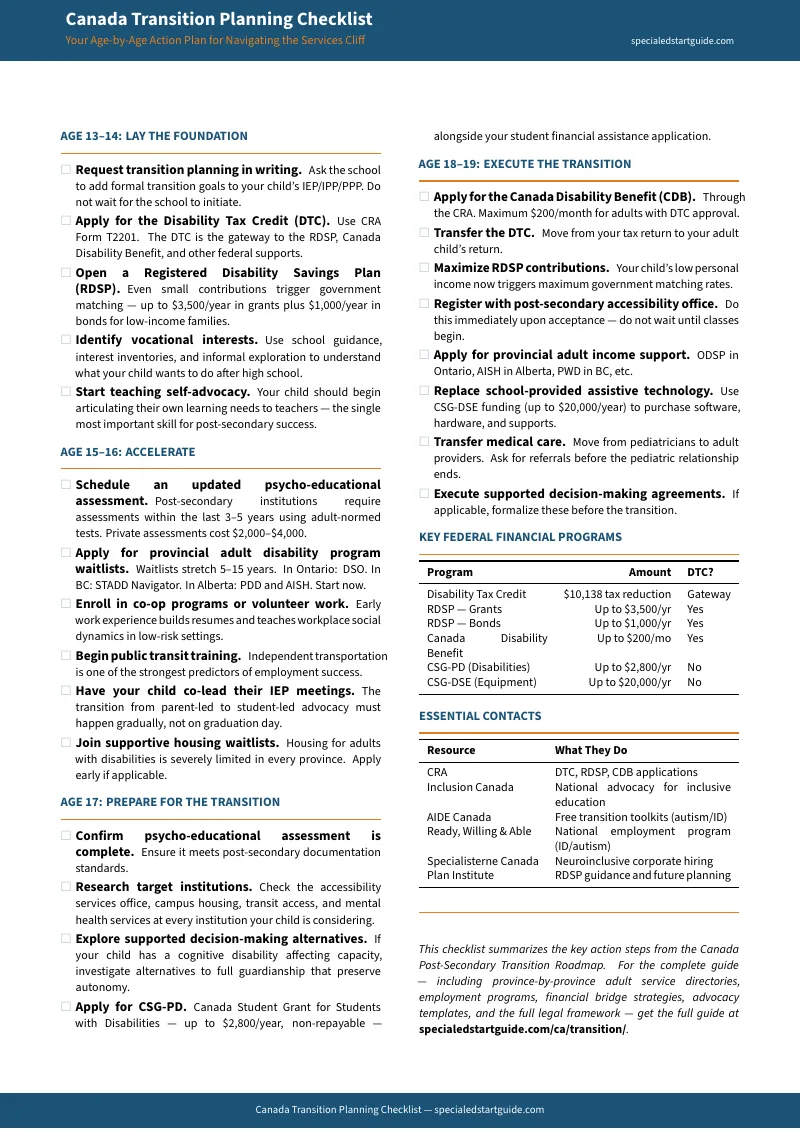
Age 13: apply for the DTC, open the RDSP. Age 15: schedule the updated assessment, join adult service waitlists. Age 17: research target institutions, explore supported decision-making. Age 18: apply for the CDB, transfer the DTC, register with accessibility offices, apply for provincial adult income support. Every action dated. Every deadline explained. Every consequence of delay quantified. This is the project management tool that replaces the 40 open browser tabs.
Templates and Tools
University accommodation request letters. Employer disclosure and accommodation templates. Adult service registration applications. RDSP opening checklists. IEP transition goal language you can insert into your child's plan. Self-advocacy scripts your child can use when they need to speak for themselves for the first time. Fill-in-the-blank, ready to send.
Who This Roadmap Is For
- Canadian parents of teenagers (ages 13-21) with any disability — autism, ADHD, learning disabilities, intellectual disabilities, physical impairments, mental health conditions — who need a unified plan for what happens after high school
- Parents whose child's IEP transition plan feels generic, vague, or disconnected from the realities of adult services, employment, and financial planning
- Parents who just learned about the "services cliff" and are realizing the school's legal obligation expires but their child's needs do not
- Parents who discovered that adult residential waitlists are 5-15 years and need to know which applications to submit now
- Parents navigating the DTC, RDSP, CDB, and Canada Student Grants for the first time — and confused about how they connect
- Parents of students with "mild" disabilities who are told they do not qualify for adult services but still need accommodations in university or the workplace
- Families who have moved or are considering moving between provinces and need to understand how adult services differ
- Indigenous families navigating the transition from band-funded schools and Jordan's Principle to provincial post-secondary and adult systems
- Parents who cannot afford a private transition consultant at $75-$125 per hour but refuse to figure this out by trial and error
Why Not Free Resources?
Free Canadian transition resources are not bad — some are excellent. They are structurally incomplete. Here is exactly where each one stops:
- Ontario's RARC Transition Resource Guide covers every Ontario college and university — and nothing else. It maps accessibility services across the province but ignores employment pathways, financial planning, skilled trades, community day programs, and every other province. If your child is heading to the workforce rather than university, or if you live in Alberta, the RARC guide cannot help you. This roadmap covers all 13 jurisdictions and all pathways — education, employment, and independent living.
- BC's STADD program provides navigators — but only for severe developmental disabilities. If your child has ADHD, a learning disability, or a physical impairment, STADD's eligibility criteria exclude them entirely. They are left to navigate adult services alone. This roadmap covers all disability types across every provincial service system.
- AIDE Canada publishes excellent toolkits — fragmented across dozens of PDFs with no chronological structure. Their "Prepare to Launch" guide, housing resources, and employment frameworks are individually strong. But assembling them into a coherent, time-sequenced plan for your specific child requires weeks of reading and cross-referencing. And they focus exclusively on autism and intellectual disabilities. This roadmap integrates everything into one year-by-year timeline covering all disabilities.
- NEADS focuses on post-secondary education — and speaks to the student, not the parent. Their Financial Aid Directory and scholarship resources are valuable, but they assume a capable student navigating the system independently. If you are the one doing the project management — and for most families in transition, you are — NEADS does not address your needs. This roadmap is written for the parent orchestrating the entire transition.
- Federal government websites explain each program — in complete isolation from each other. The CRA explains the DTC. Employment and Social Development Canada explains the RDSP. A separate page explains the Canada Disability Benefit. None of them tell you that the DTC is the prerequisite for the RDSP which is the prerequisite for maximum government matching which is the financial foundation your child needs before they turn 18. This roadmap connects every federal program into a single financial strategy with exact dollar amounts and deadlines.
— Less Than Twenty Minutes of a Transition Consultant's Time
Private transition consultants charge $75 to $125 per hour. Comprehensive multi-week transition packages cost up to $2,999. Estate lawyers setting up Henson Trusts and supported decision-making agreements charge $300 to $500 per hour. A single private psychoeducational assessment — which the guide teaches you how to fund through federal grants — runs $2,000 to $4,000 out of pocket.
This roadmap gives you the same province-by-province knowledge, the same financial planning strategy, and the same templates those professionals use — for less than the cost of a single consultation phone call. It does not replace a lawyer for complex estate planning. It equips you to handle the transition planning, service applications, accommodation requests, and financial decisions that account for 90% of the work — so you only pay professional rates for the 10% that genuinely requires legal counsel.
Your download includes 9 PDFs:
- Canada Post-Secondary Transition Roadmap (guide.pdf) — The full 12-chapter guide covering the services cliff, the legal framework for adult life, province-by-province transition mandates and adult services, post-secondary accommodation strategies, employment pathways, the federal financial bridge (DTC, RDSP, CDB, Canada Student Grants), independent living planning, Indigenous youth barriers, the master year-by-year timeline from age 13 to 21, and ready-to-use templates
- Master Timeline (master-timeline.pdf) — 2-page fridge-ready year-by-year action plan from age 13 to 21 with checkboxes for every milestone — print it, post it, check items off as you go
- Federal Financial Bridge (federal-financial-bridge.pdf) — 2-page reference card connecting the DTC, RDSP, and CDB with exact dollar amounts, the flow diagram showing how each program unlocks the next, and the age-based action checklist — bring it to the bank when opening an RDSP
- Provincial Services Directory (provincial-services-directory.pdf) — 2-page quick-reference with adult disability programs, waitlist estimates, and application timelines for all 13 provinces and territories, plus a contact directory with URLs
- Post-Secondary Funding Guide (post-secondary-funding.pdf) — 2-page reference card with the Canada Student Grants table, the 5-step accessibility office registration process, common accommodations, and the technology cliff checklist
- Employment Disclosure Framework (employment-disclosure.pdf) — 2-page reference covering the 4-step disclosure strategy with example scripts, federal and provincial employment programs, and the high school employment readiness checklist
- Letter Templates (letter-templates.pdf) — 3 fill-in-the-blank templates ready to print and send: post-secondary accommodation request, employer accommodation request, and IEP transition planning request
- Documentation Organizer (documentation-organizer.pdf) — 1-page printable binder checklist organized into 6 sections so every assessment, IEP, correspondence, and application record is tracked in one place
- Canada Transition Planning Checklist (checklist.pdf) — 1-page age-by-age action plan with the federal financial programs quick reference table and the key deadlines families miss most often
You can also download the Canada Transition Planning Checklist for free — a standalone age-by-age action plan with the federal financial quick reference table, so you can see exactly what needs to happen at 13, 15, 17, and 18 before committing to the full roadmap.