Your child's school form says "Category Q." The psychologist's report documents an autism diagnosis. The school district says "doesn't meet criteria." You have a meeting in three days.
British Columbia's special education designation system uses 12 letter codes — A, B, C, D, E, F, G, H, K, P, Q, and R — to classify students for support planning and district funding. These codes sit at the centre of every IEP meeting, every School-Based Team review, and every conversation about what your child will and won't receive in the classroom. But the Ministry of Education and Child Care manual that defines them is 93 pages of policy language written for Learning Support Teachers, not parents. The school district's own handbooks are inconsistent across 60 districts. And searching online pulls up decade-old district PDFs, US special education advice that references laws that don't exist here, and forum posts from parents who are just as lost as you are.
The BC Designation Category Crosswalk is a structured decoder that takes the entire Ministry designation framework and reorganizes it into the reference parents actually need: every category defined in plain language, every evidence requirement itemized, every funding level explained honestly, and every common confusion addressed directly.
What makes this different from reading the Ministry manual
The Ministry manual tells you what Category G is. It doesn't tell you why your child's clinical autism diagnosis didn't automatically become a Category G designation. It doesn't explain that the $24,340 per year flowing into the district for a Level 2 student goes into general revenue — not into a dedicated account for your child's Educational Assistant hours. It doesn't prepare you for the moment the School-Based Team says your child "doesn't meet criteria" and you have no idea which criteria they mean or what evidence would change the decision.
The Crosswalk bridges every one of those gaps. Here's what's inside:
Every designation category decoded
- Categories A and B (Level 1 — $51,300 supplemental) — Physically Dependent and Deafblind: the most intensive designations, what they require, and why they generate the highest per-student funding
- Categories C, D, E, F, and G (Level 2 — $24,340 supplemental) — Moderate to Profound Intellectual Disability, Physical Disability or Chronic Health Impairment, Visual Impairment, Deaf or Hard of Hearing, and Autism Spectrum Disorder: the clinical and educational evidence each one demands, and the diagnostic-versus-designation confusion that trips up most families at the Category G table
- Category H (Level 3 — $12,300 supplemental) — Intensive Behaviour Intervention/Serious Mental Illness: how diagnostic requirements differ by pathway, what evidence each requires, and what happens when behaviour is treated as a discipline issue instead of a designation pathway
- Categories K, P, Q, and R (High Incidence — no supplemental funding) — Mild Intellectual Disability, Giftedness, Learning Disability, and Moderate Behaviour Support/Mental Illness: the categories where an IEP is generally required, subject to the exceptions in Order M638/95, but which generate zero supplemental funding, why this surprises nearly every parent who hears the word "designated," and what supports you can still expect
The funding reality — decoded honestly
Parents routinely assume a designation means money earmarked for their child. The decoder explains how BC's operating grant system actually works: supplemental funding flows to the district's general inclusive education pool, not to a dedicated per-student account. A Level 2 designation brings $24,340 into the district — but nothing in the system ties those dollars to specific EA hours, specialist time, or classroom resources for your child. Understanding this changes the conversation at every IEP meeting, because you stop asking "where's the money?" and start asking "what adaptations will be documented in the IEP, and how will I know they're being delivered?"
Evidence requirements — category by category
Every designation hinges on the documentation in the student's file at the time of the Form 1701 Student Data Collection. The decoder itemizes the evidence standards for each category — the specific assessment types, clinical reports, and educational records that School-Based Teams review. When the school says your child "doesn't meet criteria," this section lets you check: is the evidence genuinely missing, or has the team interpreted criteria in a way that deserves a conversation?
Diagnosis vs. designation — the confusion that derails meetings
A clinical autism diagnosis from a psychologist is not the same thing as a Category G educational designation from the school district. A WISC-V score in the below-average range is not the same thing as a Category Q designation. The decoder explains the structural difference between medical and clinical diagnoses and the administrative designations the Ministry uses for support planning and funding — so you stop conflating the two in meetings and start asking the right questions about each.
Meeting questions — neutral, specific, and built for BC
Not scripts designed to intimidate the school team. Not American IEP advocacy language that signals immediately that your research came from the wrong country. The decoder includes structured questions organized by situation — your child was just designated, your child was denied a designation, the designation doesn't match the clinical evidence, or you don't understand what supports the designation actually triggers. Each question is designed to open a productive conversation, not escalate a conflict.
Appeals and next steps
When informal conversation doesn't resolve the issue, the decoder outlines the Section 11 appeal process under the School Act, what documentation strengthens an appeal, and when to contact free BC organizations like BCEdAccess, Inclusion BC, or the Family Support Institute. It doesn't replace a private advocate or lawyer — it makes sure you've exhausted every free step before you consider paying for one.
Printable worksheets and planning tools
The decoder kit includes 7 standalone printable PDFs designed to bring to meetings and fill in by hand: an Evidence Inventory Tracker (check off every document before the Form 1701 deadline), an Assessment and Designation Log (chronological record of every assessment and decision), a Meeting Question Planner (prepared questions with space for the team's answers), an IEP Review Checklist (term-by-term review against Ministry requirements), an Agency Communication Log (track every call, email, and meeting), a Category Crosswalk Card (all 12 designations at a glance), and an Evidence Requirements by Category reference card (what documentation the district needs for each letter code).
Who this decoder is for
- Parents who received a school form or IEP with a letter code and need to know what it means before the next meeting
- Parents whose child has a clinical diagnosis but no school designation — or a designation that doesn't seem to match the diagnosis
- Parents who were told their child "doesn't meet criteria" and don't know what criteria the school is applying
- Parents who assumed a designation meant funded support and are discovering it means something more complicated
- Parents preparing for a School-Based Team review who want specific, BC-relevant questions instead of generic advice
Why not just use Understood.org or Wrightslaw?
Understood.org and Wrightslaw are genuinely excellent — for the United States. They cover IDEA, FAPE, Section 504 Plans, and due process hearings. None of those exist in British Columbia. BC has its own School Act, its own Ministry designation categories, its own funding tiers, its own Form 1701 process, and its own Section 11 appeal pathway. If you've been using American resources to prepare for a BC school meeting, the people on the other side of the table already know, and your questions don't align with the system they're operating in.
General AI tools are even worse for this — they routinely confuse BC categories with US special education classifications, hallucinate funding amounts, or state confidently that a clinical diagnosis automatically qualifies a child for a school designation when the process is entirely separate.
The free quick reference card
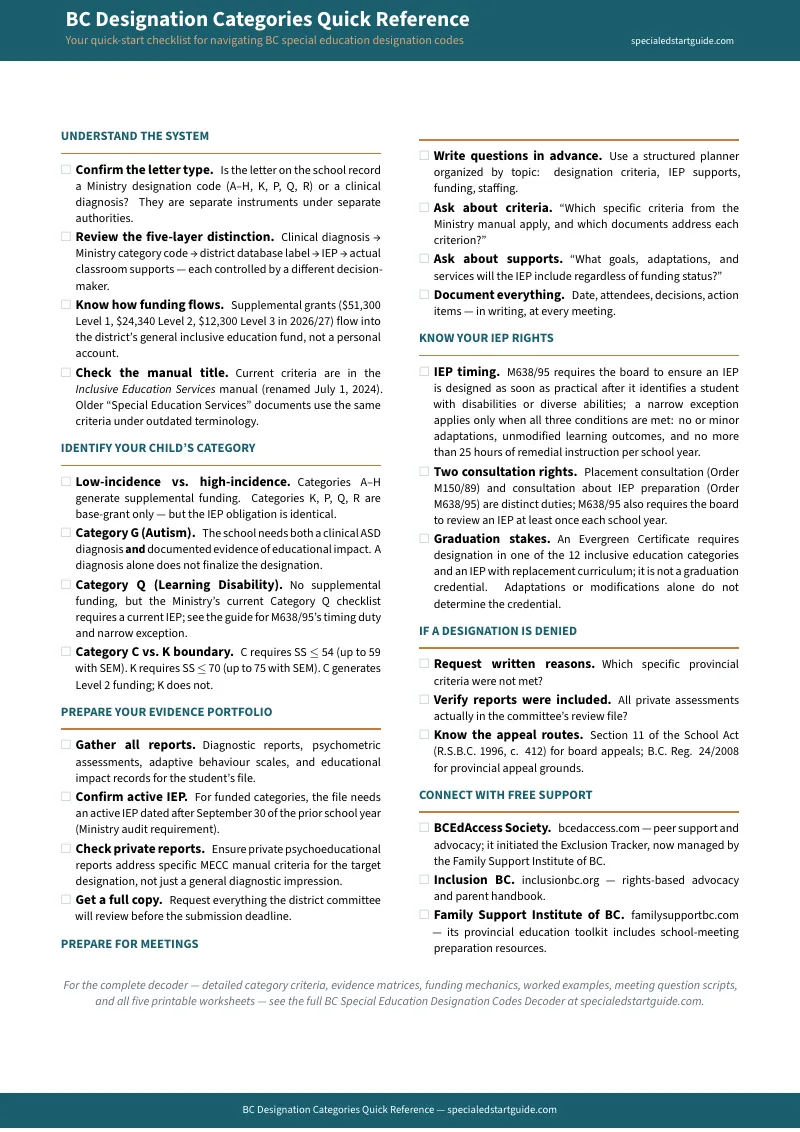
Not sure you need the full decoder? Start with the free BC Designation Categories Quick Reference — a one-page card listing every letter code, what it covers, its incidence level, and direct links to free provincial organizations. If the quick reference answers your question, you don't need the full guide. If you realize the answer is more complicated than a one-page card can cover, the decoder is here.
Satisfaction guarantee
Full refund, no time limit. If the decoder doesn't help you understand your child's designation, email [email protected] and you'll get your money back.
Get the BC Designation Codes Decoder — instant download, understand every category before the next meeting.
Frequently Asked Questions
What if the rules change after I buy?
We update the guide when the rules change. Email us any time, even years later, and we'll send you the current edition free.