Your child's school records say "Code 54." The psychologist's report diagnoses a learning disability. The school says there's no extra funding attached. You have an IPP meeting in three days.
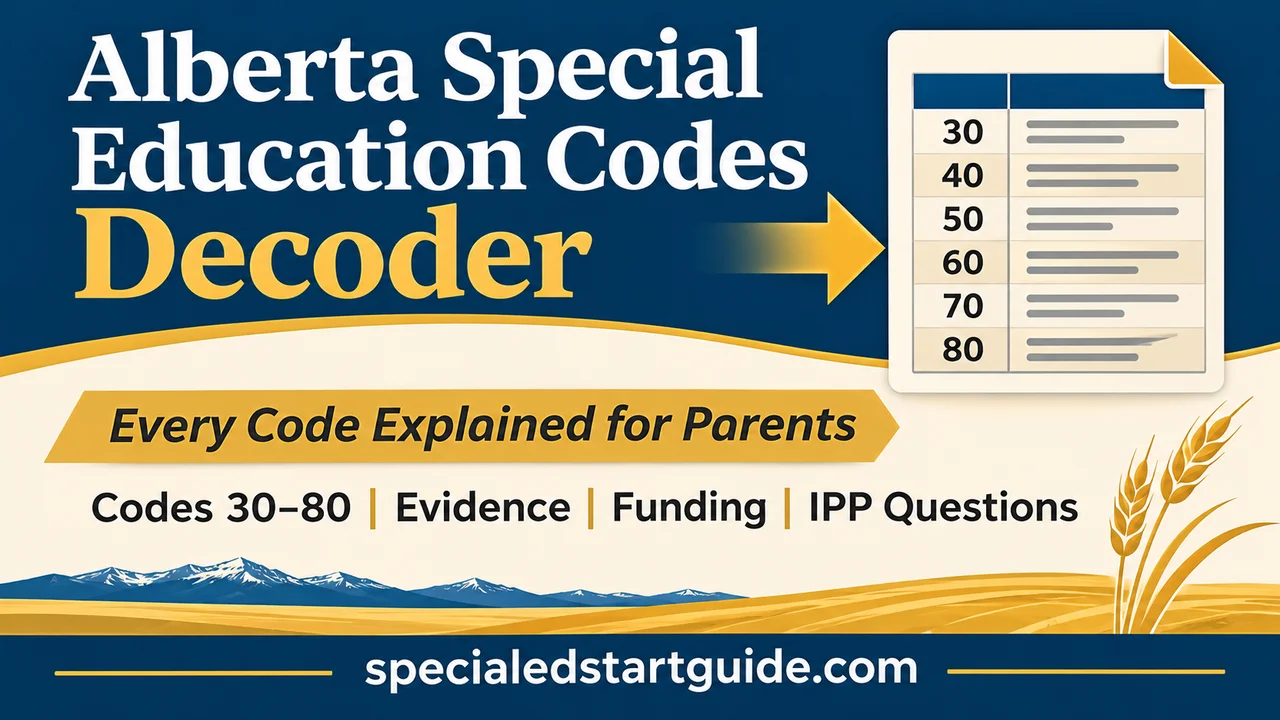
Alberta's special education system assigns numerical codes — from Code 30 through Code 80 — to report special education data to Alberta Education. These PASI codes sit behind every Individualized Program Plan meeting, every annual review, and every conversation about what your child will and won't receive in the classroom. But the official Special Education Coding Criteria document is written for school administrators and data-entry clerks, not for the parent sitting across the table wondering what Code 42 means and whether it changes anything about their child's day.
The Alberta Coding Criteria Translator is a structured decoder that takes the entire provincial coding framework and reorganizes it into the reference parents actually need: every code defined in plain language, every evidence requirement itemized, every funding structure explained honestly, and every common confusion addressed directly.
What makes this different from reading the government PDF
The official coding criteria document tells you what Code 54 is. It doesn't tell you why a clinical learning disability diagnosis from your child's psychologist didn't automatically become a Code 54 in the school's system. It doesn't explain that K–12 funding through the Specialized Learning Support grant is allocated to school authorities by formula and is not determined by individual codes. It doesn't prepare you for the moment the school team says your child "doesn't meet criteria" and you have no idea which criteria they mean or what evidence would change the decision.
The Translator bridges every one of those gaps. Here's what's inside:
Every active Alberta special education code decoded
- Severe codes (41–46) — Severe Intellectual Disability, Severe Emotional/Behavioural Disability, Severe Multiple Disability, Severe Physical or Medical Disability, Deafness, and Blindness: what clinical and educational documentation each requires, the diagnostic pathways, and why the threshold between "moderate" and "severe" matters for the evidence required under each code
- Mild/moderate codes (51–59) — Mild and Moderate Intellectual Disability, Emotional/Behavioural Disability, Learning Disability, Hearing Disability, Visual Disability, Communication Disability/Disorder, Physical or Medical Disability, and Multiple Disability: the codes parents encounter, the assessment evidence behind each one, and why a clinical diagnosis is not the same thing as the school assigning a code
- Early Childhood Services codes (30, 47, 48) — Mild/Moderate Disability or Delay, Severe Language Delay, and Moderate Language Delay: the ECS-only codes that apply before Grade 1, what happens when these codes become invalid as your child enters primary school, and the transition questions most parents don't know to ask
- Code 43 (Severe Multiple Disability) — for students with two or more non-associated moderate-to-severe cognitive and/or physical disabilities that together result in severe-to-profound functioning and require significant programming and support
- Code 80 (Gifted and Talented) — the only code that can be co-assigned alongside another special education code, what giftedness criteria look like in Alberta, and what dual coding means for a child who is both gifted and has a diagnosed disability
The four things parents confuse — decoded honestly
Parents routinely assume that a diagnosis leads to a code, a code leads to funding, and funding leads to dedicated support. The Translator breaks down the four distinct concepts that the provincial system treats separately: a clinical diagnosis from a psychologist or physician, a PASI code registered by the school for provincial reporting, an Individualized Program Plan outlining classroom accommodations, and the Specialized Learning Support Grant allocated to school authorities. For K–12 students, having one does not automatically produce the others; ECS funding has separate eligibility rules. Understanding this changes the conversation at every IPP meeting — because you stop asking "where's the money for my child's code?" and start asking "what accommodations will be documented in the IPP, and how will I know they're being delivered?"
The funding reality
Under Alberta's current funding model, the Specialized Learning Support grant is allocated to school authorities through a formula and distributed based on student needs, not through per-student allocations tied to individual codes. A code registered in PASI does not generate a cheque earmarked for your child. The school saying "we don't have the resources" is describing a school-authority-level allocation decision, not a code-level funding fact. The decoder explains how funding actually flows, what Program Unit Funding means for children in Early Childhood Services, and what this funding structure means for the support conversation at the IPP table.
Evidence requirements — code by code
Every code hinges on the documentation in the student's file at the time the school registers it in PASI. The decoder itemizes the evidence standards for each code — the specific assessment types, clinical reports, and educational records that the school team reviews. When the school says your child "doesn't meet criteria," this section lets you check: is the evidence genuinely missing, or has the team interpreted criteria in a way that deserves a conversation?
The PUF-to-school transition
The transition from Program Unit Funding in pre-kindergarten to Grade 1 is one of the highest-confusion moments in Alberta special education. ECS-only codes like Code 47 (Severe Language Delay) become invalid at Grade 1 entry. Parents routinely mistake this administrative transition for a clinical declaration that their child no longer needs support. The decoder explains which codes sunset, what the school should be considering as replacements, and the questions to ask before your child ages out of pre-K so supports don't disappear.
Meeting questions — neutral, specific, and built for Alberta
Not scripts designed to intimidate the school team. Not American IEP advocacy language that references IDEA and Section 504 — laws that don't exist in Alberta. The decoder includes structured questions organized by code and situation: your child was just coded, the school says your child doesn't meet criteria, the code doesn't match the clinical evidence, the code was removed at the annual review, or your child is transitioning from ECS into Grade 1. Each question is designed to open a productive conversation, not escalate a conflict.
Assessment evidence explained
Psychoeducational assessment reports arrive dense with technical language — WISC-V indices, WIAT standard scores, CELF composites, ABAS adaptive behaviour profiles. The decoder explains what standard psychometric terms mean in general terms within Alberta's coding framework, what score ranges the school typically looks at when determining whether criteria are met, and why the school's interpretation of an assessment may differ from the clinician who administered it. This is not individual score interpretation — it's the context you need to follow the conversation when the school team reads from the report.
Who this decoder is for
- Parents who received a school document or IPP with a code number and need to know what it means before the next meeting
- Parents whose child has a clinical diagnosis but no PASI code — or a code that doesn't seem to match the diagnosis
- Parents who were told their child "doesn't meet criteria" and don't know what criteria the school is applying
- Parents whose child is transitioning from pre-kindergarten PUF into Grade 1 and discovering that their child's code no longer applies
- Parents who assumed a code meant earmarked funding and are learning it means something more complicated
- Grandparents, kinship carers, and extended family members sitting in on IPP meetings who need to understand the system quickly
- Adult learners reviewing old school records to understand legacy codes and assessment reports
Why not just use Understood.org or Wrightslaw?
Understood.org and Wrightslaw are genuinely well-regarded — for the United States. They cover IDEA, FAPE, Section 504 Plans, and due process hearings. None of those exist in Alberta. Alberta has its own Education Act, its own PASI coding system, its own IPP process, and its own funding model. If you've been using American resources to prepare for an Alberta school meeting, the people on the other side of the table already know, and your questions don't align with the system they're operating in.
General AI tools are even worse for this — they routinely confuse Alberta's numbered PASI codes with American IDEA eligibility categories, hallucinate criteria that don't exist, or state confidently that a clinical diagnosis automatically qualifies a child for a school code when the process is entirely separate. Uploading your child's assessment report to a public AI tool also creates a data privacy risk you don't need.
The free quick reference card
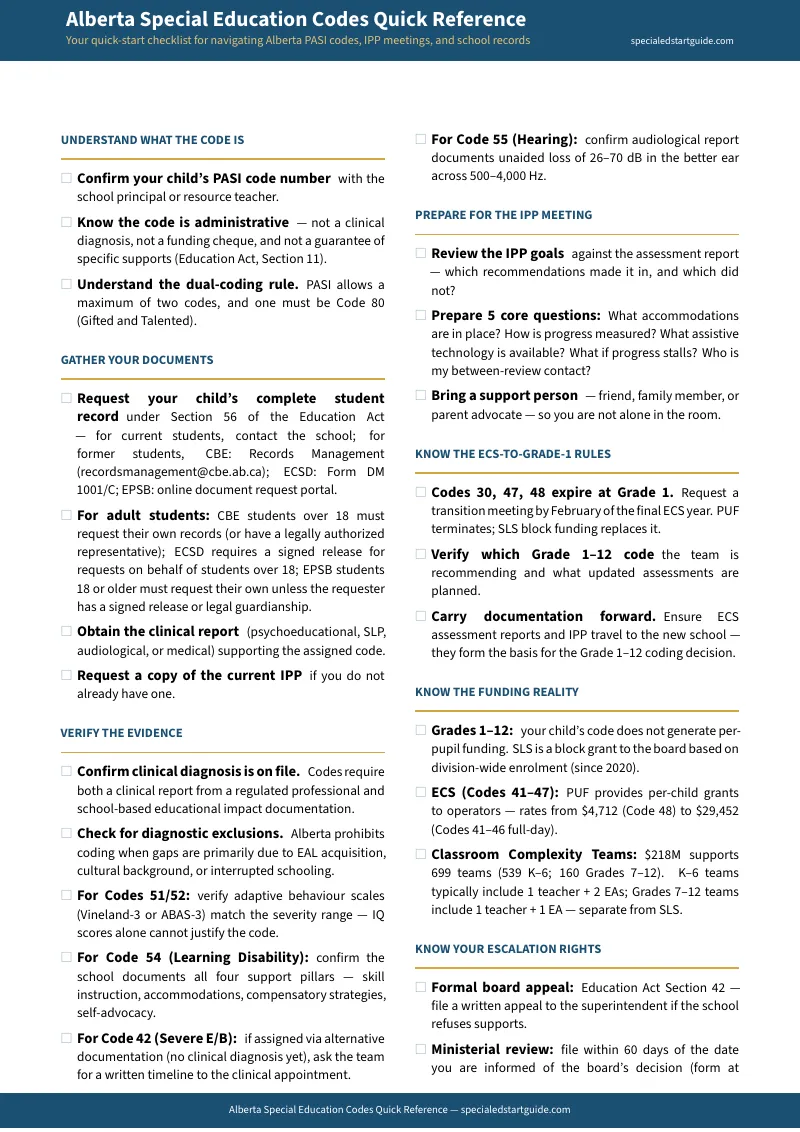
Not sure you need the full decoder? Start with the free Alberta Special Education Codes Quick Reference — a two-page card listing each active PASI code, what it covers, the grade range it applies to, and the evidence usually needed, plus direct links to free provincial organizations. If the quick reference answers your question, you don't need the full guide. If the answer is more complicated than a one-page card can cover, the decoder is here.
Satisfaction guarantee
Full refund, no time limit. If the decoder doesn't help you understand your child's code, email [email protected] and you'll get your money back.
Get the Alberta Special Education Codes Decoder — instant download, understand every code before the next meeting.
Frequently Asked Questions
What if the rules change after I buy?
We update the guide when the rules change. Email us any time, even years later, and we'll send you the current edition free.