Wisconsin's transition timeline starts at 14 and fragments across five agencies. No single brochure connects the pieces — because no single agency is allowed to.
Your child's school just handed you a computer-generated Postsecondary Transition Plan with drop-down goals and generic course-of-study language. Somewhere between the standardized PTP worksheet and the confusing references to "measurable postsecondary goals," you realized this plan wasn't written for your child. It was written for compliance.
That's not a glitch — it's the system working exactly as designed. DPI explains the school's obligations. DVR explains employment services. The ADRC explains long-term care waivers. WI FACETS offers peer support but can't give legal advice. And none of these agencies are permitted to show you how to coordinate their programs, challenge a school district that won't cooperate, or make the strategic decisions that determine whether your child exits school with real-world skills or a stack of disconnected brochures.
The Wisconsin IEP Transition to Adulthood Guide is a Transition Integration System — a single chronological framework that sequences every agency, every filing, and every decision point from the first PTP at 14 through the school-term exit at 21. It doesn't replace the free brochures. It connects them into a timeline you can actually follow.
What's Inside
- Complete transition timeline (ages 14–21) — every milestone organized chronologically with the lead agency, statutory citation, and your specific action items, so you stop discovering deadlines after they've passed
- PTP audit framework — how to review the school's web-generated Postsecondary Transition Plan against Indicator 13 compliance, rewrite generic drop-down goals into measurable postsecondary targets, and push back when the plan doesn't reflect your child's actual interests
- DVR Pre-ETS coordination guide — the five core Pre-Employment Transition Services, how to connect with a DVR counselor starting at age 14, and how to braid DVR funding with school-based transition services so your child isn't starting from scratch at graduation
- Chapter 52 vs. Chapter 54 decision framework — a side-by-side comparison of Supported Decision-Making Agreements and court-ordered guardianship, with the exact DHS F-02377 form instructions, so you can choose the path that protects your child's rights without court fees or mandatory training — unless full guardianship is genuinely needed
- Diploma strategy guide — exactly how accepting a regular high school diploma under s. 118.33 terminates FAPE, why a Certificate of Completion preserves services, and how to design Beyond-18 programming (Project SEARCH, STRIVE, community-based training) that gets your child out of the high school building
- CLTS-to-adult-services handoff — the age-17.5 warm-handoff protocol, the Adult Functional Screen, and a structured comparison of Family Care (managed care) versus IRIS (self-directed waiver) so you can choose the right model before the transition window closes
- SSI and asset protection toolkit — the Age-18 Redetermination process, the $2,000 Medicaid asset limit, ABLE account rules (up to $100,000 without affecting SSI), and Wisconsin pooled trust options through WisPACT and Life Navigators
- Dispute resolution playbook — how to use the Wisconsin Special Education Mediation System (WSEMS), the state complaint process, and the Division of Hearings and Appeals when the district isn't delivering on transition commitments
- Eight fillable worksheets — Transition Timeline Tracker, DVR Pre-ETS Sequencing Worksheet, Decision-Making Comparison Worksheet, ADRC Functional Screen Preparation Sheet, Agency Communication Log, Graduation Decision Worksheet, SSI Application Preparation Checklist, and Asset Protection Planner
Who It's For
This guide is for Wisconsin parents at any stage of the IEP transition process — whether your child just hit the age-14 PTP trigger or you're compressing years of missed planning into a single urgent push before the school-term exit at 21.
- You just received a standardized PTP with generic goals and have no idea how to make it meaningful
- Your child is approaching 17 and you need to choose between Supported Decision-Making and guardianship — but the school staff who mentioned guardianship can't legally advise you on either option
- The district is pushing your child toward a standard diploma to boost its graduation metrics, and you need to understand the legal consequences before signing anything
- You're trying to coordinate DVR, the ADRC, DHS, and the SSA at the same time and the deadlines don't align with each other or the school calendar
- You're looking at special education advocates charging $100–$175 per hour and attorneys starting at $250, and you need to get organized before you can decide if professional help is worth it
Why the Free Brochures Aren't Enough
State agencies and nonprofits produce excellent materials — each covering its own piece of the system. DPI publishes policy bulletins. DVR distributes Pre-ETS guides. The ADRC hands out long-term care brochures. WI FACETS runs webinars. The TIG website offers PTP compliance checklists. But these resources are siloed by design — each organization explains what its own programs do, not how they interact with the others.
No state agency can show you how to time a DVR referral so it coordinates with the IEP timeline. No free brochure walks you through the legal comparison between SDM and guardianship that school staff are prohibited from making. No nonprofit can advise you on whether to accept the diploma your district is offering or defer graduation to preserve transition services. Those are strategic decisions that fall between the agencies — exactly where families get stuck and exactly what this guide covers.
The Guarantee
Money-back guarantee, no time limit. If the guide doesn't help you navigate your child's transition, email us for a full refund — no forms, no questions.
Start Planning Before the System Moves Without You
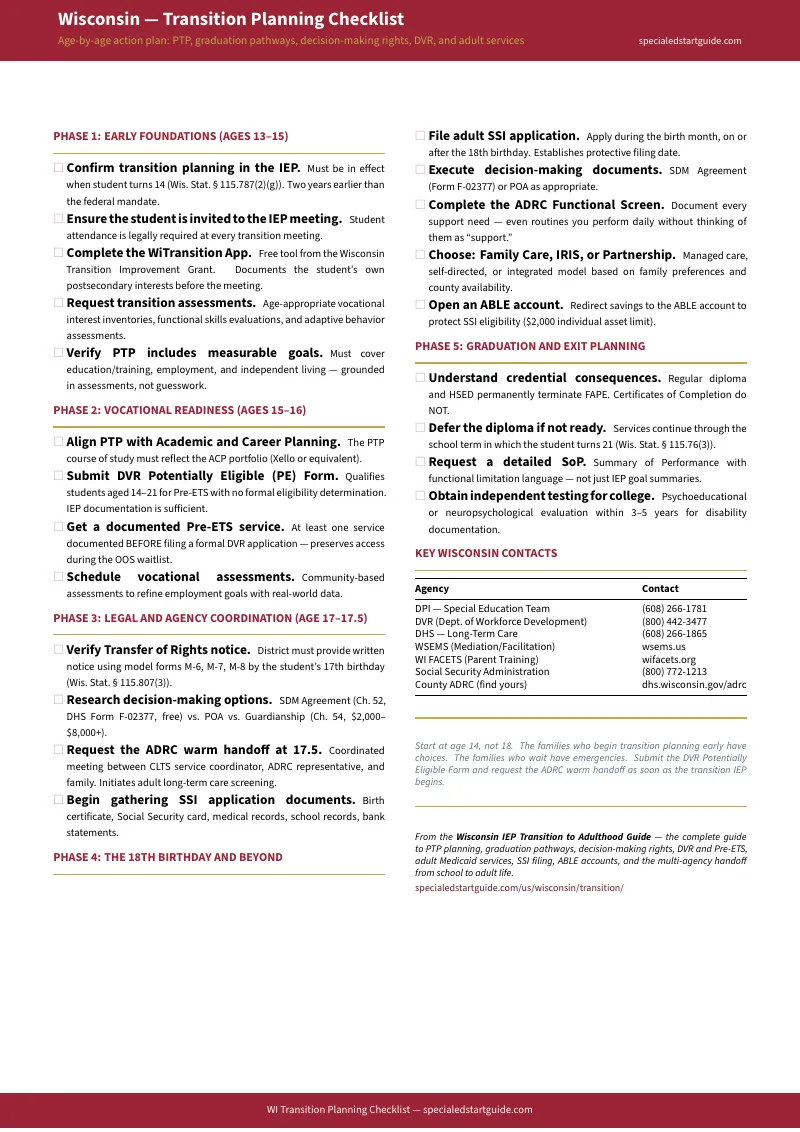
Download the free Wisconsin Transition Planning Checklist — a printable one-page timeline of every critical milestone from age 14 through 21. Bring it to the next IEP meeting and see how many boxes your district hasn't checked yet.
Ready for the full system? The Wisconsin IEP Transition to Adulthood Guide gives you the complete timeline, the decision frameworks, the agency coordination tools, and the worksheets to manage every step — for a fraction of what one hour with a special education advocate costs.
Frequently Asked Questions
What if the rules change after I buy?
We update the guide when the rules change. Email us any time, even years later, and we'll send you the current edition free.