Five adult-eligibility conditions, the developmental-delay path through age 19, adaptive-score rules, and age-19 review rules — plus a stack of forms that don't explain what happens if you get them wrong
Your family just got a letter about DDA eligibility — or someone at school mentioned "applying to DDA before graduation" — and now you're trying to decode WAC 388-823, figure out which evidence the state actually needs, and work out whether your child's psychological testing meets the threshold. DDA's own website gives you the forms but not the context. The WAC is public but written in regulatory prose. And the free parent groups can explain what DDA does in general without walking you through the specific evidence rules, score thresholds, and appeal deadlines your situation turns on.
Meanwhile, the clock is running. Under WAC 388-823-1010, an age-19 review applies if the most recent eligibility determination was completed before age 16, or if eligibility with another neurological or other condition similar to intellectual disability relied on academic delays as evidence of substantial functional limitations. If that age-19 review leaves insufficient information, DDA can disenroll the person on their 20th birthday. And if DDA says no at any point, you have 90 days to request an OAH hearing — or just 10 days to preserve existing services while you appeal.
The Evidence Inventory System
The Washington DDA Eligibility Guide is built around the problem that makes this process so stressful: DDA eligibility isn't a single yes-or-no test. There are five adult-eligibility condition categories and a separate developmental-delay pathway for applicants under age 20, each with its own evidence rules and age-of-onset requirements. The guide gives you a structured system for matching your child's existing records to the specific WAC section that applies — so you're not guessing whether an adaptive score qualifies or relying on an IQ score, which DDA no longer uses to determine enrollment.
This isn't a generic disability planning binder with blank medical logs and emergency contact sheets. It's a Washington-specific walkthrough of the DDA administrative code — from first application through HCBS waiver access — written for families who need to understand what the evidence rules actually mean, not just where to find the forms.
What's Inside
The full guide includes a comprehensive walkthrough plus eight standalone printable worksheets: the Evidence Inventory Worksheet, Age-Based Review Timeline Chart, Young-Person-Led Goal Notes, Notice and Deadline Tracker, Agency Communication Log, Age 19 Review Preparation Checklist, Application Packet Checklist, and OAH Hearing Evidence Organizer.
- Eligibility-Pathway Evidence Breakdown — the five adult-eligibility condition categories and the developmental-delay pathway for applicants under 20, with the adaptive behaviour score thresholds for conditions that use them, the developmental-delay evidence standard, cerebral palsy's direct-assistance rule, and age-of-onset documentation
- Psychometric Score Decoder — a plain-language explanation of how DDA evaluators read adaptive behaviour scales, what "two standard deviations below the mean" actually means in numbers, and how to check whether the testing in your child's file meets current requirements in WAC 388-823-0740
- Application Walkthrough — step-by-step instructions for Form DSHS 14-151 (the enrollment determination request) and Form DSHS 14-012 (consent), including who signs what after the young person turns 18, plus the printable Application Packet Checklist
- Age 18 Transition and Age 19 Review Preparation — guidance on the age-18 transition and the printable Age 19 Review Preparation Checklist for a review when WAC 388-823-1010 applies, including what evidence to update and DDA's offer to administer an adaptive assessment at no cost when no result from an accepted adaptive assessment is available from the past 36 months and other eligibility criteria are met
- No Paid Services Navigation — how the NPS caseload works, why enrollment alone does not authorize funded services, and the steps to log a formal service request and complete a functional-needs assessment
- HCBS Waiver Overview — the three waiver programs covered in this guide (Individual and Family Services, Basic Plus, and Core) among DDA's five programs, what each covered waiver funds, the statutory priority groups under RCW 71A.10.110, and how to describe functional needs accurately during the CARE/SIS assessment
- Notice and Deadline Tracker — a printable landscape log for recording receipt dates of Notices of Planned Action, calculating 10-day stay-put windows, and tracking 90-day OAH hearing request deadlines
- OAH Hearing Roadmap — how to request a hearing, what to expect from the process, the printable OAH Hearing Evidence Organizer, and when to seek legal representation through Disability Rights Washington, the Northwest Justice Project, or Washington LawHelp
Who This Guide Is For
- Parents of a teenager with an intellectual or developmental disability who've been told to apply for DDA eligibility before school ends — and need to understand the evidence rules before they submit the forms
- Families whose child just received a six-month notice for an age-19 eligibility review and need to know what evidence to update and what to expect
- Parents who've received a denial or a Notice of Planned Action and need to understand the OAH hearing process and the deadlines that apply
- Families whose child is on the No Paid Services caseload and want to understand how to request funded services and what happens after
- Young adults with IDD who are turning 18 and want to understand their own rights, their own application, and their own choices — the guide treats you as the primary rights holder
Why Free Resources Don't Cover This
Washington has strong free resources. PAVE offers parent training and information. Informing Families publishes policy summaries and timelines. Disability Rights Washington handles systemic advocacy. The Arc of Washington State connects families with peer mentors. And the WAC itself is freely available on the state legislature's website.
The problem isn't that any single resource is bad — it's that they serve different purposes. PAVE focuses primarily on school-age special education, not DDA administrative appeals. Informing Families provides general overviews but doesn't walk you through psychometric score thresholds or OAH hearing preparation. Disability Rights Washington handles high-priority systemic cases but can't take every routine eligibility denial. And reading WAC 388-823 in raw form means parsing dozens of sections of regulatory prose to find the three that apply to your child's condition.
The guide bridges those gaps. It takes what DDA publishes in forms and WAC sections and organises it into a single workflow — from first application through waiver access — with the evidence rules translated into plain language and checklists you can actually use. Special needs attorneys charge $150–$300 per hour. Independent waiver consultants run $100–$300 per hour. This guide gives you the same organisational framework, available the moment you download it.
100% Satisfaction Guarantee
If the guide doesn't help you take clear, informed action on DDA eligibility, email [email protected] for a full refund, no time limit.
Start With the Free Checklist — or Get the Full Guide
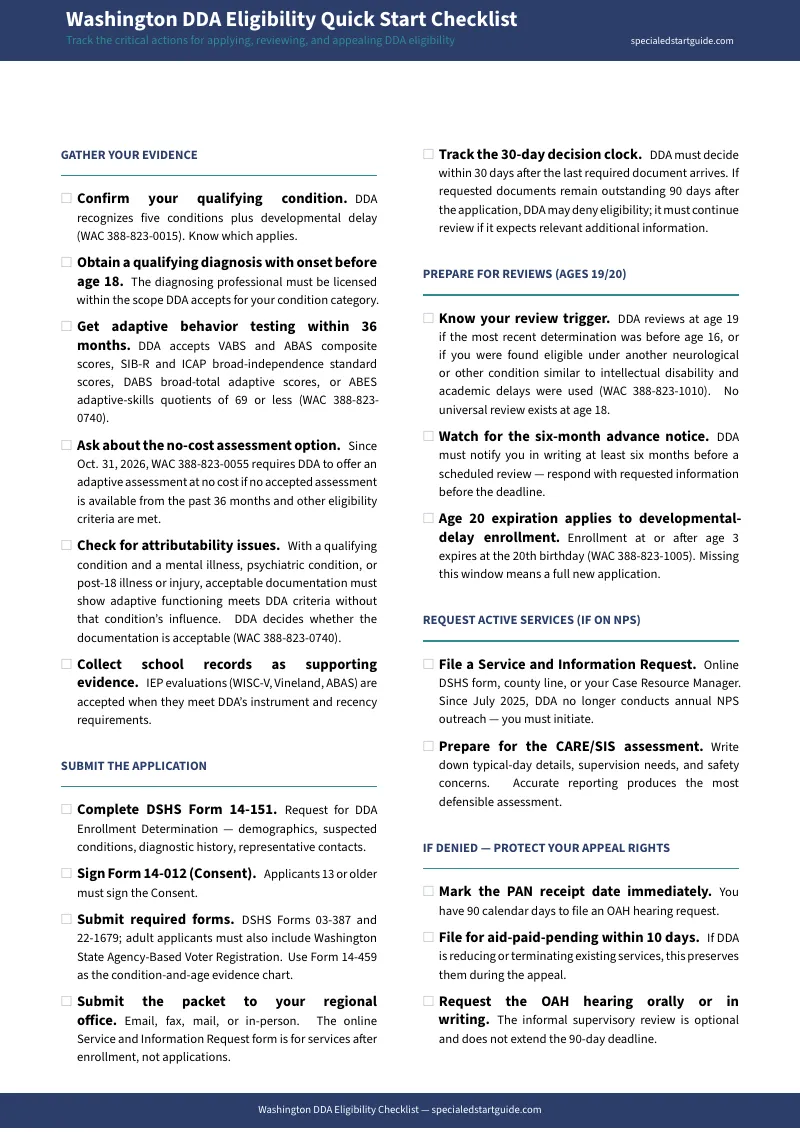
Download the free Washington — DDA Eligibility Checklist to see the eligibility rules, evidence requirements, and application steps at a glance. When you're ready for the complete walkthrough — with score thresholds explained, review preparation checklists, waiver navigation, and the OAH hearing roadmap — the full guide is waiting.
Get the Washington DDA Eligibility Guide →
Frequently Asked Questions
What if the rules change after I buy?
We update the guide when the rules change. Email us any time, even years later, and we'll send you the current edition free.