You Downloaded the Free Form. Now You Need to Know How to Use It.
Disability Rights Texas has the statutory form. TexasLawHelp.org has it too. You can pull up the exact text of chapter 1357 of the Texas Estates Code and read every section. The form is free, the statute is public, and the concept is straightforward: your young adult picks trusted supporters to help with decisions, and nobody goes to court.
But the form doesn't tell you what happens next. It doesn't explain the statutory witness-age rule or the practical cautions for people who plan to witness. It doesn't walk you through what to do when the bank's compliance department rejects the agreement because they've never seen one. It doesn't cover how to pair the agreement with HIPAA and FERPA releases so a supporter can actually get records from a doctor or a school. And it doesn't warn you that an SSA representative payee is a completely different process that the state agreement can't replace.
Between "we have the form" and "this agreement is working in our daily life," there are a dozen practical steps that no free resource puts in order.
The Texas Supported Decision-Making Agreement Guide is the Agreement Execution Workbook — the structured walkthrough that takes you from choosing a supporter through signing, sharing, and managing the agreement so it actually works with the doctors, banks, schools, and agencies your family deals with.
What's Inside the Guide
The Chapter 1357 Framework
Before you fill in a single line of the form, you need to understand what a supported decision-making agreement does and doesn't do under Texas law. It lets a supporter help gather information, understand options, and communicate decisions — it does not let a supporter make decisions for the adult, sign contracts on their behalf, or manage their money. The guide breaks down every section of the statute in plain language: what the agreement authorises, the life areas it can cover, and exactly where the supporter's authority stops. If you've been told "it's like guardianship but easier," the guide explains why that comparison is misleading and what it actually means for day-to-day life.
The Supporter Selection Worksheets
Choosing a supporter isn't just picking the most helpful person in the family. Under section 1357.052, a supporter takes on four statutory fiduciary duties: act in good faith, stay within the authority the agreement grants, act loyally and without self-interest, and avoid conflicts of interest. The worksheets help the young adult evaluate who understands the role, whether a potential supporter has conflicts of interest that could become problems later, and how to have the conversation about boundaries before the agreement is signed. The guide covers the difference between being a helpful parent and being a legally designated supporter — because they're not the same thing, and the duties that come with the role matter.
The Signing and Execution Checklist
Getting the execution wrong can invalidate the agreement entirely. Texas law gives you two paths: sign before two witnesses aged 14 or older, or sign before a notary public. You don't need both — but you do need to get the one you choose right. The checklist walks through each option step by step: the statutory witness-age rule and practical cautions about who should not witness, what the notary must do (and what they don't need to do), how to verify that the signing was voluntary, and the common mistakes that leave families with an agreement that looks right but won't hold up when presented to an institution.
The HIPAA and FERPA Release Map
An agreement says a supporter can help gather records. The Texas model form calls for releases allowing the supporter to see protected health information and educational records to be attached. HIPAA and FERPA set different rules for sharing and access; the release map explains how to coordinate the agreement with those releases and what each does and doesn't cover. If your young adult is still in school with an IEP and also sees specialists, this is the section that keeps the supporter from hitting walls at the front desk.
The Third-Party Presentation System
Banks refuse the agreement because they've never seen one. Clinics ask for a power of attorney instead. School administrators confuse it with guardianship. This happens, and it's the most common reason families feel like the agreement doesn't work. The guide includes a structured process for presenting the agreement to resistant institutions: what to bring, who to ask for, how to cite the statutory safe-harbour protection under section 1357.101 that most compliance staff have never heard of, and when to escalate. Most refusals come from unfamiliarity, not from a legal objection — and knowing the difference changes the conversation.
The Complementary Tools Reference
A supported decision-making agreement doesn't cover everything. It doesn't give a supporter the authority to manage money, sign a lease, or consent to medical treatment on the adult's behalf. For some families, the agreement is enough. For others, it works best alongside a durable power of attorney, a medical power of attorney, or an SSA representative payee designation. The guide maps which tool covers which decisions, where they overlap, and how to combine them without creating conflicts — so the young adult has exactly the support structure that fits, not more and not less.
The Review, Revocation, and Replacement Workflow
Circumstances change. The supporter moves away. The young adult's needs shift. Under section 1357.053, a DFPS finding that the supporter abused, neglected, or exploited the adult triggers automatic termination. Either party can also end the agreement at any time — ending it means notifying every third party that holds a copy, and executing a new agreement means starting the witness or notary process again. The workflow covers annual review prompts, revocation notification steps, and the execution checklist for a replacement agreement, so transitions between supporters don't leave gaps where nobody can help.
The State Agency and Benefits Coordination Guide
HHSC programs, LIDDA intake, Texas Workforce Solutions vocational rehabilitation, and SSI at 18 each interact with the agreement differently. The guide explains how to present the agreement during intake meetings, what agency staff can and can't do with it, and the critical distinction between a state-law supporter and a federal representative payee. If your family is also navigating Medicaid waiver interest lists, benefits redeterminations, or vocational rehabilitation services, this section shows where the agreement fits into those processes — and where it doesn't.
Tracking Logs and Worksheets
The guide includes printable worksheets and logs: a supporter evaluation sheet, a signing-day checklist, a permission-release coordination map, a third-party sharing log (who has a copy, when it was delivered, their contact information), an annual review prompt, and a revocation notification checklist. These aren't optional extras — they're the operational backbone that keeps the agreement working over time instead of sitting in a drawer after signing day.
Who This Guide Is For
This is for Texas families making a supported decision-making agreement — whether the 18th birthday is coming soon or the agreement needs updating years later.
- You've decided guardianship isn't the right fit and you want an alternative that keeps your young adult in charge, but you need more than a blank form — you need the step-by-step process for getting from "we know this exists" to "this is working in our daily life"
- You downloaded the statutory form from DRTx and you're stuck on the details: who can witness, whether you need a notary too, and what happens if you get the execution wrong
- A bank, doctor's office, or school administrator already refused to accept the agreement and you don't know how to respond — or whether the law actually requires them to cooperate
- Your young adult has an IEP and transition plan, and you need to understand how the agreement connects to FERPA, HIPAA, and the school's transfer-of-rights process at 18
- You want to combine the agreement with a power of attorney or representative payee designation but you're not sure which tool covers which decisions, or whether one replaces the other
- You set up an agreement years ago and the supporter needs to change — you need to know how to revoke the old one, notify everyone who has a copy, and execute a new one correctly
Why Not Just Use the Free Form?
You should use the free form — it's the actual agreement. The statutory form from Disability Rights Texas and TexasLawHelp.org is the document your young adult will sign. This guide doesn't replace it.
What the free form doesn't include is the execution workbook around it. Disability Rights Texas publishes the form and operates a free SDMA generator tool — essential for getting the agreement itself. But after a DRTx legal-services application is submitted, it takes at least 10 business days for the organization to decide whether to take the case. DRTx intake is restricted to cases meeting specific priority criteria. If your family just needs to execute an agreement correctly and get third parties to cooperate, the guide walks you through the operational steps that the form itself doesn't cover.
Texas Parent to Parent offers peer support workshops and conference materials that highlight guardianship alternatives. The information is valuable but relies on external links for execution workflows and notary guidance — you'd need to follow a chain of references to piece together one signing checklist.
The Arc of Texas and Partners Resource Network publish plain-language manuals explaining the rights behind a supported decision-making agreement. These are strong on the why. This guide is the how: execution requirements, witness rules, record releases, third-party presentation steps, and tracking systems that keep the agreement working after signing day.
This guide takes the free form and wraps a structured execution workflow around it — from supporter selection through signing, sharing, and long-term management — so your family gets it right the first time and knows what to do when things change.
Satisfaction Guarantee
Full refund, no time limit. If the guide doesn't give you a clear process for making, sharing, and managing a supported decision-making agreement in Texas, you get your money back. Email [email protected] and we'll handle it.
Get Started
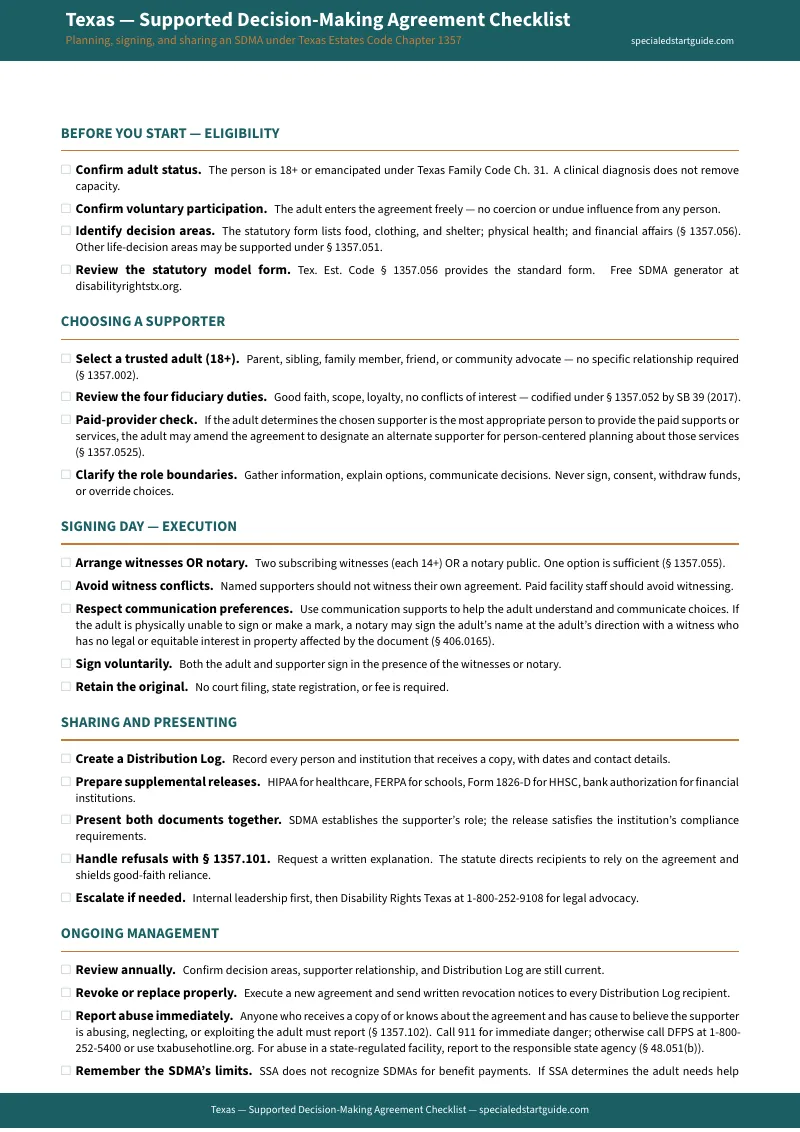
Download the free Texas Supported Decision-Making Agreement Checklist for the essential steps — or get the full Texas Supported Decision-Making Agreement Guide for the complete execution workbook with worksheets, release maps, and presentation guidance.
Your young adult's 18th birthday doesn't have to mean a courtroom. Texas gave families a better option. This guide shows you how to use it.
Frequently Asked Questions
What if the rules change after I buy?
We update the guide when the rules change. Email us any time, even years later, and we'll send you the current edition free.