Three Agencies. Zero Coordination. One Deadline You Can't Miss.
You left the IEP meeting with a new word ringing in your ears: "transition." The special education coordinator mentioned postsecondary goals and measurable outcomes. Someone said "Vocational Rehab." Someone else said "Dakota at Home." You wrote down every acronym you could catch — DRS, DDD, ICAP, Pre-ETS, MPSG — and then you went home and searched for what any of it actually means in South Dakota.
Here's what you found: the school handles the IEP transition goals, but has no authority over adult services. The Division of Rehabilitation Services handles employment prep, but doesn't coordinate with the Division of Developmental Disabilities. DDD manages the waiver programs your child may need for long-term support, but their waitlists run one to two years. And the Unified Judicial System handles guardianship, but nobody at the school mentioned that your parental rights vanish at age 18 unless you take legal action before the birthday.
Every one of these systems has its own referral form, its own eligibility process, and its own deadlines. None of them shares a calendar. If you miss the waiver intake window because nobody told you it existed, your child ages out of school and sits at home — not because services don't exist, but because you didn't apply in time.
The South Dakota IEP Transition to Adulthood Guide is the Transition Sequence Coordinator — the step-by-step system that organizes these three agencies into a single chronological calendar, so you never discover a deadline after it's passed.
What's Inside the Guide
The Three-Agency Coordination Map
South Dakota splits transition authority across the school district (IEP and graduation), the Division of Rehabilitation Services (employment and Pre-ETS), and the Division of Developmental Disabilities (Medicaid waivers and long-term support). Each one has its own intake process, its own eligibility rules, and its own timeline. The guide maps exactly what each agency controls, when you need to engage them, and how to make sure nothing falls through the cracks between their separate systems. When the school transition coordinator says "we'll send a referral to DRS," you'll know exactly what that referral triggers and what it doesn't.
The Fiscal-Year Exit Calculator
Under ARSD 24:05:22:05, a student who turns 21 during the fiscal school year (July 1 through June 30) retains the right to FAPE through June 30 of that year. That means a student born in August who turns 21 gets nearly eleven more months of school services — but a student born in June gets almost none. This single rule changes everything about your planning window for adult service applications, waiver intake, and guardianship filings. The guide calculates your child's exact exit date and builds the rest of the timeline backward from it.
The Diploma Pathway Decision Framework
This is the highest-stakes decision in the entire transition process. Accepting a standard unmodified diploma terminates FAPE immediately — your child loses all school-based services the moment they walk across that stage. Choosing a modified pathway under ARSD 24:05:27:12 preserves services through age 21, giving your child continued access to transition programming, work placements, and therapy. But modified pathways affect postsecondary options differently. The guide walks you through the tradeoffs with a structured decision worksheet, including teacher certification requirements that affect whether modified courses actually count toward credits.
The Transfer-of-Rights Legal Toolkit
At age 18, all educational decision-making authority transfers from you to your child — automatically, without any action on your part. The school must notify you at least one year before, but that notification comes without a roadmap for what to do about it. The guide compares every legal option available in South Dakota: informal supported decision-making (no state statute, which means third parties aren't required to recognize it), durable financial and healthcare powers of attorney under SDCL Chapter 59-7, limited guardianship, and full guardianship under SDCL Title 29A. Each option includes the civil rights impact, the cost range, and the exact sequence for pursuing it.
The Medicaid Waiver Navigation System
South Dakota runs two primary HCBS waivers for individuals with developmental disabilities: the CHOICES Waiver (comprehensive residential and day services) and Family Support 360 (self-directed in-home care). Both have interest lists. The CHOICES Waiver has approximately 185 people waiting. Family Support 360 is capped at 2,967 spots with a one-to-two-year wait. The guide walks you through the Dakota at Home intake process (1-833-663-9673, Option 2), the ICAP assessment that determines your child's service level, and the Medicaid financial application through the Department of Social Services — including the fact that both waivers evaluate only the child's income and assets, not yours.
The Federal Benefits Tracker
When your child turns 18, SSA conducts an Age-18 Redetermination using the stricter adult disability standard. Many students actually qualify for SSI for the first time at 18, because SSA stops counting parental income. The guide covers the 2026 SSI rate ($994/month individual), the Substantial Gainful Activity threshold ($1,690/month), the Student Earned-Income Exclusion ($2,410/month up to $9,730 annually), and the expanded ABLE account rules (up to $20,000 annual contribution, $100,000 excluded from SSI resource limits). It also confirms that the WEP and GPO have been fully repealed under the Social Security Fairness Act — if your family includes public-sector workers, any prior advice about those offsets is outdated.
Vocational Rehabilitation and Pre-ETS Coordination
The Division of Rehabilitation Services offers Pre-Employment Transition Services to students with disabilities starting at age 14 — no formal VR eligibility required. The five core areas (job exploration, work-based learning, postsecondary counseling, workplace readiness, and self-advocacy) provide real employment preparation while your child is still in school. The guide details how to request a DRS counselor at IEP meetings, the "Consent to Invite Outside Agency" form the school must use, and how to transition from school-based Pre-ETS to an adult Individualized Plan for Employment before the school exit date.
Who This Guide Is For
- Parents whose teenager's IEP team just introduced transition planning and who need a clear chronological map of every South Dakota deadline, referral, and application between now and school exit
- Families approaching the age-18 transfer of rights who need to make guardianship, power-of-attorney, or supported decision-making decisions before the window closes — and who want to understand the options without paying an attorney $3,000 to $10,000 just for the consultation
- Parents of students aged 20–21 who are running out of time before the fiscal-year exit and need an emergency action plan for Dakota at Home intake, ICAP scheduling, and Medicaid waiver applications
- Families deciding between a standard diploma and a modified pathway who need to understand exactly what each option means for services, eligibility, and post-school life
- Parents who have been told by the school that "transition is handled" but who've discovered that the IEP transition plan says nothing about adult waivers, guardianship, SSI, or the circuit court
Why Not Just Use the Free Resources?
South Dakota has strong free transition resources. The Transition Services Liaison Project (TSLP) maintains tracking tools and workshop materials. South Dakota Parent Connection provides peer navigators and learning series. Disability Rights South Dakota publishes legal information. Here's why families still fall through the cracks after consulting all of them:
- TSLP focuses on school-based milestones — not the adult-service handoff. Their transition tracking tools are excellent for IEP compliance, but they stop at the school door. There's no guidance on SSI redetermination timelines, waiver waitlist strategy, guardianship filing sequences, or how a diploma decision affects adult Medicaid eligibility. The highest-stakes decisions happen outside the school system.
- South Dakota Parent Connection is neutral by mandate. As a federally funded Parent Training and Information Center, SDPC navigators remain objective. They can explain the system, but they aren't positioned to give you the tactical, step-by-step action sequences for each agency — or to tell you what to prioritize when deadlines overlap.
- Disability Rights South Dakota is reactive. DRSD is a legal safety net for severe rights violations. They don't help families proactively organize the administrative steps that prevent a crisis from happening in the first place. By the time DRSD is involved, something has already gone wrong.
- No single free resource connects the timeline. The school handles IEP goals. DRS handles employment. DDD handles waivers. The UJS handles guardianship forms. SSA handles federal benefits. Each agency publishes its own information in isolation. Nobody has assembled these into a single chronological calendar that shows a South Dakota family exactly what to file, with which agency, in what order. That's what this guide does.
The free resources explain what each agency offers. This guide coordinates the sequence between them.
— Less Than One Hour with a Special Needs Attorney
Special needs attorneys in South Dakota charge $150 to $300 per hour, and a guardianship case alone can run $3,000 to $10,000. If you walk into an attorney's office without organized documentation — transition assessments, functional evaluations, waiver eligibility records, IEP history — you'll spend the first several billable hours just getting caught up. This guide teaches you how to organize every document, understand every decision, and prepare every application, so that if you do hire an attorney, your time together is spent on execution, not education.
Your download includes the complete guide plus nine printable planning tools — the checklists, trackers, and decision worksheets that turn the guide's sequence into a working system.
- Complete Transition Guide (49 pages) — 12 chapters covering the three-agency landscape, year-by-year timeline, fiscal-year exit rule, graduation pathways, transfer of rights, guardianship alternatives, VR and Pre-ETS, Medicaid waivers, federal benefits, the dual-system window, school exit requirements, and post-21 support planning
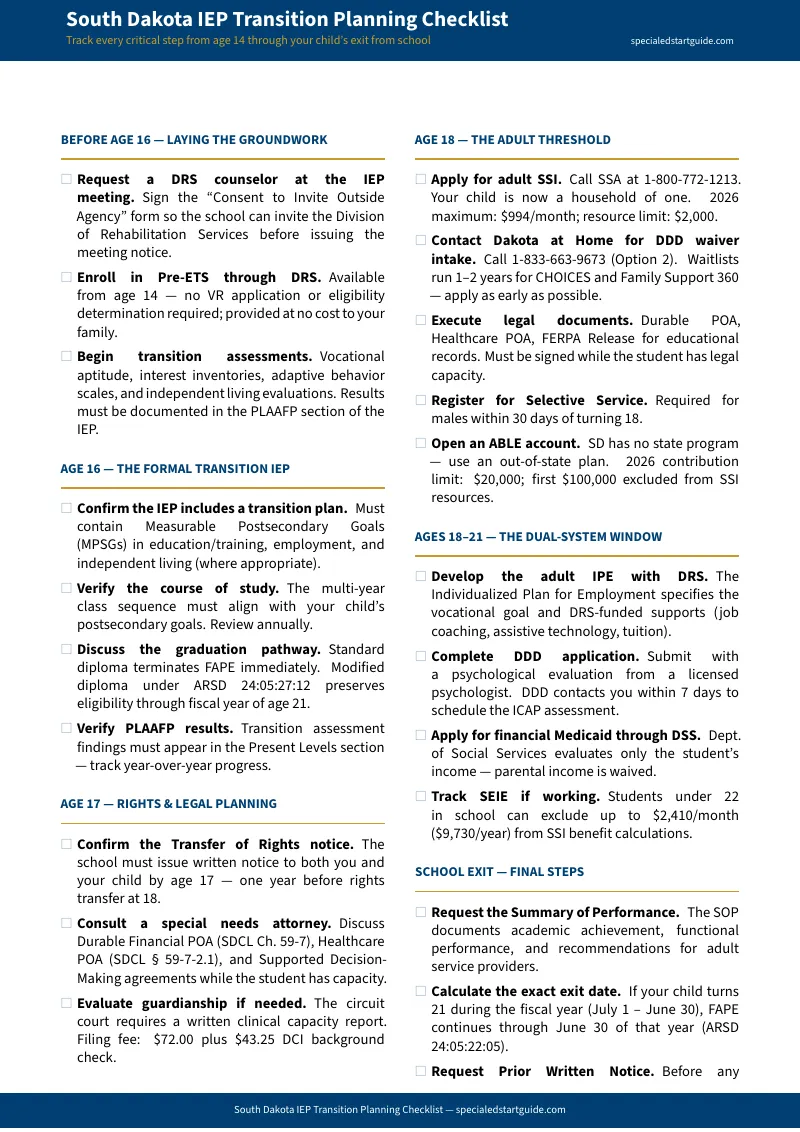
- Transition Planning Checklist (2 pages) — the printable milestone tracker with every South Dakota-specific deadline, referral, and application in chronological order
- Transition Milestone Tracker (1 page) — every deadline from age 14 through school exit with target dates, completion dates, and the responsible agency for each step
- Agency Communication Log (1 page) — a structured record of every call, email, and meeting across the school, DRS, DDD, DSS, and SSA — your evidence trail if a promise isn't kept
- IEP Meeting Preparation Worksheet (2 pages) — the transition components to verify, documents to bring, and space for the team's answers and commitments
- Decision-Making Capacity Evaluation Checklist (2 pages) — map which decisions your child handles alone, with support, or not yet, and see which legal tool matches the pattern
- Adult Services Application Tracker (2 pages) — run the SSA, DDD, DRS, and DSS applications in parallel with documents, dates, and follow-ups for each
- Document Execution Tracker (1 page) — the signing, notarization, filing, and distribution record for every POA, release, and petition
- Diploma Pathway Decision Worksheet (2 pages) — compare standard, modified, and certificate pathways against FAPE, postsecondary, and military impact, then record your decision
- Waiver Comparison Worksheet (2 pages) — CHOICES vs. Family Support 360 side by side, with your intake status from the Dakota at Home call to the interest list
Instant PDF download. Print the checklist tonight. Start your planning calendar tomorrow.
Money-back guarantee, no time limit. If the guide doesn't change how you approach your child's transition from school to adult life, email us for a full refund. No questions asked.
Not ready for the full guide? Download the free South Dakota Transition Planning Checklist — the chronological milestone tracker with every key deadline from Pre-ETS at age 14 through the post-21 adult services handoff. It's enough to see what's coming, and it's free.
The school handles one piece of this. The state handles three others. You are the one connecting them. This guide makes that possible.
Frequently Asked Questions
What if the rules change after I buy?
We update the guide when the rules change. Email us any time, even years later, and we'll send you the current edition free.