
Your child qualifies for coverage you were told didn't exist
A therapist mentioned TEFRA. A hospital social worker said "Katie Beckett." Another parent in an online group told you the wait is years long. And somewhere in the middle of all that, you landed on a state website full of form numbers and eligibility tables that assume you already know what you're looking for.
Here's what nobody explains clearly: TEFRA is not a waiver with a waiting list. It's a Medicaid State Plan entitlement. Every child who meets the requirements must be enrolled. South Carolina cannot cap slots or maintain a queue. If your application is taking months, that's a processing backlog — not a line you're waiting in.
The problem isn't eligibility. It's the evidence. SCDHHS evaluates your child's daily functional needs against an institutional Level of Care. Form 3291ME asks the physician to certify that home care is appropriate even when the child's condition may warrant acute or institutional care; it doesn't collect the detailed evidence SCDHHS uses for the Level-of-Care review. Parents submit the paperwork, wait months, and get denied because the medical records didn't translate daily functional care into the clinical language the state assessment requires.
The SC TEFRA Application System
This guide replaces the scattered state forms, contradictory forum advice, and phone calls that go nowhere with a single organised process. It's built around the actual SCDHHS application packet — Form 3290, Form 3291ME, Form 3218D-ME, Form 921, the FM 923 checklist, and the BHDD/OIDD Permission to Evaluate TEFRA Applicant Form — and walks through every section with the context the state leaves out.
The guide is structured so you work through it once, in order, and come out the other side with a complete application and the evidence framework to support it.
What's inside
- The parental income disregard, explained — how TEFRA calculates eligibility using only the child's own income (below $2,982/month for 2026) and resources (at or below $2,000), with worked examples showing why a family earning well above standard Medicaid thresholds still qualifies
- Level-of-Care evidence worksheets — a framework for documenting your child's daily functional care needs in clear terms that support the ICF/IID, Nursing Facility, or Hospital Level-of-Care review, with notes for the physician completing the In-Home Care Certification (Form 3291ME)
- The 15-month medical record organiser — which recent records to gather from within the past 15 months (SCDHHS says these are optional but may help speed processing) and how to present diagnostic evaluations, therapy summaries, and IEP documentation so the reviewer can find relevant information
- TEFRA vs. HCBS waiver comparison — a clear breakdown of TEFRA (uncapped State Plan entitlement) versus the capped ID/RD, Community Supports, and HASCI waivers, so you know exactly which programme you're on and what each one provides
- Renewal and deadline tracker — the annual review process (Form WKR009), Fair Hearing filing windows, and the 10-day window for requesting continued benefits while an appeal is pending, with a tracking worksheet so no deadline slips
- Coverage breakdown with EPSDT — what TEFRA Medicaid actually pays for, how it works alongside private insurance as secondary coverage, and what Early and Periodic Screening, Diagnostic, and Treatment (EPSDT) services add beyond the state benefit schedule
- Denial and Fair Hearing walkthrough — what a denial notice means, how to identify whether the issue was medical evidence or procedural, and how to request a Fair Hearing with the right documentation to support your case
- Age-18 transition map — the step-by-step hand-off from pediatric TEFRA to adult SSI and adult Medicaid categories, when parental income deeming stops, what the young person needs to do before their 19th birthday, and how supported decision-making fits in
Who this guide is for
- Parents or guardians of a child under 19 with a significant disability or complex medical needs who have been told to "look into TEFRA" and don't know where to start
- Families who earn too much for standard Medicaid and have been denied SSI based on parental income — and don't realise their child may still qualify for coverage
- Parents whose private insurance caps are running out on speech, occupational, or ABA therapy and need secondary coverage that picks up where the commercial plan stops
- Families who have already been denied TEFRA and need to understand why the Level of Care assessment came back negative and what to do about it
- Parents approaching their child's annual TEFRA review who want to make sure the renewal goes through without interruption
Why not just use the free state resources?
The state forms are free, and so is Family Connection of South Carolina's helpline. Both are valuable — the guide tells you exactly when and how to use them. But SCDHHS provides blank forms without explaining how to structure the medical evidence narrative that makes or breaks the Level of Care determination. Family Connection's staff handle calls across every pediatric special needs programme in the state, and their availability is limited to business hours.
The guide organises your child's records, worksheets, and timelines before you call the helpline or submit the application, so every interaction with the state is more productive and every form is backed by the evidence it needs.
What you get
Your download includes 9 PDFs:
- guide.pdf — the complete South Carolina TEFRA guide (52 pages), from eligibility rules through the age-18 transition
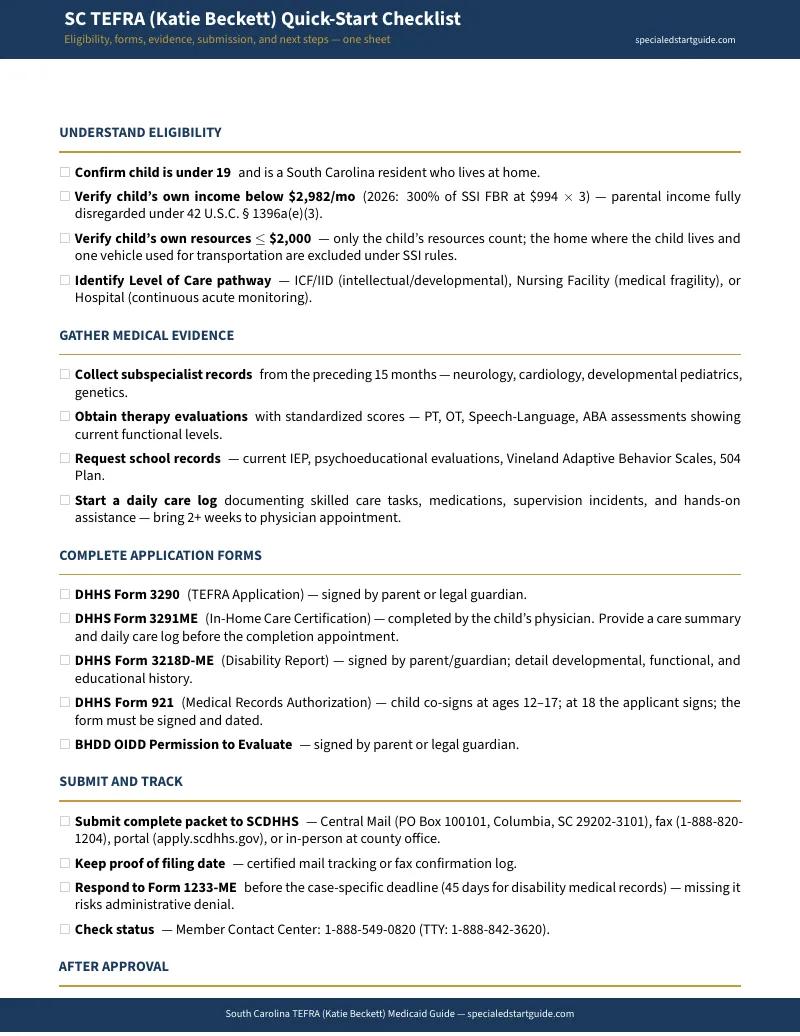
- checklist.pdf — a standalone application checklist with every form, deadline, and supporting document itemised
- daily-care-log.pdf — a dated log for recording daily care events to build Level-of-Care evidence
- application-timeline-tracker.pdf — tracks every document submitted, every SCDHHS deadline, and every response
- medical-records-checklist.pdf — an itemised 15-month record organiser for subspecialist, therapy, and school records
- renewal-deadline-tracker.pdf — tracks annual renewals, reminders, and Fair Hearing filing windows
- appeal-preparation-worksheet.pdf — organises your response to an adverse notice with evidence and deadline tracking
- transition-planning-worksheet.pdf — a milestone tracker from age 13 through 19 for the hand-off to adult services
- agency-communication-log.pdf — records every call, email, and visit with SCDHHS, BHDD, SSA, and advocacy organisations
Full refund, no time limit. If the guide doesn't help, email [email protected] and we'll refund you — no questions, no deadline.
Frequently Asked Questions
Does my family's income disqualify my child from TEFRA?
No. TEFRA disregards parental income and assets entirely. Eligibility is based only on income and resources held in the child's own name. For 2026, that means gross monthly income below $2,982 and countable resources at or below $2,000.
Is there a waiting list for TEFRA in South Carolina?
TEFRA is an uncapped Medicaid State Plan entitlement. South Carolina cannot maintain a waiting list or enrollment ceiling. Processing delays are administrative backlogs, not a programme queue.
Can my child have TEFRA and private insurance at the same time?
Yes. TEFRA Medicaid works as secondary coverage alongside private insurance. Parents are not required to drop their existing commercial plan.
What if my child was already denied?
The guide walks through the Fair Hearing process, the documentation that strengthens an appeal, and the deadlines you need to meet. It also explains how to identify whether the denial was based on the Level of Care assessment, missing medical evidence, or a procedural issue.
How is this different from the free checklist?
The free checklist lists the forms and basic eligibility rules. The full guide provides the evidence worksheets, Level of Care documentation framework, renewal tracker, denial and appeal walkthrough, and the age-18 transition map that the checklist doesn't cover.
What happens when my child turns 18?
The guide covers the full transition — from pediatric TEFRA ending at age 19, to adult SSI eligibility (where parental income deeming stops the month after the child turns 18), adult Medicaid categories, EPSDT continuation through age 20, and supported decision-making alternatives to guardianship.
Frequently Asked Questions
What if the rules change after I buy?
We update the guide when the rules change. Email us any time, even years later, and we'll send you the current edition free.