Your child's eighteenth birthday is a legal cliff — and North Carolina just changed the rules at the edge
One day, you're the person who signs the consent forms, talks to the doctors, and manages the bank account. The next day — the exact day your child turns eighteen — every one of those doors locks. HIPAA shuts you out of medical records. The school's IEP team stops returning your calls. The bank won't acknowledge your name on the account.
If you've been told that full guardianship is the automatic fix, you're working from an outdated playbook. Since January 2024, North Carolina's Chapter 35A requires the Clerk of Superior Court to prioritize less restrictive alternatives before granting any guardianship petition. If you can't prove you evaluated supported decision-making, powers of attorney, and limited guardianship first — and explain why they're insufficient — the court can dismiss your filing.
The problem isn't that the information doesn't exist. It's that it's scattered across six state agencies, three court forms portals, a dozen advocacy sites, and a handful of attorney blogs that don't explain the process beyond "call us for a consultation." You're left piecing together a legal strategy from fragments — and you have roughly eight months to get it right.
The Transition Authority Blueprint
This guide gives you one structured system for the entire turning-eighteen process in North Carolina. Instead of navigating between ECAC transition toolkits, DRNC self-advocacy packets, court forms portals, and LME/MCO intake lines — trying to figure out what applies to your child and what doesn't — you work through a single eight-month timeline that covers every legal pathway, every deadline, and every form.
It's built for the specific legal environment your family operates in: Chapter 35A guardianship proceedings before the Clerk of Superior Court, Chapter 32C durable powers of attorney, Chapter 32A healthcare proxies, and the 2024 statutory revision that made supported decision-making a formally recognized less restrictive alternative.
What's inside
- Diagnostic capacity worksheets — structured assessments across healthcare, financial, educational, and daily-living domains that help you and your clinical team determine which decision-making tools fit your child's actual needs, not a one-size-fits-all assumption
- Supported Decision-Making Agreement framework — guidance for building an SDM agreement under North Carolina's non-statutory model, with strategies for presenting it to hospitals, schools, and financial institutions so they actually accept it
- Court petition walkthrough — step-by-step instructions for completing AOC-SP-200 (Petition for Adjudication of Incompetence) and AOC-E-200 (Application for Appointment of Guardian), including how to document less restrictive alternatives in Section 5 so the Clerk doesn't send you back
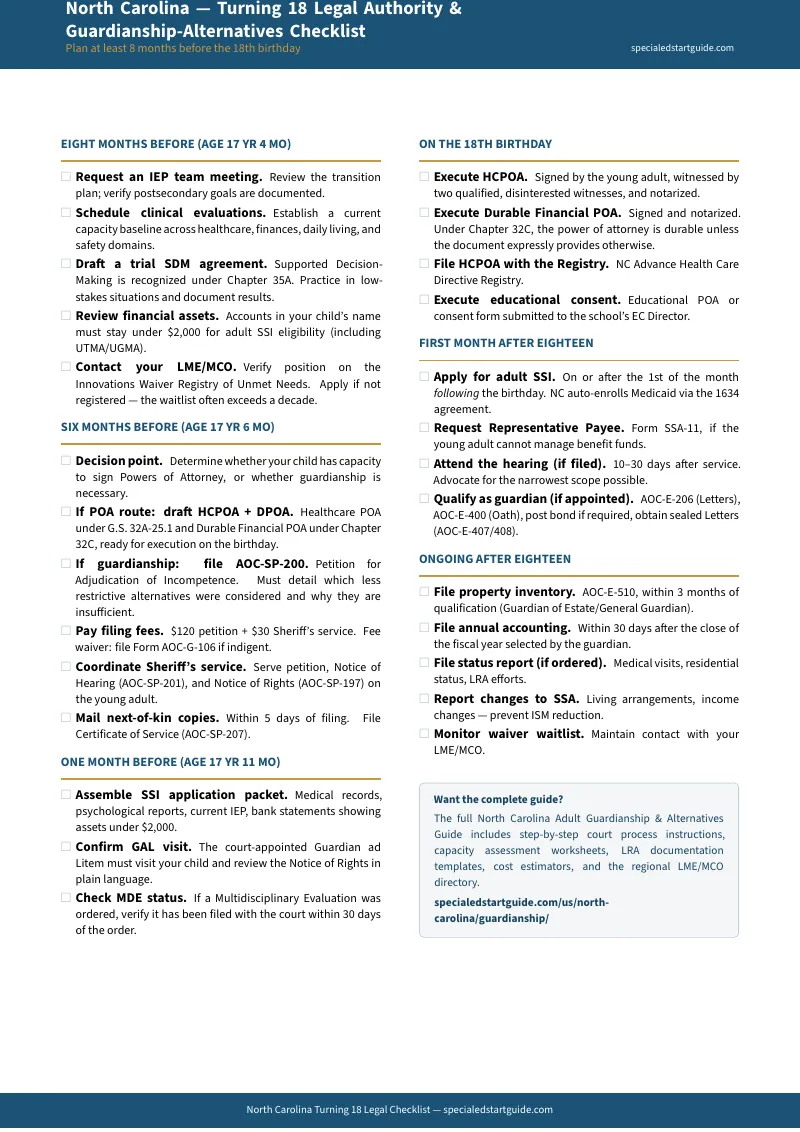
- Eight-month countdown timeline — every milestone mapped to your child's birthday: when to schedule clinical evaluations, when the court filing window opens (six months before turning eighteen), when to execute powers of attorney, and when to apply for adult SSI
- GAL interview preparation guide — what the Guardian ad Litem will ask, what they're looking for, and how to present your child's capacity evidence clearly
- Benefits coordination chapter — SSI adult eligibility timing, the Innovations Waiver Registry of Unmet Needs, Representative Payee designation, ABLE account rules (including the 2026 age-of-onset expansion to under 46), and how each tool interacts with the $2,000 resource limit
- Ongoing compliance checklists — annual status report requirements, property inventory filing deadlines, record-keeping protocols, and the process for modifying or terminating a guardianship order when circumstances change
- Referral directory — ECAC, Disability Rights NC, First in Families NC, regional LME/MCO contacts, and clear guidance on when to stop using the guide and start working with a special needs attorney
Who this is for
This guide is designed for parents in North Carolina whose child with an intellectual or developmental disability is approaching their eighteenth birthday — typically about eight months out.
You might be an autonomy-first planner who wants to preserve your child's independence with supported decision-making and powers of attorney. You might be a parent facing the Innovations Waiver waitlist — roughly 21,000 people deep with a ten-to-twenty-year average wait — who needs decision-making authority while adult services are still years away. Or you might be navigating family disagreements about capacity, who should serve as guardian, or whether court involvement is even necessary.
Whatever your starting point, the guide helps you build a documented, evidence-based plan that any court, hospital, or agency will take seriously.
Why free online resources leave you exposed
The free resources available in North Carolina are individually useful but structurally incomplete:
- ECAC transition toolkits focus on IEP goals and vocational planning — they don't cover Chapter 35A court procedures, powers of attorney execution requirements, or SSI timing
- Rethinking Guardianship NC booklets are excellent on supported decision-making philosophy — but they're scattered across multiple PDFs and don't provide a chronological filing sequence
- NC Courts (AOC) forms portal gives you blank forms with no guidance on how to complete the sections that determine whether your petition gets accepted or dismissed
- Attorney blogs explain concepts at a high level, then end with "schedule a consultation" — useful for establishing that you need help, but not for the forty hours of preparation that determines how many billable hours that help actually costs
This guide bridges the gap between "free but fragmented" and "professional but expensive." Families who arrive at an attorney's office with organized evidence, completed worksheets, and a clear understanding of their options spend a fraction of what unprepared families pay in billable hours.
Satisfaction guarantee
If the guide doesn't deliver on its promise — if it doesn't give you a clear, actionable path for your family's specific situation — email us and we'll refund your purchase. No conditions, no time limit.
The free checklist gives you the timeline. The full guide gives you the system — the worksheets, templates, court preparation steps, and benefits coordination that turn a checklist into an executed legal strategy.