Your Child Has a Diagnosis. OPWDD Wants Specific Evidence.
You were told to "apply for OPWDD" before school ends. So you called the Front Door number. You were given a list of documents to gather. And then you discovered that the clinical evaluation your child already has — the one you paid thousands for — might not be what OPWDD actually accepts.
The eligibility rules under New York's Mental Hygiene Law § 1.03(22) are precise. The wrong type of IQ test, an adaptive behaviour score that is documented the wrong way, or missing proof that the condition started before age 22 — any one of these can stall an application for months or trigger a denial. And the official guidance is scattered across administrative memos, regulation PDFs, and agency web pages written in language that assumes you already understand the system.
The OPWDD Eligibility Navigation System
This guide brings the entire process into one place — from gathering evidence to appealing a denial — in plain language written for families and young adults, not agency insiders.
Instead of reading a stack of government PDFs and hoping you haven't missed something, you work through a structured sequence that mirrors the actual steps OPWDD reviewers follow. The Clinical Evidence Inventory worksheet lets you check your existing records against the ADM 2023-02 standards before you submit anything, so an avoidable documentation gap doesn't become a months-long delay.
What's Inside the Guide
- The statutory definition in plain English — what MHL § 1.03(22) actually requires, the four concurrent criteria, and why a diagnosis alone is not enough
- Clinical Evidence Inventory — a self-audit worksheet where you log your testing dates, practitioner credentials, Full-Scale IQ scores and Vineland-3/ABAS-3 domain scores, with flags for common red flags like abbreviated IQ tests or missing adaptive sub-scores
- Front Door and application walkthrough — Form ELI, the five DDRO regions, what goes in the evidence packet, and how to track its progress through the CHOICES portal
- The 3-step DDRO review process — 1st Step intake check, 2nd Step clinical committee, 3rd Step independent review committee — with what each level looks for and what your options are at every stage
- Fair Hearing preparation — when you have the right to request a hearing at OTDA, the 60-day deadline, what evidence to bring, and what to expect on the day
- Post-eligibility roadmap — how to choose a CCO, enrol in Medicaid, access HCBS Waiver services, understand Self-Direction, and navigate the residential and service waiting lists
- Age 18 and transition planning — legal consent at adulthood, Supported Decision-Making under MHL Article 82, and the records to secure before school services end
- Key contacts and handoffs — Parent to Parent of NYS, INCLUDEnyc, Advocates for Children of NY, ACCES-VR, and when to consider a special needs attorney
- 5 standalone printable worksheets — Clinical Evidence Inventory, DDRO Document Checklist, Agency Communication Log, Appeal Timeline Tracker, and Post-Eligibility Service Planning Sheet — all designed to print and bring to meetings
Who This Guide Is For
- Parents and carers in New York of a teenager or young adult with an intellectual or developmental disability who need to apply for OPWDD eligibility
- Families preparing for the high school transition cliff — when school-based services end and adult services have to be in place
- Anyone who has received a denial or an incomplete-application notice from their DDRO and wants to understand the review steps and appeal options
- Young adults navigating the system themselves, with or without family support
Why Not Just Read the OPWDD Website?
The statutory rules, ADM 2023-02 guidance and advocacy organisations are all freely available, and the guide links to every one of them. What they do not provide is a structured, step-by-step workflow that ties those scattered sources together into the order you actually need them — with tracking worksheets that let you verify your evidence against OPWDD's specific standards before your application reaches a reviewer.
Free state helplines and CCO intake coordinators provide verbal advice in the moment. The guide gives you a permanent reference you can read at your own pace, mark up, and bring to every meeting — so the advice you receive lands on organised ground rather than a jumble of notes.
What This Guide Does Not Do
This is an independent educational tool. It does not promise eligibility, priority placement, or queue shortcuts. It does not provide legal, medical or financial advice. It is not published, endorsed or affiliated with OPWDD, any DDRO, any CCO, or any other New York State agency. If your family needs legal representation at a Fair Hearing or court proceeding, the guide includes directions to free legal advocacy organisations and explains when professional help is the right next step.
Satisfaction Guarantee
Full refund, no time limit. If the guide does not help, email [email protected] and you'll get your money back.
Get Started
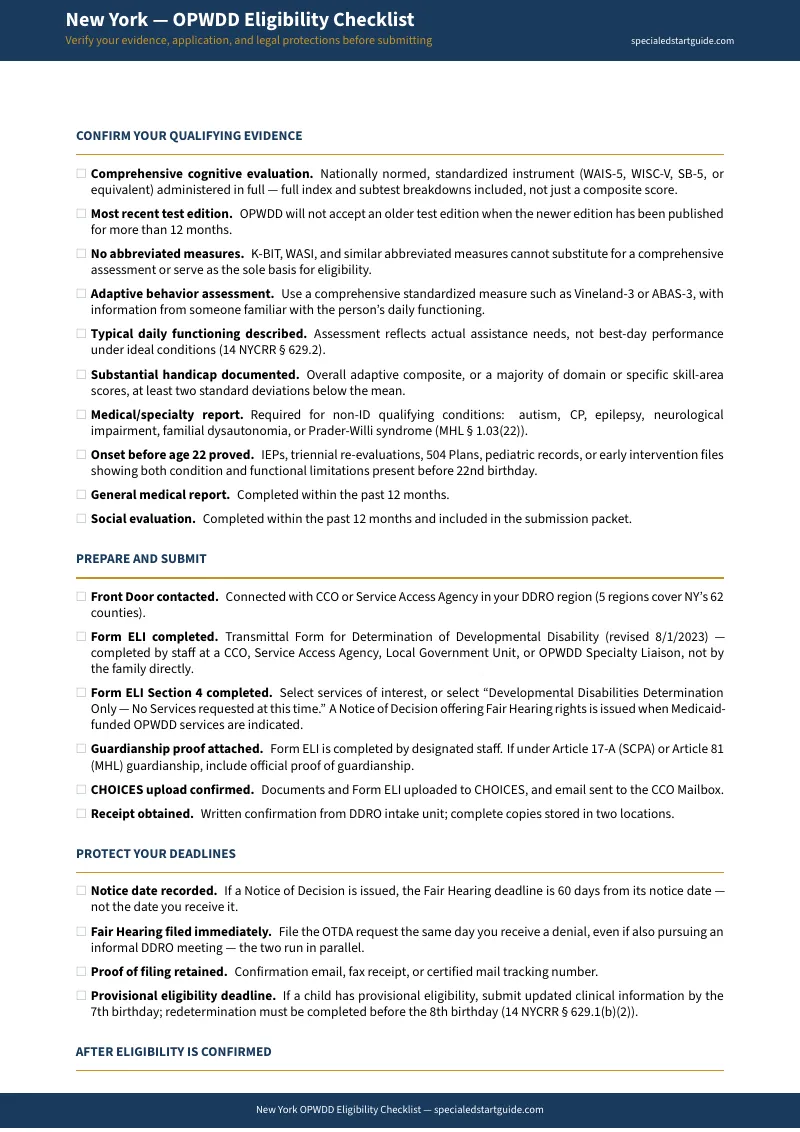
Download the free OPWDD Eligibility Checklist to see whether the guide is right for your situation. If you're ready for the full walkthrough — the evidence inventory, the DDRO review process, the Fair Hearing preparation, the post-eligibility roadmap, and all five standalone worksheets — the complete guide is available for .
Frequently Asked Questions
What if the rules change after I buy?
We update the guide when the rules change. Email us any time, even years later, and we'll send you the current edition free.