School services end. The agencies don't coordinate. This guide does.
Your child's IEP team introduced the word "transition" — and suddenly the plan includes terms like "measurable postsecondary goals," "courses of study," and "pre-employment transition services" that nobody defined. The school's transition coordinator documented the minimum required boxes. The Division of Vocational Rehabilitation told you to call back later. The DD Waiver intake process exists somewhere on the Health Care Authority website, buried under acronyms you've never seen. And everyone assumes someone else already explained their piece.
Meanwhile, there's a diploma pathway decision that could end your child's right to school services permanently. There's a transfer of rights at age 18 that happens automatically unless you act first. There's a Medicaid waiver system that eliminated its waitlist — but the intake process has asset limits, eligibility reviews, and regional intake specialists that nobody mentioned at the IEP meeting.
Free state handbooks cover each agency in isolation. This guide is a Transition Coordination System — it maps every agency, every deadline, and every decision point into a single sequential workflow so you can see the full picture and act on it before a gap opens.
What's Inside
- The age-14-to-22 planning timeline — New Mexico mandates transition planning two years before the federal requirement, and the guide maps every milestone across that entire span so you know what needs to happen this semester, not just "before graduation"
- Graduation Pathway Decision Worksheet — Standard, Modified, and Ability programs of study broken down by course requirements, assessment rules under HB 171 (2024), and FAPE implications, so the IEP team's recommendation doesn't blindside you with consequences nobody explained
- Transfer of rights and SDM planning tools — the 2025 Supported Decision-Making Act gives your child a legally recognized alternative to guardianship starting July 1, 2025, and the guide walks you through the Supreme Court form requirements, notary and witness rules, and a comparison of every option from powers of attorney to limited guardianship
- DVR and Pre-ETS enrollment sequence — five required Pre-Employment Transition Services available at no cost to students with IEPs or 504 plans aged 14–22, with email templates that request specific services and get DVR at the IEP table
- DD Waiver intake roadmap — the no-waitlist reality still requires a two-step eligibility review through DDSD and the Health Care Authority's Income Support Division, and the guide details every form, threshold, and regional specialist contact so you start the process before school services end
- SSI, DAC benefits, and ABLE account protections — how to apply for Supplemental Security Income at 18, claim Disabled Adult Child benefits on a parent's record (WEP/GPO repealed under the Social Security Fairness Act), and shelter up to $100,000 through NM STABLE without jeopardizing benefits
- Agency request templates — customizable letters requesting DVR attendance at IEP meetings, vocational assessment requests, eligibility appeal language, and Prior Written Notice demands when the district refuses transition services
- Tribal and rural resource directory — EPICS, the Ability Center, Centers for Independent Living by region, UNM CDD programs, and strategies for accessing services when the nearest field office is hours away
Who This Is For
This guide is for New Mexico parents whose teenager or young adult has an IEP and is moving toward adulthood — whether they're 14 and the transition page just appeared in the IEP, or 20 and about to age out with no adult services lined up.
You need this if:
- The IEP team drafted postsecondary goals you don't understand and can't evaluate
- Nobody explained which diploma pathway preserves the right to continued services and which one ends it
- You've been told guardianship is the only way to stay involved after your child turns 18
- DVR and DDSD feel like separate planets that don't communicate with the school or each other
- You're in a rural or tribal community where agencies are hours away and in-person services are scarce
- You want to apply for SSI and set up benefit protections but the rules feel designed to be confusing
Why Free Resources Aren't Enough
Parents Reaching Out publishes transition handbooks. The NMPED Parent Portal hosts procedural safeguards. DVR has a Pre-ETS page. The Health Care Authority documents the waiver intake process. Every one of these resources is genuinely useful — and every one exists in its own silo with its own terminology, its own timelines, and zero cross-references to the others.
The problem isn't missing information. It's coordination. The school's transition timeline overlaps with DVR's referral window. The waiver intake process has financial thresholds that interact with SSI rules. The transfer of rights at 18 affects who can sign forms for every other agency. No single free resource maps these interactions — because no single agency is responsible for the full picture. That's the gap this guide fills.
What You're Getting
Eleven downloadable PDFs, yours to keep — print them, annotate them, bring them to every IEP meeting and agency appointment:
- The full guide (52 pages) — every stage of the transition from age 14 through adult services: the planning timeline, diploma pathways, transfer of rights, DVR enrollment, DD Waiver intake, SSI and ABLE protections, dispute resolution, and tribal and rural resources
- Transition Timeline Planner — every milestone from age 14 to 22 on one map, with write-in rows for your own target dates
- Graduation Pathway Decision Worksheet — the three programs of study side by side, with family decision factors and a rationale record
- SDM Preparation Checklist — step-by-step execution of a Supported Decision-Making agreement under the 2025 Act
- Transition Assessment Tracker — record and compare assessment results across annual reviews
- Waiver Application Document Tracker — every medical and financial eligibility document, intake milestone, and the 90-day appeal clock in one place
- Benefits and Financial Planning Worksheet — SSI at 18, SSI vs. DAC comparison, and STABLE account contribution planning
- Agency Communication Log — a landscape log for every call, email, and meeting across DVR, DDSD, HCA, SSA, and the district
- IEP Meeting Preparation Sheet — a pre-meeting organizer covering the transition components to verify, documents to bring, and your questions
- Agency Request Templates — four copy-and-customize letters: DVR attendance at IEP meetings, transition assessment requests, Prior Written Notice demands, and waiver eligibility appeals
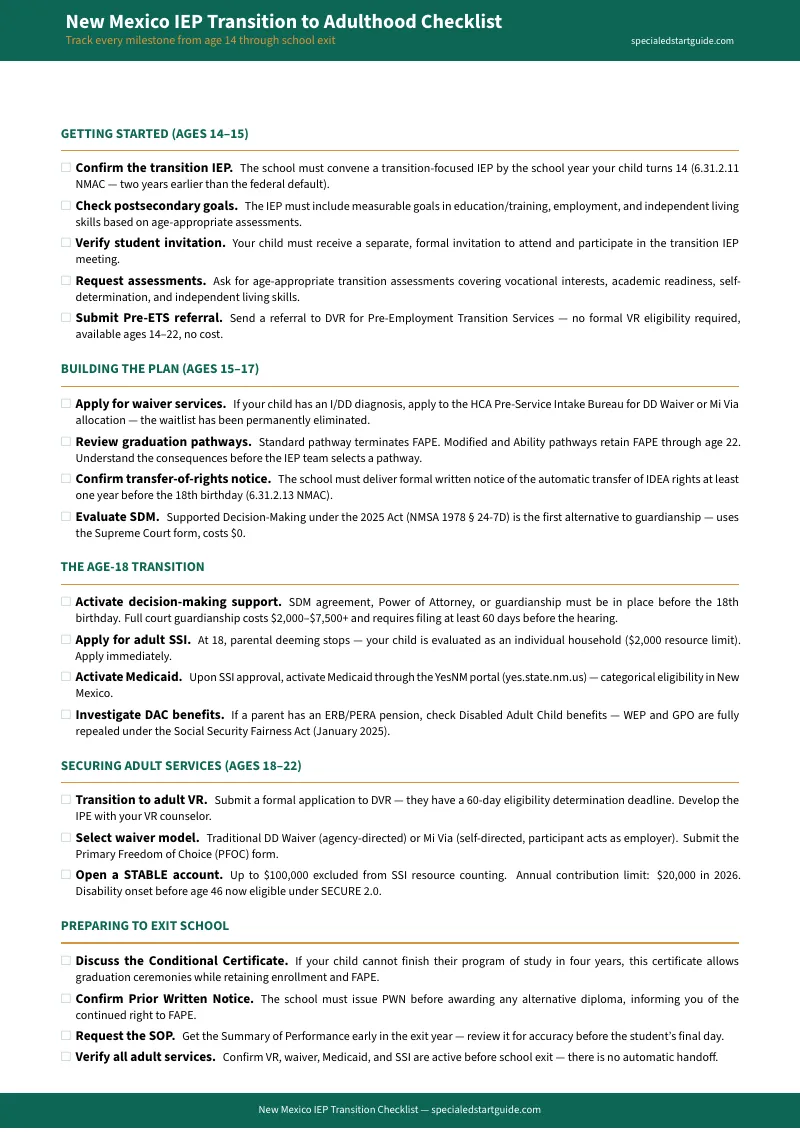
- Transition Planning Checklist — a two-page chronological reference covering the major milestones, organized by planning stage
The checklist is also available as a free download if you want to start there.
Every purchase is backed by a satisfaction guarantee, no time limit. If the guide doesn't help you navigate the transition process more confidently, email us for a full refund — no questions, no justification required.
The transition from school services to adult life is the single highest-stakes handoff in your child's education. It doesn't have to be one you figure out alone, one agency at a time. Get the Transition Guide and walk into every meeting knowing exactly what to ask for, who to contact next, and what deadline is coming.