The school says "transition." You hear "figure it out yourself."
Your child's IEP team just introduced a word that changes everything — and handed you a stack of forms that explain nothing. Missouri requires a transition plan by age 16, but the plan the school drafts is often boilerplate: vague postsecondary goals, no agency referrals, no timeline for the decisions that actually matter.
Meanwhile, the clock is running on three fronts at once. Decision-making rights transfer to your child at 18 — whether or not they're ready. DD waiver waitlists stretch for years, and you can't get on one until you know which waiver fits. And the moment your child graduates with a regular diploma, every school-based support disappears.
Free resources from DESE and MPACT tell you that these things exist. They don't tell you how to sequence them so nothing falls through the cracks.
The Transition Sequencing System
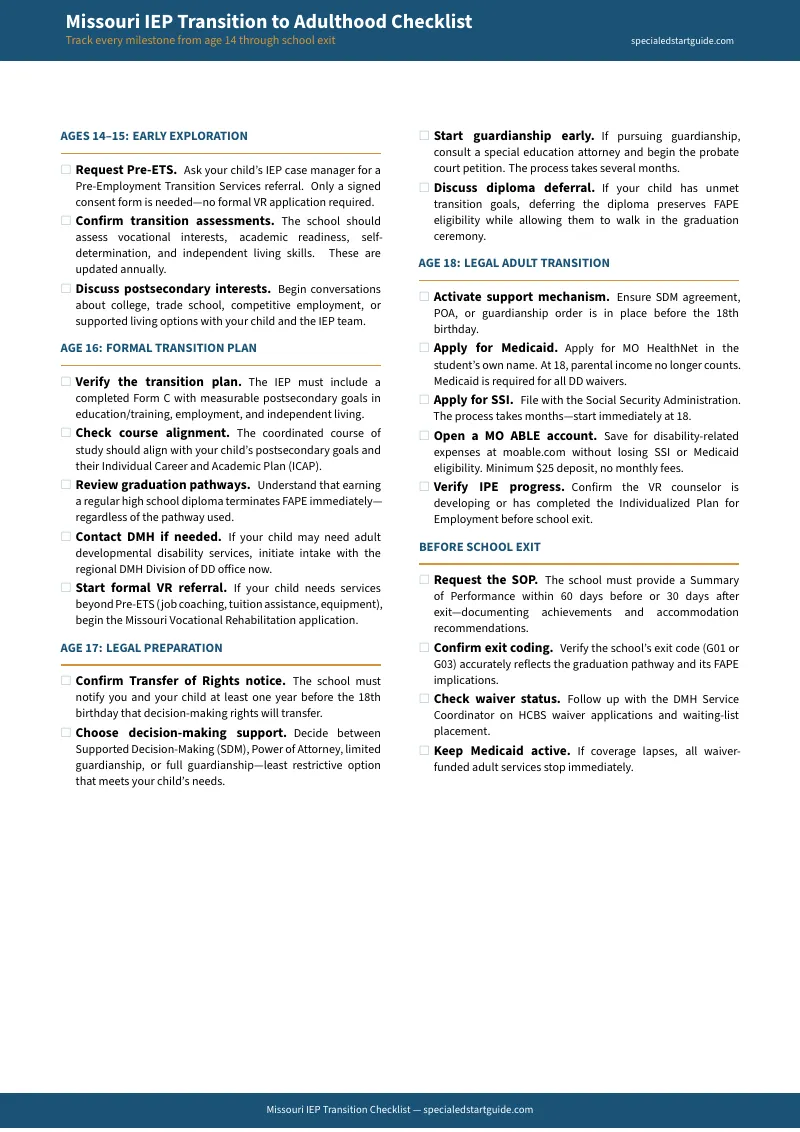
The Missouri IEP Transition to Adulthood Guide maps every required action to the age it's due — and connects each milestone to the specific Missouri agency, form, or decision point that follows it. Instead of juggling disconnected checklists from DESE, MVR, and the Division of DD, you get one sequenced timeline that shows exactly what to do at 15, 16, 17, 18, and 21.
This isn't a summary of federal law with "Missouri" in the title. It's built around how Missouri actually runs transition — the DESE state plan, the MVR Pre-ETS consent process, the Division of DD waiver tiers, and the G01/G03 diploma codes that determine whether your child can stay in school until 21.
What's Inside
- Age-by-age transition timeline — every Missouri-specific deadline and action step mapped chronologically, from early transition assessments through the Summary of Performance at exit
- IEP goal audit framework — side-by-side comparison of boilerplate goals vs. measurable postsecondary objectives, so you can push back on vague language at the IEP table with specific alternatives
- VR and Pre-ETS referral walkthrough — the exact consent forms, the "potentially eligible" pathway that doesn't require a full MVR case, and how to time the referral so your child gets services before graduation
- Division of DD waiver comparison — the four Medicaid waivers (Comprehensive, Community Support, Partnership for Hope, MOCDD) explained in plain language, with MAAS/PON scoring guidance so you understand where your child lands on the waitlist
- Transfer of rights decision worksheet — guardianship, partial guardianship, and supported decision-making compared on the dimensions that actually matter, with action steps to complete before your child turns 18
- Diploma pathway decision tree — how G01 vs. G03 graduation codes affect FAPE eligibility, when a certificate of attendance makes sense, and the DESE rules on staying in school through age 21
- Postsecondary education bridge — what changes when your child moves from IDEA entitlements to ADA/Section 504 accommodations, and what documentation Missouri colleges actually require
- Dispute resolution roadmap — IEP facilitation, mediation, state complaints, and due process hearings explained with practical strategies for documenting disagreements and using Prior Written Notice
- Regional resource directory — MVR offices, Division of DD regional contacts, county SB40 boards, and Centers for Independent Living organized by area
Who It's For
Parents of Missouri students with IEPs who are approaching — or already in — the transition years. Whether your child is headed toward competitive employment, college, or long-term community-based support, the guide covers the Missouri-specific steps for each pathway.
It's especially useful if you're in a district where the transition specialist is also the general special education teacher, and nobody's walking you through the agency referral sequence because nobody has time.
Why Free Resources Aren't Enough
DESE publishes model forms and compliance checklists. MPACT offers workshops and webinars. MVR has a services guide. The Division of DD has waiver manuals. Each agency covers its own piece — none of them shows you how those pieces connect.
The result: families spend weeks jumping between websites, discovering deadlines after they've passed, and showing up to IEP meetings with the wrong questions because no single source explains how Missouri's transition system works as a whole.
The guide doesn't replace those agencies. It sequences their work into one timeline, translates their clinical language into plain English, and gives you the specific questions and action steps for each phase — so you stop being the person who finds out about the VR referral two years too late.
Satisfaction Guarantee
If the guide doesn't help you navigate your child's transition planning, email us and we'll refund you — no questions, no hassle.
Start With the Free Checklist — or Get the Full Guide
Download the free Transition Planning Checklist for a quick-reference timeline of Missouri's key milestones. When you're ready for the complete system — the full guide plus 6 printable standalone worksheets including the master timeline, IEP goal audit worksheet, transfer of rights worksheet, DD waiver comparison, diploma pathway comparison, and regional resource directory — the paid kit picks up exactly where the checklist leaves off.