Navigate Maryland DDA Eligibility, Priority Categories, and Appeals — Without Guessing What Reviewers Need
If your teenager or young adult is approaching age 18 or high school exit at 21 — or if a letter just arrived from the Maryland Developmental Disabilities Administration (DDA) saying "Supports Only" or "Not Eligible" — you already know how fast the paperwork turns overwhelming.
In Maryland, public school entitlement under IDEA ends at the end of the school year a student turns 21. Adult services through DDA are eligibility-based, governed by Maryland Health-General § 7-101(g) and COMAR 10.22.12. A diagnosis alone is not enough. Families regularly discover too late that a "Supports Only" determination excludes a young adult from the primary DD Medicaid waiver waiting list, that waiting on an informal reconsideration can quietly burn through a 45-day COMAR appeal window, or that online articles still describe the old Family Supports and Community Supports waivers that Maryland consolidated into the Community Pathways Waiver on October 6, 2025.
One Plain-Language Guide Built Around the Evidence-to-Determination System
The Maryland DDA Eligibility Guide: Applying, Priority Categories and Appeals brings every Maryland rule, statutory deadline, and record-organizing tool into one structured Evidence-to-Determination System. Instead of stitching together raw Maryland Code sections, COMAR regulations, and scattered PDFs, you get a step-by-step binder that maps your young person's clinical, adaptive, and school records directly to what DDA reviewers evaluate — while keeping the young adult's own voice and legal rights at the center of every meeting.
What's Inside Your Instant Download
- 47-Page Maryland DDA Eligibility Guide (12 Chapters) — Plain-language coverage of the five-part Health-General § 7-101(g) test, the difference between Developmentally Disabled (DD), Supports-Only (SO), and Not Eligible outcomes, all four DDA Regional Offices, the October 2025 Community Pathways Waiver (MD.0023) consolidation, Low Intensity Support Services (LISS), Self-Directed Services operational caps, Transitioning Youth (GTYI) coordination, and Office of Administrative Hearings (OAH) fair hearing procedures.
- Eligibility Evidence Index & Daily Functioning Log — Because handing DDA a stack of unindexed school and medical records leaves reviewers hunting for proof of onset before age 22 and continuing daily support needs, these worksheets map psychological evaluations, adaptive behavior scores (Vineland-3, ABAS-3), IEPs, and typical vs. high-stress daily routines straight to Maryland's statutory elements — accurately, without overstating or minimizing needs.
- DDA Application and Receipt Tracker + Worked 60-Day Timeline — Because your 7-calendar-day preliminary determination and 60-day final determination clocks start when DDA receives your application, you get a tracked-submission log and a full worked example from Day 0 through Day 60.
- Waiting List Priority Update Log (COMAR 10.22.12.07) — Because waiting list priority depends on documented circumstances (Category I Crisis Resolution, Category II Crisis Prevention including caregiver age 65+ with urgent need, or Category III Current Request), this tracker helps you log changes in caregiver health, housing stability, or safety and submit dated written updates to your CCS and Regional Office.
- Written Notice and Appeal Deadline Tracker — Because official Maryland instructions conflict on eligibility appeal windows (the DDA Guide to Services cites 90 days from receipt while COMAR 10.22.16.04–.05 sets 45 days from postmark, and cutting existing waiver services triggers a strict 10-calendar-day Aid Paid Pending rule), this tracker keeps every notice date, postmark, reconsideration request, and OAH filing deadline in one place.
- Transitioning Youth Milestone Planner & Self-Directed Services Worked Budget — Because aligning IEP transition planning, CCS selection, DORS vocational rehabilitation, and the Governor's Transitioning Youth Initiative (GTYI) before age 21 requires early sequencing — and Self-Directed Services carries strict operational caps ($5,000 goods and services cap per plan year, 40-hour/week paid family staff cap, 10-hour/month admin cap) — you get a chronological roadmap plus a complete worked staffing and budget example.
- Young Adult Voice and Goals Worksheet & Agency Communication Log — Because Maryland young adults reach legal majority at age 18 and sign their own applications unless a court-appointed guardian or legally valid representative has authority, these tools put the young person's own words, strengths, and community goals first while keeping a clean record of every agency call and email.
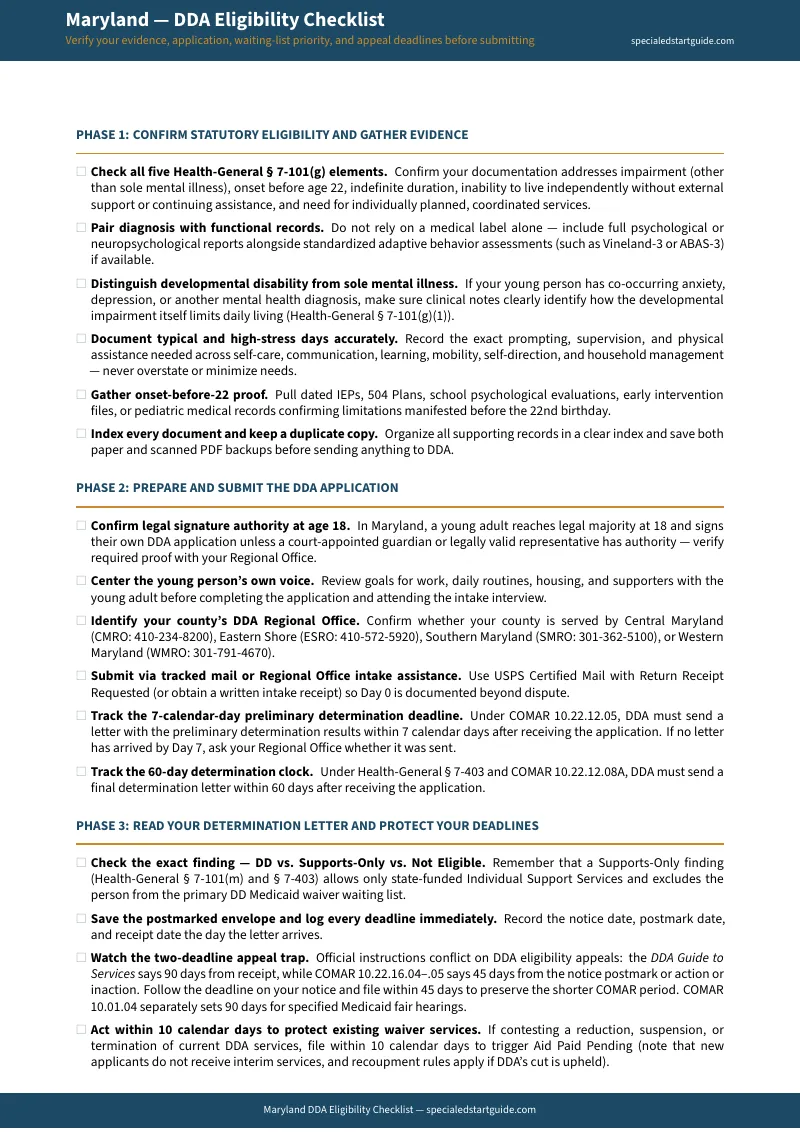
- 2-Page Maryland DDA Eligibility Checklist — A 20-item verification checklist covering all four phases so nothing slips through the cracks before you mail an application or respond to a determination letter.
Who This Guide Is For
- Parents and carers of a Maryland teenager or young adult (ages 16–22) preparing an initial DDA application before public school services end.
- Families who received a "Supports Only," "Current Request," or "Not Eligible" letter and want clear, organized steps for requesting reconsideration, updating priority documentation, or preparing for an OAH fair hearing.
- Young adults with intellectual or developmental disabilities directing their own DDA application and person-centered planning, independently or with supported decision-making.
Why Families Choose This Over Scattered Free Pages or Generic Binders
Maryland's statutes, COMAR regulations, DDA Regional Office intake desks, parent centers, and legal aid organizations are valuable public resources — and Chapter 12 gives you a full directory of official Maryland contacts so you can use them directly. What public agency pages and generic national disability binders do not give you is a Maryland-specific, pen-ready preparation system:
- Generic national binders treat eligibility as a single yes/no form and miss Maryland's DD vs. Supports-Only split, COMAR 10.22.12 priority rules, GTYI school-exit coordination, and the October 2025 Community Pathways Waiver consolidation.
- Raw statutory and regulatory pages publish legal definitions without showing how to organize clinical reports, document daily prompting accurately, or reconcile the 45-day vs. 90-day appeal deadline conflict.
- Outdated online articles still reference separate Family Supports and Community Supports waivers or old LISS caps, creating confusion right when families need current Maryland rules.
Independent, Plain-Language, and Transparent
Special Ed Start Guide is an independent publisher. This guide is plain-language process navigation — not legal, medical, financial, or benefits-planning advice — and is not affiliated with or endorsed by the Maryland Department of Health, DDA, or any government agency or court. No guide can guarantee DDA eligibility, alter a waiting list position, or secure waiver funding. If you are facing an immediate safety emergency, call 988 or 911; if you are heading to a contested OAH hearing or legal dispute, consider free legal advocacy through Disability Rights Maryland or a qualified Maryland attorney.
Full Refund, No Time Limit
Every purchase is backed by a full refund, no time limit. If this guide does not help your family prepare your Maryland DDA records and understand your next steps, email [email protected] and we will refund your purchase in full.
Ready to Get Organized?
Get the complete Maryland DDA Eligibility Guide: Applying, Priority Categories and Appeals — instant PDF download with the 47-page guide, 2-page checklist, and eight printable worksheets. Not ready for the full guide yet? Download the free 2-page Maryland DDA Eligibility Checklist above to verify your core steps tonight.
Frequently Asked Questions
What if the rules change after I buy?
We update the guide when the rules change. Email us any time, even years later, and we'll send you the current edition free.