
You Were Told "Get on PUNS." Nobody Told You What Happens After That.
A therapist, a school social worker, or another parent said the words: get your child on the PUNS waiting list. So you called the number. Maybe you even had the intake meeting. And now you are waiting — with no clear picture of how the system actually works, what decisions are being made about your child, or what you should be doing while the years tick by.
The Illinois developmental disabilities system splits authority across two state departments, a network of regional gatekeepers called Independent Service Coordination agencies, and six separate administrative decisions. Each decision has its own paperwork, its own deciding body, and its own timeline. Confusing any two of them — believing that PUNS enrollment is a Medicaid application, or that a selection letter means services start automatically — is exactly how families lose months to procedural dead ends.
The Six-Decision Navigation System
The Illinois PUNS Waiting List and DD Waiver Selection Guide maps every step across all six decision tracks — from your first ISC meeting through waiver selection, service authorization, and the hand-off to adult services at 18. It is the independent organizational framework that the state's own fragmented web pages, raw PDF forms, and scattered fact sheets never provide in one place.
This is not a generic "special needs planner" with blank therapy logs. It is built specifically for the Illinois IDHS-DDD and HFS administrative system, with the category mechanics, eligibility dimensions, and appeal deadlines that apply in this state.
What's Inside
- The Six-Decision State File Ledger — one row per decision track (DD clinical eligibility, institutional level of care, Medicaid financial, PUNS slot status, service authorization, provider matching) so you always know exactly where things stand
- All three DD waivers explained side by side — Children's Support (IL.0464), Children's Residential (IL.0473), and Adult DD (IL.0350), with who each serves, what it covers, and when a DD waiver is the wrong route entirely
- Four-dimension eligibility framework — categorical DD criteria, institutional level of care (ICAP assessment), Medicaid financial rules, and non-financial requirements, with what documentation each demands
- Seeking Services vs. Planning for Services mechanics — how category placement affects your waiting time, why the distinction matters for adult waiver selection, and how to verify your ISC logged the right category
- The parental income question, answered — under the children's waivers, family income is waived for Medicaid eligibility but the child's resources are still considered. The guide walks through what that means in practice and how to file the separate ABE portal application
- Assessment preparation — how to document daily support realities accurately for the ICAP and clinical evaluations, without underreporting on good days or overstating on difficult ones
- Annual update maintenance — a tracking system for every ISC interaction and document submission so your active PUNS status is preserved year after year
- Post-selection protocol — what to do when the selection invitation letter arrives: completing pre-admission screening, establishing Medicaid eligibility, and securing qualified providers
- The Age-18 Reset Protocol — the step-by-step checklist to re-categorize from pre-18 PUNS to adult Seeking Services on or before the 18th birthday, because pre-18 time does not carry over to adult waiver selection
- Appeals and fair hearings — the timeframe to send written intent to appeal, what form to reference, and how to request legal help through Equip for Equality; its intake process determines what assistance is available
- School-to-adult transition bridge — coordinating IEP transition plans with ISC adult intake meetings, Supported Decision-Making under 755 ILCS 9, and connections to DRS vocational rehabilitation
- Eight standalone printable worksheets — the Six-Decision Ledger, Daily Support Needs Log, Agency Communication Log, Category Verification Worksheet, Age-18 Reset Checklist, Appeal Deadline Worksheet, Renewal Tracker, and Post-Selection Action Plan, all as separate PDFs you print and fill in at the moment you need them
Who This Is For
- Parents of a child recently diagnosed with autism, an intellectual disability, or another qualifying developmental disability who have been told to "get on PUNS" and need to understand what that actually involves
- Families already on the PUNS waiting list who want to verify their category placement, stay properly enrolled through annual updates, and prepare for the selection process
- Families of a teenager approaching 18 who need to navigate the transition from school-based special education to adult DD waiver services without losing their position
- Young adults with chosen support networks who want to understand their options without surrendering legal rights or accepting full guardianship
What This Is Not
This guide is an independently published educational reference. It is not affiliated with or endorsed by IDHS, DDD, HFS, or any state agency. It does not provide legal, medical, or financial advice. It does not guarantee eligibility, priority position, or expedited selection. No publication can move you up the waiting list.
If you are facing an active legal dispute, a contested fair hearing, or a guardianship proceeding, you should contact Equip for Equality (1-800-537-2632) or a special education attorney. This guide is for families handling the administrative process themselves.
Why Not Just Read the IDHS Website?
Every underlying statute and policy is public record — this guide does not sell access to state information. What it provides is organization. The IDHS website scatters rules across separate pages for separate divisions. The HFS financial eligibility process lives on a different portal entirely. Non-profit fact sheets explain the concepts but do not give you a framework to track your own file. Generic special needs planners from Etsy and similar marketplaces offer therapy logs and appointment trackers with zero Illinois-specific waiver mechanics.
This guide synthesizes the IDHS, HFS, and ISBE rules into a single system with checklists, tracking tools, and step-by-step protocols for every stage — from first ISC contact through post-selection service setup.
Free Checklist Included
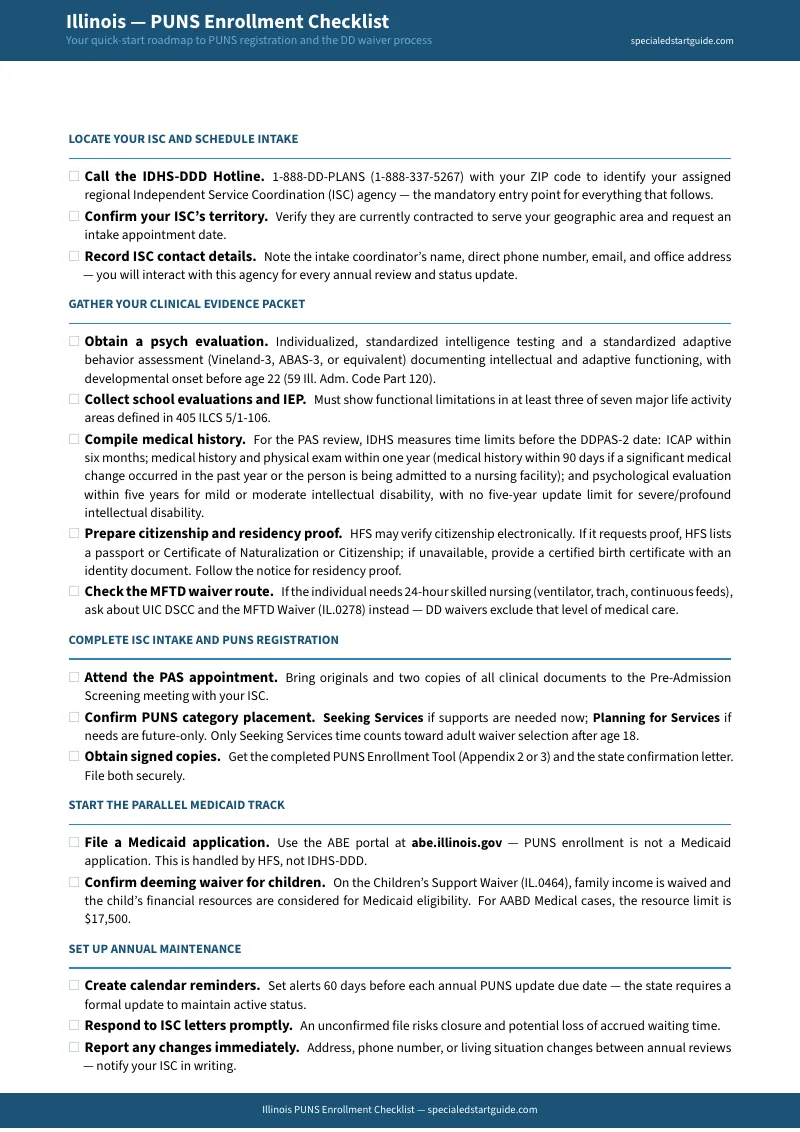
The Illinois PUNS Enrollment Checklist is free — no purchase required. It covers the basic intake steps, the documents to gather, and the key phone numbers including the IDHS-DDD Hotline (1-888-DD-PLANS). Download it and start there. If you decide you need the full system, the complete guide goes deeper on every dimension.
Satisfaction Guarantee
Full refund, no time limit. If the guide does not help, email [email protected] and we will process the refund. No questions, no deadline.
Frequently Asked Questions
What if the rules change after I buy?
We update the guide when the rules change. Email us any time, even years later, and we'll send you the current edition free.