Your child's IEP team just said "transition." Now what?
You walked out of that IEP meeting with a stack of new vocabulary — Pre-ETS pre-cases, transfer of rights notifications, UGCOPAA, Liberty Healthcare assessments — and a sinking feeling that nobody in that room has a plan for what happens after high school ends.
They're right about one thing: Idaho special education services stop the semester your child turns 21. That's a hard deadline, not a guideline. And between now and then, your family has to coordinate with three separate state agencies, each with its own applications, its own eligibility rules, and its own timeline that doesn't wait for the others.
The school handles the IEP. But nobody at the school can apply for your child's adult Medicaid, manage SSI redeterminations, prepare documentation for the Liberty Healthcare functional assessment, or draft a Supported Decision-Making agreement under Idaho's new UGCOPAA statute. That work falls to you — and there's no master checklist for any of it.
The Multi-Agency Coordination Blueprint
This guide replaces the scattered notes, downloaded PDFs, and half-remembered conversations from IEP meetings with a single, structured system for managing Idaho's entire transition process from age 14 through 21.
It's not a motivational workbook. It's not a summary of federal law. It's a state-specific operational manual that maps every deadline, every application, and every agency handoff your family needs to manage — organized chronologically so you always know what's due next and which agency handles it.
What's Inside
- Age-by-age transition timeline — every milestone from age 14 through 21, mapped to the specific Idaho agency responsible (SDE, IDVR, DHW, probate court), so you never confuse which deadline belongs to which system
- IDVR Pre-ETS and VR case walkthrough — the operational difference between a "pre-case" (no formal evaluation, available ages 14–21) and a traditional VR case (formal eligibility, IPE, monthly counselor contact), including how to navigate the Order of Selection when categories are closed
- DHW adult waiver application sequence — step-by-step instructions for securing Medicaid financial eligibility, scheduling and preparing for the Liberty Healthcare functional assessment, and selecting between Traditional and Self-Directed waiver pathways
- Diploma pathway decision framework — how Idaho's four exit credentials affect your child's continued FAPE eligibility, and why the timing of graduation is a strategic decision, not an administrative formality
- Transfer of rights and decision-making guide — the mandatory 17th-birthday notification, plus a plain-language comparison of Supported Decision-Making, Power of Attorney, and guardianship under Idaho's UGCOPAA (SB 1240, effective January 2027)
- SSI and ABLE account coordination — how SSI redetermination changes at age 18, the countable resource limit, and how Idaho ABLE accounts protect savings without jeopardizing benefits
- Rural service cliff strategies — telehealth workarounds, self-directed community supports, and Certified Family Home pathways for families in counties where 98.7% are designated Health Professional Shortage Areas
- Dispute resolution procedures — Idaho's complaint, mediation, and due process hearing options when the school district or a state agency isn't meeting its obligations
- Decision worksheets and planning tools — fillable frameworks for organizing the transition IEP review, tracking IDVR service hours, documenting the Liberty Healthcare assessment preparation, and mapping the adult services handoff
Who This Is For
- Parents of Idaho students with IEPs who are approaching or already in the transition window (ages 14–21)
- Families who just heard "transition" for the first time at an IEP meeting and need to understand what it actually requires
- Parents managing the age-18 legal threshold — transfer of rights, SSI applications, Medicaid, and the guardianship-vs-SDM decision
- Rural Idaho families dealing with provider shortages who need self-directed alternatives and remote service strategies
- Anyone coordinating with multiple Idaho agencies (SDE, IDVR, DHW, SSA, probate court) and losing track of which application goes where
Why the Free Resources Aren't Enough
Idaho has strong free resources — the Idaho Training Clearinghouse, Idaho Parents Unlimited, and DisAbility Rights Idaho all publish valuable material. But each one covers only its own piece of the system.
The ITC portal is built for educators, not parents. Its training webinars and policy memos don't translate into a chronological action plan. IPUL publishes the "Building a Bridge" guide, but their federal funding prohibits them from attending your IEP meetings, recommending providers, or advocating for your child individually. The DisAbility Rights Idaho Transition Forward app generates draft IEP transition statements, but it doesn't touch DHW waivers, Medicaid applications, or probate court filings.
None of these resources coordinates across all three systems simultaneously. That's the gap this guide fills — a single document that tracks the IEP transition plan, the IDVR case, and the DHW waiver application together, with the deadlines cross-referenced so you can see when a school milestone triggers an action at a different agency.
Private advocates charge $80–$150 per hour. The first thing they'll ask for is an organized file.
If you eventually hire a special education attorney or transition coach, the first thing they'll request is a complete history — IEP records, transition assessments, VR logs, clinical evaluations. If you hand them loose paperwork, you'll spend hours of billable time on sorting before any strategy work begins. This guide helps you build that organized record from the start, so if you do bring in a professional, your budget goes to strategy rather than administration.
Satisfaction Guarantee
If the guide doesn't help you build a clearer picture of your child's transition timeline, email us and we'll refund you — no questions, no forms, no waiting period.
Start With the Free Checklist
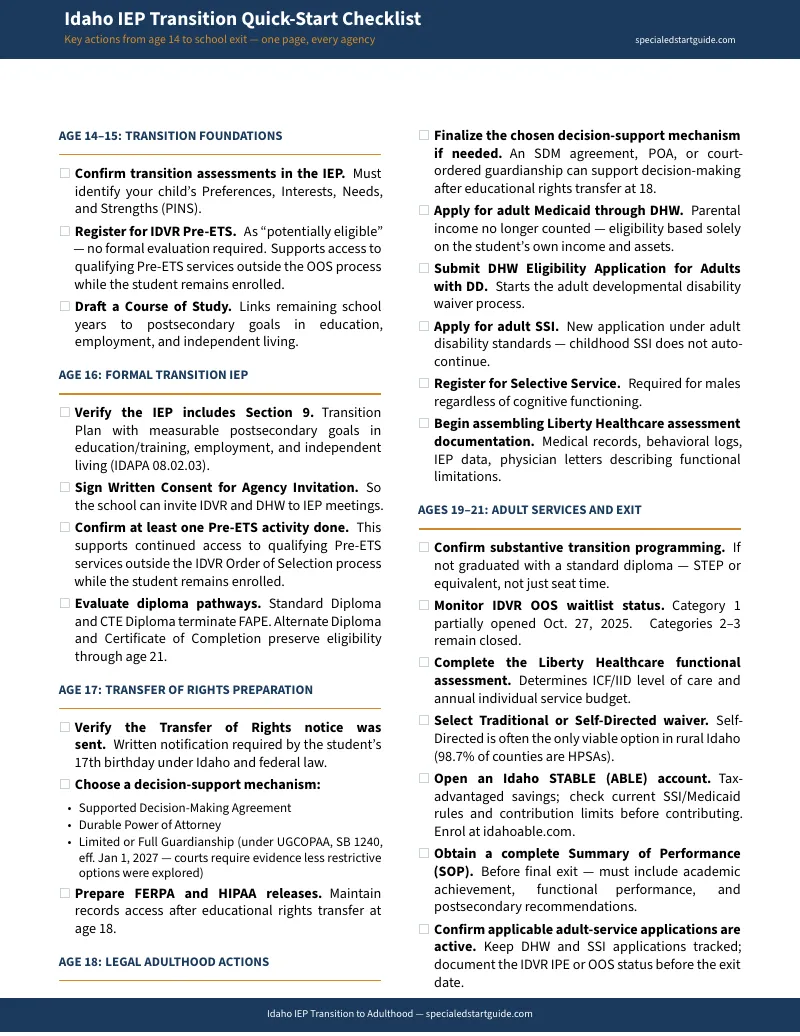
Download the free Idaho Transition Planning Checklist — a one-page milestone tracker covering ages 14 through 21, with every key deadline and the agency responsible. Use it to see exactly where your family stands in the process.
When you're ready for the full system — the detailed walkthrough, the agency coordination framework, the worksheets and decision tools — the complete guide is available for instant download. For less than the cost of a single hour with a transition coach, you get a permanent reference you can use through every IEP meeting, every agency application, and every deadline from now through your child's exit from special education.